



Western Digital SE16 750GB: "Quiet" a Performer
by Dave Robinet on August 9, 2007 2:00 AM EST- Posted in
- Storage
The Hard Drive Wars
Western Digital owns the second largest portion of the hard drive market, trailing only Seagate in terms of total number of drives shipped. The company accounts for roughly 21.5% of global hard drive sales, which puts it a long way from either taking the lead from Seagate (34.6%) or losing its seat to third-place Hitachi, which is at 17.2%. These numbers have remained fairly consistent for the past year, and hide what has become a fiercely competitive fight for the most lucrative portions of the market.
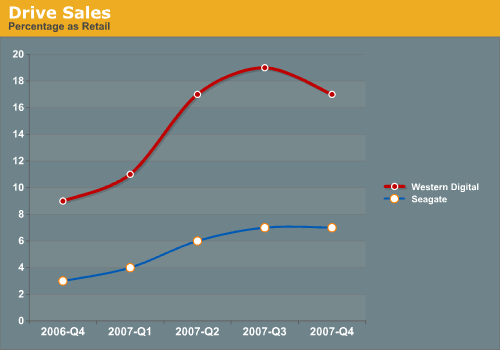
Sales to OEM customers (that is to say, companies which buy large quantities of drives in bulk to put into computers or other devices) tend to be substantially less profitable than packaging drives in attractive boxes and selling them individually to consumers. OEM customers have entire departments devoted to squeezing pennies from manufacturers when negotiating these large buys, whereas a typical end-user has very limited influence over the price they pay for their drives. As the chart shows, both Western Digital and Seagate have dramatically reduced their percentage of sales to the OEM category, and are putting significant effort into expanding their retail presence in the market.
While retail consumers are largely unable to negotiate prices, they are generally more selective than OEMs in terms of the features they want from their drives. This has led to manufacturers focusing on improving the drives they market to end-users, and the resulting benefits in terms of capacity, performance, and feature sets have been obvious.
Western Digital's SE16 Line
Officially designated as being intended for high-performance desktop applications, the SE16 takes WD's mainstream SE line one step further by increasing the drive's cache to 16MB (vs. 8MB in the SE line), and adding WD proprietary technologies like SecurePark and Preemptive Wear Leveling (PWL). The resulting specifications allow for a 20% faster transfer rate (buffer to disk) than similar drives found on Western Digital's SE line, as well as a notable reduction in power consumption. These factors, combined with Western Digital's decision to extend the warranty of all Caviar-class drives purchased after August 1, 2007 to 3 years, gives Western Digital a powerful combination in their continued push for more retail market share.
Western Digital owns the second largest portion of the hard drive market, trailing only Seagate in terms of total number of drives shipped. The company accounts for roughly 21.5% of global hard drive sales, which puts it a long way from either taking the lead from Seagate (34.6%) or losing its seat to third-place Hitachi, which is at 17.2%. These numbers have remained fairly consistent for the past year, and hide what has become a fiercely competitive fight for the most lucrative portions of the market.
Sales to OEM customers (that is to say, companies which buy large quantities of drives in bulk to put into computers or other devices) tend to be substantially less profitable than packaging drives in attractive boxes and selling them individually to consumers. OEM customers have entire departments devoted to squeezing pennies from manufacturers when negotiating these large buys, whereas a typical end-user has very limited influence over the price they pay for their drives. As the chart shows, both Western Digital and Seagate have dramatically reduced their percentage of sales to the OEM category, and are putting significant effort into expanding their retail presence in the market.
While retail consumers are largely unable to negotiate prices, they are generally more selective than OEMs in terms of the features they want from their drives. This has led to manufacturers focusing on improving the drives they market to end-users, and the resulting benefits in terms of capacity, performance, and feature sets have been obvious.
Western Digital's SE16 Line
Officially designated as being intended for high-performance desktop applications, the SE16 takes WD's mainstream SE line one step further by increasing the drive's cache to 16MB (vs. 8MB in the SE line), and adding WD proprietary technologies like SecurePark and Preemptive Wear Leveling (PWL). The resulting specifications allow for a 20% faster transfer rate (buffer to disk) than similar drives found on Western Digital's SE line, as well as a notable reduction in power consumption. These factors, combined with Western Digital's decision to extend the warranty of all Caviar-class drives purchased after August 1, 2007 to 3 years, gives Western Digital a powerful combination in their continued push for more retail market share.


 Facebook
 Twitter
 RSS
RSS


37 Comments
View All Comments
miahallen - Wednesday, August 15, 2007 - link
http://www.silentpcreview.com/forums/viewtopic.php...">Very good discussion concerning the problems with anandtech's sound measuring methodology here.The Boston Dangler - Friday, August 10, 2007 - link
for Samsung to offer larger drivesLord Evermore - Thursday, August 9, 2007 - link
So...have all drives up to this point only had the drive shaft secured on one side? The end of the shaft just spinning in the air between the top platter and the casing? That seems like a very unlikely thing given how easily that could result in the platters moving and hitting the heads or even hitting the casing. Given the G forces they're rated to handle even when running makes it sound even less likely.Lord Evermore - Thursday, August 9, 2007 - link
Oh, and haven't all drives had auto-parking heads for like a decade or more? The only reason the heads would move onto the platter during spin-up is if the controller specifically drives the armature to do so. So basically, SecurePark is WD saying "hey, we don't do something stupid with the heads anymore!"I hate how every company has to give their own trademarked name to a basic technology that everybody has.
falc0ne - Thursday, August 9, 2007 - link
I've noticed in stores 250, 320 and 400GB versions of AAKS are they the same revision drives? I'm ready to order one if so.Also, with the same capacities WD has drives in series KS.
Please, I need support, I'm buying a new PC. Thank you
Adul - Thursday, August 9, 2007 - link
Where did you find the Seagate for 180?Gary Key - Thursday, August 9, 2007 - link
At the time Dave wrote this, our price engine was showing ClubIT to have it for $188.89 if I remember right. I just checked and it was up to $199. We will get the article updated shortly.AdamK47 - Thursday, August 9, 2007 - link
Want!gloinsir - Thursday, August 9, 2007 - link
The following charthttp://images.anandtech.com/graphs/wd750_080807108...">http://images.anandtech.com/graphs/wd750_080807108...
, the Load Acoustics Chart, was missing results for the Hitachi 7K1000 with AAM/Off.
Gary Key - Thursday, August 9, 2007 - link
Fixed with a press of the refresh button... strange things today.