



Intel's Larrabee Architecture Disclosure: A Calculated First Move
by Anand Lal Shimpi & Derek Wilson on August 4, 2008 12:00 AM EST- Posted in
- GPUs
Putting it all Together - Return of the Ring Bus
Intel is keeping two important details of Larrabee very quiet: the details of the instruction set and the configuration of the finished product. Remember that Larrabee won't ship until sometime in 2009 or 2010, the first chips aren't even back from the fab yet, so not wanting to discuss how many cores Intel will be able to fit on a single Larrabee GPU makes sense.
The final product will be some assembly of a multiple of 8 Larrabee cores, we originally expected to see something in the 24-to-32 core range but that largely depends on targeted die size as we'll soon explain:
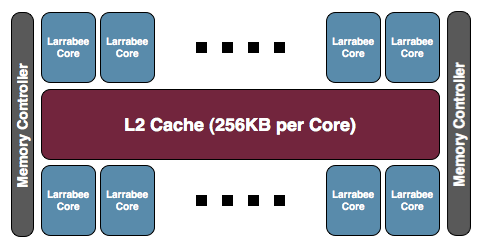
Intel's own block diagrams indicated two memory controller partitions, but it's unclear whether or not we should read into this. AMD and NVIDIA both use 64-bit memory controllers and simply group multiples of them on a single chip. Given that Intel's Larrabee will be more memory bandwidth efficient than what AMD and NVIDIA have put out, it's quite possible that Larrabee could have a 128-bit memory interface, although we do believe that'd be a very conservative move (we'd expect a 256-bit interface). Coupled with GDDR5 (which should be both cheaper and highy available by the Larrabee timeframe) however, anything is possible.
All of the cores are connected via a bi-directional ring bus (512-bits in each direction), presumably running at core speed. Given that Larrabee is expected to run at 2GHz+, this is going to be one very high-bandwidth bus. This is half the bit-width of AMD's R600/RV670 ring bus, but the higher speed should more than make up the difference.
AMD recently abandoned their ring bus memory architecture citing a savings in die area and a lack of need for such a robust solution as the reason. A ring bus, as memory busses go, is fairly straight forward and less complex than other options. The disadvantage is that it is a lot of wires and it delivers high bandwidth to all the clients on the bus whether they need it or not. Of course, if all your memory clients need or can easily use high bandwidth then that's a win for the ring bus.
Intel may have a better use for going with the ring bus than AMD: cache coherency and inter-core communication. Partitioning the L2 and using the ring bus to maintain coherency and facilitate communication could make good use of this massive amount of data moving power. While Cell also allows for internal communication, Intel's solution of providing direct access to low latency, coherent L1 and L2 partitions while enabling massive bandwidth behind the L2 cache could result in a much faster and easier to program architecture when data sharing is required.


 Facebook
 Twitter
 RSS
RSS


101 Comments
View All Comments
del - Friday, August 15, 2008 - link
Don't be a hater. :P Intel has got it goin' on right now. Believe in the POWAH of Larrabee... unless it proves to be a failure upon release.:)
Thatguy97 - Sunday, June 28, 2015 - link
IM FROM TEH FUTURE LARRABAE WAS CANCELLED OMG XDDDDDatlmann10 - Saturday, August 9, 2008 - link
Think about this ok AMD originally was a private IBM cpu manufacturer. Then bought out and run as a side unit of INTEL, that was dropped after they were done with them. So in a way the were partners and I'm sure there was some friendliness. As it's always been said keep your friends close but your enemies closer. There have been some things especially in these past two years that struck me kind of odd. Such as AMD's graphics chips running fine on a x38/48 chipset and the physics collaboration things as well as a few other rumors. Then Nvidia starts spouting off about how they could kick INTELS A77 etc. Now AMD has a definite GPU coprocessor in ATI and they wanna break into the market of GPU's etc. They know that there will be graphics competition with Nvidia being there largest competitior because there dedicated to GPU's solely and have a reputation. However now AMD has some chips that compete straight on weakening Nvidia to a point. Then AMD is getting more and more out of there cpu's gpu's and chipsets so INTEl jumps in the CPU GPU market just like AMD. Either way it turns out more are going to go with INTEL cpu's and many other products where AMD is kind of a fringe player. Who would you rather compete against full on 2 major GPU manufacturers or attempt to kind of co-align yourself with there competetitor while the somewhat down. Then throw out a whole new way to do graphics that performs well Nvidia is already loosing market share. So more people try it and the same number of people go with ATI. That leaves a much lower market for Nvidia plus there paying back what some 200 million dollars in bad GPU's right now as well and a few other problems they been having. Now this is not anything I know but knowing INTEL loves to stick it to competitors when there weak think about it.benkantor - Wednesday, August 6, 2008 - link
if you could fit 10 Larrabees on 143 mm^2, you could fit 40 Larrabees on 286 mm^2, not 20... :PMamiyaOtaru - Saturday, August 9, 2008 - link
For the love of education. We've already been through this. See the end of page 6 through page 7 in the comments section.143mm^2 doesn't mean 143*143. It means 143 square millimeters. 286 square millimeters is twice as many, allowing twice as many cores.
http://img379.imageshack.us/my.php?image=squaremmh...">http://img379.imageshack.us/my.php?image=squaremmh...
The article is right and you are so very wrong.
Barack Obama - Wednesday, August 6, 2008 - link
Derek and Anand deliver again!KGR - Wednesday, August 6, 2008 - link
I am not a profeesional about software and hardware that is why maybe this question can sound nonsense .If larrabee will have a software renderer and programmed by C++ is it possible that it is not depended on windows? I mean if it doesnt need direct X can we run the games on Linux also??
npoe1 - Tuesday, August 5, 2008 - link
I enjoyed reading this so much. I think that this kind of articles is what Anandtech needs; I usually go to Arstechnica to read things like this one.Again, thanks!
TrEmEnDo - Tuesday, August 5, 2008 - link
I am definitely impressed with this new development and I expect that this technology will be disruptive down the road, however I feel that somehow they are about to commit another of their megalomaniac mistakes.Has anyone stopped for a sec and look where all gaming industry is heading into? Are PCs the future gaming platform? Maybe I am missing something but aren't the big guys already struggling to retain a 'decent' percentage of the multibillion gaming pie (PC gaming alliance anyone...)? I believe that whether us, tech enthusiast, hardcore pc gamers like it or not, it is the console arena where the big guns are going to be playing in a few years from now.
Guys, we are seeing this happening everyday, we see tittles appearing and disappearing everyday b/c companies don't want to commit the resources to develop games for more than one or two platforms (normally doing a sloppy work BTW). Now that the grandpas of graphic hardware had manage to get DX/D3D derived engines into the last gen consoles (xenos, RSX) and a terribly inertial and rigid developer community avoids and whines about how difficult is to program for the few hardware 'jewels' that we have already in our hands (Cell/RV770/G200) do you think anyone except Intel is in the mood for yet another graphics industry spin?
I have no doubt that this new development will have its own niche application or someone will definitely find something appropriate for it, but to say that Larrabee CAN do graphics and to say larrabee will kick ass so bad that in 3 years from now we all will be gaming from a Larrabee containing computer are two very different things.
Congrats to Intel as the fathers of the creature, and congrats to us to see the tech world moving on....but just don't think this will change the world as we know it.
hooflung - Tuesday, August 5, 2008 - link
They are doing something very AMD like and taking it a step further and tossing in a few Power ideals in. I just wonder what the power profile will look like and who will partner up with Intel for it.I am sure they will have 4+ of these cores built into integrated chip sets for OEMs and laptops to really boost those areas. And people who buy laptops will see that they can get a desktop with 'bigger larrabee' and play their games faster than their budget/laptop computer.
So it does make sense. However, it is an empire made on a lot of ifs. It will be fun to watch. Thanks anandtech for the informative article.