



Higher Clock Speeds, No TLB Issues and Better Pricing: The New Phenom
by Anand Lal Shimpi on March 27, 2008 12:00 AM EST- Posted in
- CPUs
3.0GHz: Where Are You?
AMD ran a controversial demo of a quad core Phenom in July of last year:
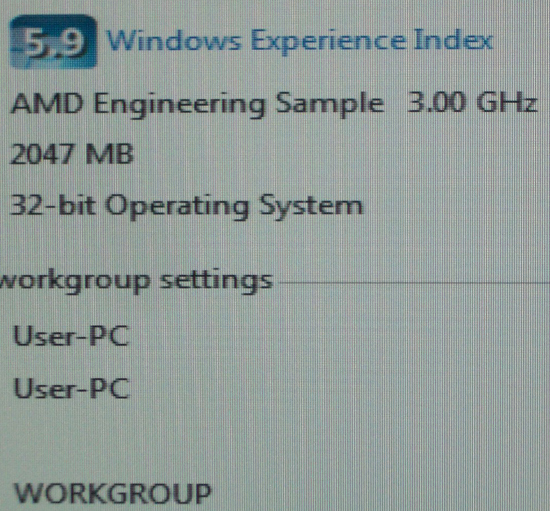
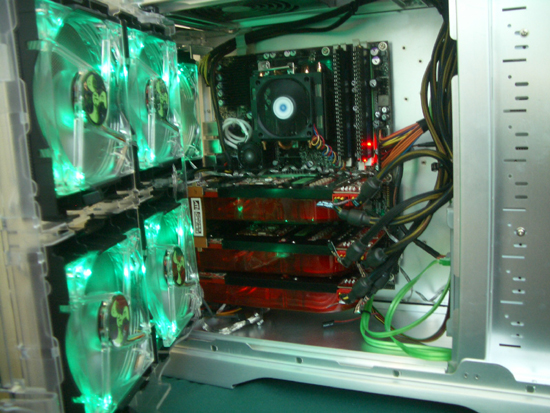
The demo ran at 3.0GHz and was designed to set expectations for Phenom. The problem is that when Phenom launched, it did so at 2.3GHz. Even today we're only at 2.5GHz. Allow me to quote, um, myself:
"In a demonstration designed to prove that Phenom isn't broken, AMD featured a quad core Phenom X4 processor, with standard cooling, running at 3.0GHz. While Phenom won't be anywhere near that clock speed when it launches at the end of this year, AMD expects to be at 3GHz within the first half of 2008. "
AMD told some members of the press that there was nothing special about these 3.0GHz Phenoms that were demoed, which begs the question - what happened?
There's nothing particularly magical about the 3.0GHz number, but the problem is this: Intel gives you two options at $266, you can purchase a Core 2 Duo E6850 (3.00GHz, dual core) or you can purchase a Core 2 Quad Q6600 (2.40GHz, quad core). The difference in clock frequency is 600MHz but you get two more cores, for the same price.
With AMD, the decision isn't as simple. At $178 you can purchase an Athlon 64 X2 6400+ Black Edition (3.2GHz, dual core), or at $195 you can buy a Phenom X4 9550 (2.2GHz, quad core). Not only do you have to spend a little more to get four cores, but you give up 1000MHz in clock frequency. Thankfully Phenom has some architectural enhancements that help narrow the performance gap, but it still does make AMD's job of competing much more difficult - forcing it to dramatically reduce prices.
Phenom could scale much higher, after all the individual cores aren't all that more complex than those in an Athlon 64 X2. We get the impression that there are some speed paths that could be optimized on the current B2 and B3 Phenoms that simply aren't because of a very sensible thought process. AMD is still on track to begin shipping its first 45nm Phenom processors (Deneb core) by the end of this year and it doesn't make sense to waste time and resources respinning a 65nm Phenom, when presumably these clock speed issues are addressed at 45nm.
AMD is expecting, clock for clock, 45nm Deneb based Phenom cores to offer up to 15% more performance (we're skeptical of that number). AMD also committed to matching clock speeds of 65nm Phenom processors when the 45nm parts launch. If Phenom is at 2.7GHz when 45nm launches, the first 45nm parts will come in at 2.7GHz (as well as models lower/higher obviously, but the point is that there will be clock speed parity with the move to 45nm).


 Facebook
 Twitter
 RSS
RSS


65 Comments
View All Comments
fireedo - Saturday, May 24, 2008 - link
can we call this fair comparison since AMD side using only DDR2 800 Mhz and Intel side using DDR3?can that things makes any differences in benchmarking?
if so then this comparison is not valid
sorry no offense :)
magnusr - Saturday, April 12, 2008 - link
Consider the power usage of the 9850 compared to the Q9300.If you get the 9850 for free and pay full price for a q9300, then you leave both systems running for an x amount of time, the 9850 will then after a x period of time be more expensive (considering expensive power bills).
Common AMD you can be better than this. When Athlon 500MHz came out they rocked the boat until Intel came out with core 2, amd just got lazy....
Currently running Q6600 @ 3GHz, had it for almost a year now.
js01 - Friday, April 11, 2008 - link
When i saw the crysis bench and saw the 9500 only getting 27 fps I ran the same bench with my system which consists of Phenom 9500, hd 3850, k9a2 cf, and 2gb ddr 800. My results were 53.095 fps average, 70.70 max, and 34.24 min. It just goes to show you the only benchmarks you can trust are your own.ntavlas - Saturday, March 29, 2008 - link
AMD can`t compete in the high end, there is no doubt about that. But I think their real purpose with this launch is improving their presence in the mainsteam. Since they can`t reach the clock speeds or instructions per clock of intel they use more cores. This approach does have it`s merit: in 4 threaded apps they are faster than intel`s dual cores in the price range. Of course they are much slower in 2 thread applications but this doesn`t tell the whole story: a core 2 8200 might be faster than a phenom 2,2 when running a 2 threaded benchmark, but don`t forget that the later still has 2 cores in reserve that can be used for other tasks. It`s something that can improve the users computing experience in real word situations.Of course if you can afford an intel quad core, by all means go for it, it is the better chip, but I think that up to the $200 price point the phenoms make good sense.
Thorsson - Friday, March 28, 2008 - link
Despite the lower power consumption the word I'v heard is that Intel's new 45nm Quads can't take extra voltage and consequently don't OC as well as the Q6600.It would have been nice to see Anandtech address this issue.
JustAnObserver - Friday, March 28, 2008 - link
I love seeing you morons arguing about who has THE best, clock per clock, top extreme black super duper alpha and omega overclocking part. When the enthusiast processor is more like a ferrari. Nice to show, but who really mekes the big money is Toyota and their common cars. You see MOST people won't overclock, MOST people won't CrossFire nor SLI, MOST people just want an average system for a day in day out workload. So the only thing that really mather is this:Keep struggling for the Extremely Over priced parts, so that the average parts (AMD or Intel, whatever) keep coming cheaper and cheaper every day. After all, I'll get, let's say, 75% of your performance, but pay less than 50% what you paid. Sounds nice to me.
But hey, thats just me.
Ps.: You americans are funny, you can't even realize that the US only answers for 7% of the world processor market. And the rest of the world is a bit smarter about how to spend their money.
gochichi - Friday, March 28, 2008 - link
Intel outdid itself, kind of shot too high I guess. Look at how Apple for instance hasn't released an iMac with the Q6600... if they did, it would completely mess up their line up and price points.Anyhow, AMD's "competition" is pretty lame, was I the only one to notice how far inferior the Phenom line is to the tried and true Q6600. Everybody knows it's basically a downclocked chip... can easily do 3.0ghz. The only reason Intel doesn't do that is that it doesn't fit in the market.
There is currently nothing in the horizon to handily beat a 3.0-3.2Ghz Intel Quad so they are showing very little interest in maxing themselves out.
Dell should absolutely feel ripped off, so many years trying to carry both intel and AMD only to achieve that when AMD makes relatively junky chips.
Anyone can plainly see (hindsight is 20/20) that purchasing a Q6600 the day it came out was the best value to be had in years (both before and after).
I did not, but I finally have one (whole computer w/ Q6600 was $400) and I feel very confident that its performance will be relevant for a couple of years to come still.
We are pampered to death these days... technically the Phenom is plenty but it's just not Intel-grade. Pentium 200 MMX for $380 anyone?
Furious computing power is now more affordable than ever and with power envelopes (Intel-wise anyway) that will hopefully bring the form factors down even further. Even graphics cards are being re-corrected in terms of efficiency... they were runaway for a while there.
I think that's what the 2000's are all about, nothing new, just delivering on old promises. Finally computers that approach "fast enough", worlds more reliable and affordable.
papounet - Friday, March 28, 2008 - link
The article is lame, it is utterly biased in its conclusion.The logic it tries to build around the fact that here is no speed improvment (" We get the impression that there are some speed paths that could be optimized on the current B2 and B3 Phenoms that simply aren't because of a very sensible thought process. AMD is still on track to begin shipping its first 45nm Phenom processors (Deneb core) by the end of this year and it doesn't make sense to waste time and resources respinning a 65nm Phenom, when presumably these clock speed issues are addressed at 45nm.") displays an absolute ignorance of the CPU design business. This stepping was an attempt to speed up the whole Phenom and improve yelds (and not only to correct the TLB bug). It does not at all deliver the speed bump (2.5% improvment ?). so let's claim that AMD did not try ... Ahahah.
With the pressure from Intel and Wall Street and OEM, AMD can not afford to do yet another stepping to try to fix their technology and/or their design and/or their process, so AMD wil bet on 45nm to fix everything.
Some other sentences just made me laugh "While we only had a few hours left over to test the overclocking stability of the 9850 it does look like it may be the first Phenom capable of easily breaking the 2.6GHz barrier." how difficult is this when starting from 2500Mhz ??
"In our opinion it's highly unlikely we'll see AMD release a 3.0GHz Phenom on 65nm this year. " Indeed
The Phenom with this performance level is one year too late to compete. It is useful for people who have bet on the m2+ plateform. but how many did ?
The model released at 2500 Mhz is very close to the design limits of the stepping (little overclocking room).
The Q6600 is not the best chip ever (celeron was, then the XP-mobile, then core2duo 4500), but is is rather good.
With some research it was possible to buy the Q6600 B0 just when it came out at a decent price: it was cooler , cheaper, faster than s3 stepping and most motherboard bugs around quads had been solved.
The higher fsb of the Q9300 as annouced by Intel could be already seen as limiting the potential easy overclock.
Did I need today that my q6600 bench at 3.6 Ghz on air on a GA-p35ds3p with 4 gig of crucial ballistix ? i run it on a daily basis at 3.2 Ghz at nearly stock voltage.
:-) OK not all my buys are as smart
(I am no fan of Intel or or AMD. I have used parts from both to build computers professionally and I still dabble into the hobby).
eye smite - Thursday, March 27, 2008 - link
Why am I seeing an Intel review when the article is supposed to be about Phenom? Is this the same cry baby ranter that did the original phenom review for AAT back in November? I see sticking to the facts and being professional isn't a high priority at this site, but hell I knew that already just from reading the articles on daily tech.rodh - Thursday, March 27, 2008 - link
The TLB error DOES NOT CAUSE PERFORMANCE LOSS!!!!!!!the PATCH for the TLB error causes a performance hit, but all the TLB error does is cause instability in extremely rare situations involving hardware virtualization (when did you last use that) on multiple cores at the same time.
Cant stand it when people overblow this error. Not that it matters anymore, its fixed.
Rod
http://roddotnet.blogspot.com">http://roddotnet.blogspot.com