



Balanced Technology eXtended (BTX) Form Factor - The Future of Cases & Motherboards
by Anand Lal Shimpi on September 18, 2003 12:34 PM EST- Posted in
- Cases/Cooling/PSUs
Three different BTX sizes
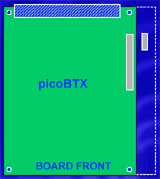
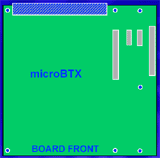
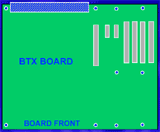
Much like the multiple sizes of ATX (micro, flex, etc...), the BTX form factor allows for multiple versions of the form factor. In terms of motherboard sizes, there are three types: picoBTX, microBTX and regular BTX.
Although the board pictures below are obviously not to scale (the BTX board is clearly larger than the picoBTX board), the idea is to show you the difference in expansion slots between the boards.
 |
 |
 |
8.0" x 10.5" |
up to 10.4" x 10.5" |
up to 12.8" x 10.5" |
The picoBTX standard can support either one or two expansion slots and has four mounting holes. PicoBTX cases will probably have one 3.5" and one 5.25" drive bay.
The microBTX standard, which most are expecting to be the more popular of the three, has support for four expansion slots and has seven mounting holes. MicroBTX cases will feature one 3.5" bay and up to two 5.25" bays.
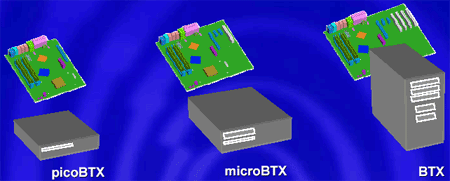
Finally we have the regular sized BTX, supporting up to a full 7 expansion slots and mounts to the case using 10 mounting screws. Regular BTX cases will be more like the mid-tower ATX cases we have today, supporting 3+ 3.5" bays and 3+ 5.25" bays.
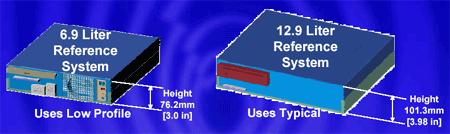
The BTX standard allows for two case heights - Type I and Type II. Type I cases are 3.98" in height and can use normal expansion cards, while Type II cases are for small form factor designs and are 3.0" in height. Expansion cards would either use risers or be low profile in a Type II case.
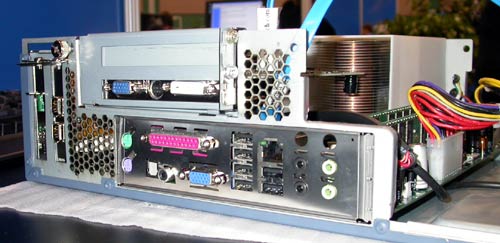
The rear of a microBTX case, you can see the circular heatsink in the thermal module.


 Facebook
 Twitter
 RSS
RSS


99 Comments
View All Comments
small - Monday, January 19, 2004 - link
According your post, I have some following question,1.
"The BTX standard covers two case heights as well. Type I for cases of 3.98 inches high and Type II for small design case at only 3 inches high. Type I use normal expansion cards while Type II will either use risers or be low profile design cards."
Is that mean type I 3.98 inches high is for microBTX case?
And type II 3 inches is for picroBTX case? Is that right?
But the case size shoudn't design by manufacturers themsleve?
2.You said ATX power supply can be use in BTX motherboard?
But according to the design guide of CFX12V power supply which issued by intel,
(CFX12V power supply is designed to support BTX systems).
The most different between CFX12V and ATX12V power supply ,
I think it should the physical dimension & main power connector to motherboard.
Due to the shape of CFX12V is different than ATX12V, so how can standard ATX12V power supply can be sued for BTX??
And also the power connector (motherboard) for CFX12V is 24PIN,and ATX12V is 20P.
why ATX12V power supply can be used in BTX motherboard and computer case?
emi
MasterOfPuppets - Thursday, January 15, 2004 - link
I would like to say to #85 that this new form fator was designed for less heat. I would not say that computer companies are losing money no their computers. they screwed themselves and are looking for a way out. they offered too much porcessing power to the market, and now the AJ(average joe) has more processing power than he knows what do do with it. HE can do everything he can imagine on it(lets just say hes kinda dumb to average with computers).the AJ doesnt need to buy another computer, b/c he has excess power to check his email and surf the web. it supply and demand, the demand plateaued but the supply of great new better technology took off.the computer companies have an excess of computer parts sitting around and the only way to get rid of them in a sensable way is to change formats and declare the old ATX obsolete. the AJ doesnt need a 3Ghz comp, but he has one and for him hes set for a couple of years. the computer companies want his money and if he doesnt buy a comp for 3+ years then the computer companies arent making too much. this is exactly why the format is changing, and if u dont believe me you can float around in your dream word where the computer companies are your friends. Back to the heat part of the case. as stated before in this forum there are cheaper meathods to get more cooling(rather than buy a new computer), and the AJ doesnt give a crap about his computers heat, it is a way to cover up the computer companies true motives(like all other companies in a captialist society, to get your money.)the only people that truely care about their computer's heat are tweaker's and it is true that they are not in the business equation, but the AJ isnt going to care about the new format if his computer works fine and does what it needs to do,surf the internet, which i should add is a very demanding task.lol. this new foramt is a business decision and they had to make this decision to get themselves out of a deep hole they dug. I would like to add that i will be the very last if ever person to switch to BTX(Broken Technology eXtended, i liked that quote) and i hope that their business decision leads them to a very dark and nasty place.MasterOfPuppets - Thursday, January 15, 2004 - link
This so called new technology just another way to get your money. Why cant ATX components be compatable, because that would decrease the amout of money that computer companies get. I currently have a lot of money invested in my computer and have little intention to buy a bunch of new parts because my current ones arent compatable with this crappy re-arranged motherboard. If people really want some heavy duty, silent cooling make water cooling more common, dont make peol buy a whole new computer just so that it will be cooler. i dont know how many of u got that out of that article, but if ur current computer is too hot do u want to go and buy a new one that only slightly colder? HELL NO! i refuse, and the computer companies can kiss my a$@!!zookus - Wednesday, October 29, 2003 - link
For those of you who haven't yet had a chance to see it, here are the specifications for just about everything relating to the BTX standard:http://www.formfactors.org/developer/specs/BTX_Spe...
What concerns me is that according to this, even the largest cases will only have room for ONE hidden 3.5" device. Sort of screws my RAID array. Has anyone heard word otherwise?
Anonymous User - Sunday, October 19, 2003 - link
o pa isto pra min é cona...cona e cu...por min tas bem agora atx e abx ou o caralhuvenha a cona
Anonymous User - Saturday, October 4, 2003 - link
#91 again this would only work well on tower casesAnonymous User - Saturday, October 4, 2003 - link
why can't they use isoecletric cooling modules like they have in coolatron camp coolers? are they too big or do they draw too much power? Put two on the bottom and the hot air rising would pull coolair up from the bottom .You have intake vents on the bottom below the cooling modulesand exhaust vents on the top of the case.Normal convection might not need fans. As the air gets hotter up top the more air it would pull up from the bottom.Just a matter of sizing the ventsand adding a thermostat.I might try it on my ATX I' building. Let ya know if it works.Anonymous User - Saturday, September 27, 2003 - link
Moving the chairs on the Titanic. Intel needs to go back to the drawing board and start putting Pentium M's on the Desktop instead of Pentium 4's. That would instantly eliminate the need for form factor changes, thermal modules, etc...Besides saving an incredible amount of energy (not that this is important).Anonymous User - Friday, September 26, 2003 - link
Will the Hollings chip be on the BTX mobos?Anonymous User - Thursday, September 25, 2003 - link
A lot of you are assuming that the things that you want is what everyone else wants as well. I've had a big 3d cool case for quite some time with plenty of active cooling, and honestly, i'm getting really really sick of it. I want something small, sleak, and quiet. So what if you have to buy a new case, deal with it, things like this happen now and then, you can't expect to use the same case for the next 50 years.You can't judge how this will all work from one preview, wait for some decent boards and cases to hit and then look over the reviews, and then you can decide. Everyone just calm down and accept that change isn't a bad thing.