



AMD Radeon HD 7950 Review Feat. Sapphire & XFX: Sewing Up The High-End Market
by Ryan Smith on January 31, 2012 9:02 AM ESTCrysis: Warhead
Kicking things off as always is Crysis: Warhead. It’s no longer the toughest game in our benchmark suite, but it’s still a technically complex game that has proven to be a very consistent benchmark. Thus even 4 years since the release of the original Crysis, “but can it run Crysis?” is still an important question, and the answer continues to be “no.” While we’re closer than ever, full Enthusiast settings at a 60fps is still beyond the grasp of a single-GPU card.
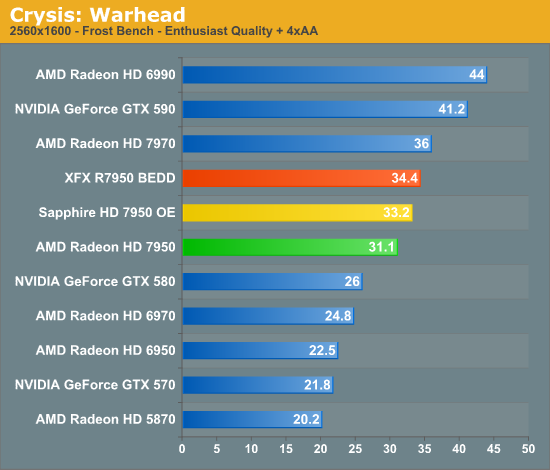
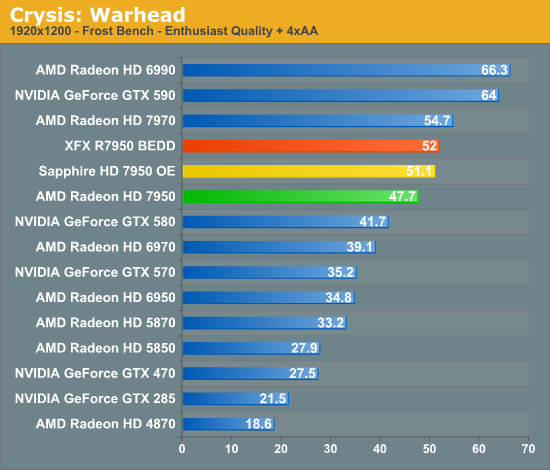
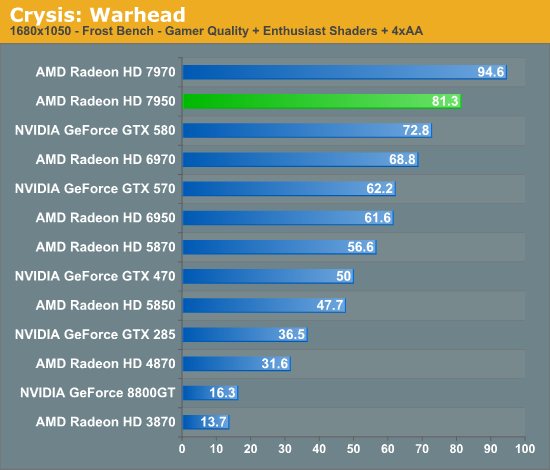
AMD’s first round of driver optimizations have given the 7900 a very solid footing in Crysis, putting the 7950 off to a great start. The 7950 is 19% ahead of the GTX 580 at 2560 and 14% ahead at 1920, putting the card in a comfortable position that for single-GPU cards is second only to the 7970. In spite of Crysis being shader-bound most of the time the 7950 is generally within 15% of the 7970, so it’s doing better than the theoretical performance gap between the two cards would predict. Meanwhile compared to AMD’s last generation offerings it’s not much of a contest: the 7950 is 20-25% ahead.
As for our factory overclocked Sapphire and XFX cards, they further close the gap between the 7950 and 7970. The 12.5% core overclock on these cards puts them between 7% and 10% faster than the stock clocked 7950, with the XFX card edging out the Sapphire due to its memory overclock. These cards do so well here than the reference 7970’s lead is reduced to just 5%.
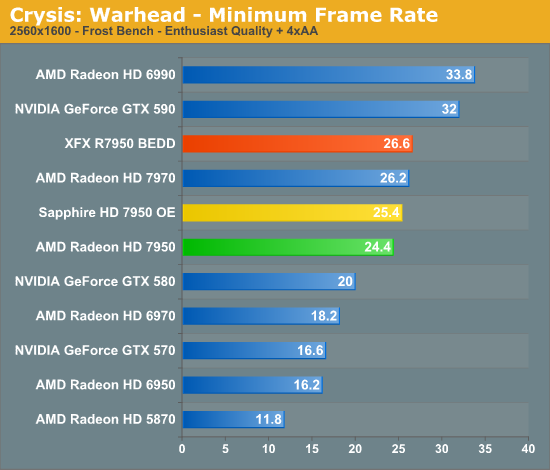
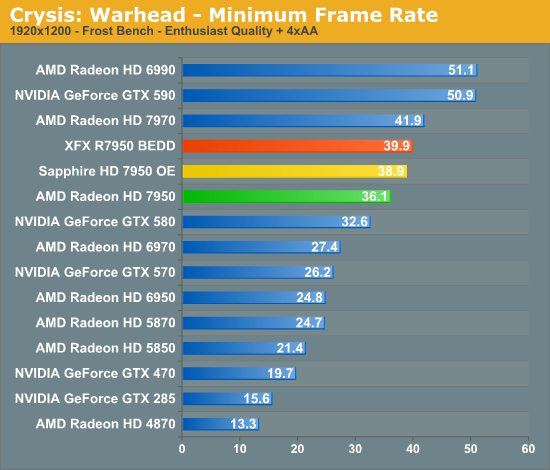
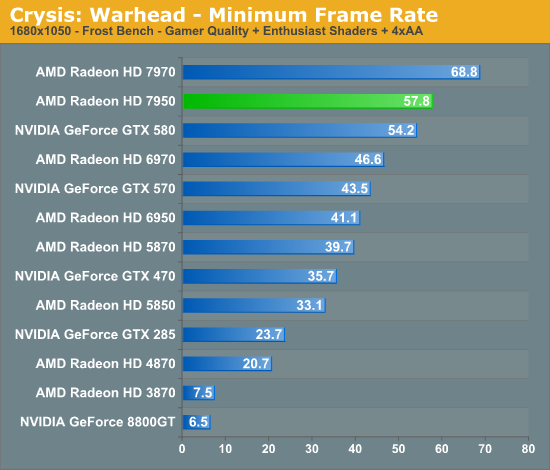
The minimum framerates in Crysis are also looking good on the 7950, with the 7950 turning in a 10-22% better minimum framerate than the GTX 580 depending on whether we’re talking about 1920 or 2560. As like we saw with the 7970, the biggest lead is at the highest resolutions, which has typically been the case for AMD cards for some time now. The overclocked partner cards add to this, tacking on an extra 5-10% in performance.


 Facebook
 Twitter
 RSS
RSS


259 Comments
View All Comments
chizow - Tuesday, January 31, 2012 - link
Now it starts to become obvious why people shouldn't be doing cartwheels in the streets over Southern Islands. Its a nice chip, it really is. But the problem with its pricing just became even more obvious with the 7950 as AMD is selling you yesterday's performance at next-gen prices. In other words, if you wanted this level of performance, you could've gotten it a year ago with the GTX 580 for almost the same price....over a year ago....And that's why AMD's pricing of these parts fails. With the 7950 it all comes into focus and if it wasn't clear before, it will become crystal once Kepler drives the nail home when it launches at its expected prices and performance levels. What's left for AMD to launch? A 7870 that's as fast as the 6970 but costs $50 more? A 7850 that's as fast as the 6950 but costs $75 more? Do we really think Nvidia is going to launch a 580 equivalent at 28nm and price it at $450? See how it all comes into focus?
But Nvidia really has a chance to return the favor to AMD here with a pricing debacle of GTX 260/280-esque proportions. If GK104 comes within spitting distance of the 7970 or even 7950 at $300, AMD is going to look really bad. If GK110 beats the 7970 by 20-25% and costs only $500, AMD execs will be jumping out of windows. We're talking about issuing rebate checks that AMD can't afford to write on every 7950/7970 sold at these ridiculous prices for however many months it takes until Nvidia releases Kepler.
Goty - Tuesday, January 31, 2012 - link
1) I believe you mean "consistently faster than last-gen performance for the same price", which is how it will remain until NVIDIA gets a card out that can compete.and
2) Keep dreaming.
chizow - Tuesday, January 31, 2012 - link
1) Well the good news is Nvidia decided to compete over a year ago when they launched the GTX 580. At these prices AMD has set, Nvidia is still amazingly competing with their 14 month old last-gen parts.and
2) The better news is AMD has set the bar extremely low for Nvidia. Should be easy pickings for Kepler.
halo37253 - Tuesday, January 31, 2012 - link
Yet a overclocked 7970 is about as fast as a gtx590, yeah... nvidia sure is competing. lolReally there is no reason to get a nvidia card right now, with the gtx580 and its continuing high costs not even able to hold its own again even a 7950. Once the 7xx series launches I can see AMD launching the hd89xx series no to long after with XDR2 memory and higher clocked cores.
For overall performance per watt it seems AMD cant be touched right now.
kashifme21 - Tuesday, January 31, 2012 - link
The real question is, Do we really need these upgrades anymore. I mean todays games barely push tech. Most of my friends are happy with their 5870's and GTX 480's we bought about 2 years backThing is games are designed with consoles in mind and with next gen console hardware rumors to be around the level of 6670 GPUs, why would anyone upgrade anymore, unless they intend to be running multiple screens.
I personally run GTX 580 SLI. I think i personally wont be upgrading until i see a game that actually stresses my system in eyefinity settings.
Its a sad state but many games recently released dont even support freatures like AA or even any pc options, games are rather straight console ports, with PC as an after thought. Why buy such expensive hardware for ports?
jleach1 - Tuesday, January 31, 2012 - link
I agree. Even my 5850 hasn't stressed much in recent games...and I bought it for 280 USD a couple years ago.Performance per dollars, and temp per dollar, AMD is on target, more often than not....now, if only we could get the FX sorted out...
I used to buy nvidia cards, but haven't since the 5000 series, and it looks to continue this way.
The moral is, competition is ultimately what brings prices down and motivation to up the performance.
I hope AMD can throw out something cool soon on the CPU side, because while I always have, and likely will continue to buy Intel, I love the competition. Sorry, I sorta gave up on AMD after the i7-930 came out. But that doesn't mean I'm not rooting for them...even if it is only for the sake of competition.
TerdFerguson - Tuesday, January 31, 2012 - link
On the other hand, upgrading the 5850 that you've had for several years is going to require you to jump to a /higher/ price tier. That's insanity. If that kind of pricing structure existed for ANY other consumer electronics product, people would be vocally antagonistic. AMD deserves some antagonism.JonnyDough - Wednesday, February 1, 2012 - link
I disagree. Supply and demand. They don't have the supply and there's a big enough demand to keep prices inflated. Nobody can be upset at all about the prices. If you don't like them, don't buy the product. It's that simple. Capitalism fails us often, but here's a case where it works just fine. :)TerdFerguson - Wednesday, February 1, 2012 - link
By your foolish reasoning, AMD would be in top form if it produced and sold just a couple of hand-crafted units each quarter. That they can't meet volume demand is a failing, not a benefit.artk2219 - Wednesday, February 1, 2012 - link
I've got to say that I agree with JohnnyDough, in the short term keeping prices high and making a killing off of each card sold is a good thing for AMD, not so great for us consumers but again, its not like anyone is forcing you to buy it. However you are correct in that in the long term that is a failing strategy for a company like AMD, its not like they're making luxury sports cars :). Either way it makes no difference to me and it puts them in a great position for a coming price war with Nvidia and Kepler which will inevitably be faster, I just hope Nvidia does something about their power profile.