



Google TV Goes ARM with Marvell's ARMADA 1500
by Ganesh T S on January 5, 2012 8:01 AM EST- Posted in
- Google TV
- Home Theater
- Media Streamer
The ARMADA 1500 (88DE3100) is a media SoC with a dual core PJ4B superscalar host processor. It is targeted towards IP/Cable/Satellite STBs, premium Blu-ray players / DMAs and Google TV applications.
The following block diagram reveals the structure of the 88DE3100 SoC:
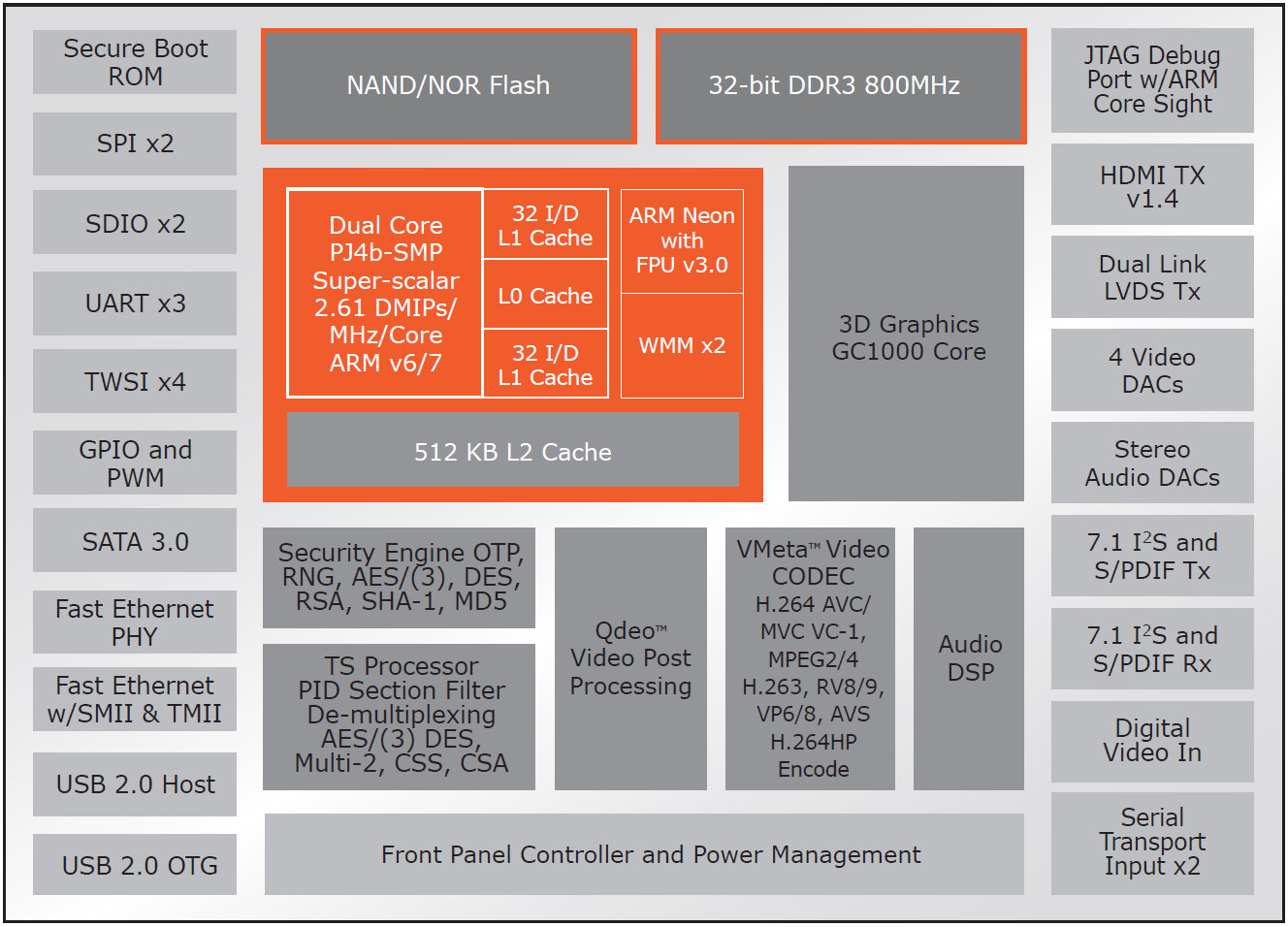
We will take a look at the I/Os first:
- A/V Inputs: Just like the CE4100, the Marvell chip also has Transport Stream inputs and support for digital inputs (plain YUV / RGB). The TS inputs are probably not of much use in Google TV applications, but I can definitely see the digital inputs being used in cases where the device needs to have a HDMI input (from a STB output) for blending / overlay.
- A/V Outputs: The SoC has a HDMI 1.4 compliant TX PHY with 1080p60 / frame and field interleaved 3D support and 12b Deep Color capability. HD audio bitstreaming and CEC support are also available. along with various combinations of component / composite / S-Video and digital audio outputs.
- Memory Interface: 32-bit DDR3 DRAM running at 800 MHz provides for 61.2 Gbps of maximum theoretical bandwidth. Up to 1 GB of DRAM is supported.
- NAND Controller: This is a 8 bit interface running at 50 MHz compliant with ONFI 1.0 specifications. Up to 2 GB of NAND Flash is supported.
- Peripherals: SATA3, USB 2.0 Host, USB 2.0 Slave, SD3.0 controller, Two Fast Ethernet (100 Mbps) ports and other miscellaneous peripherals round up the SoC features.
Marvell's PJ4B
The PJ4B CPU core was first sampled by Marvell in October 2010. It is supposed to be compatible with Cortex-A9 and delivers similar instruction throughput per cycle. Being a custom designed architecture, it has the capability to clock at a higher rate compared to off-the-shelf Cortex-A9s. While ARM estimates that the Cortex-A9 can provide around 2.5 DMIPS/MHz/Core, Marvell claims that the PJ4B can provide up to 2.61 DMIPS/MHz/Core (take this for what it is worth).
Each PJ45B core in the 88DE3100 is supported by a 4-way 32KB I-Cache and a 8-way 32KB D-Cache. There is a common 512KB coherent L2 cache.
Unlike the previous members of the ARMADA lineup which didn't have NEON support, the 88DE3100 supports both NEON VFPU and Intel WMMX. The cores are clocked at 1.2 GHz, delivering up to 6000 DMIPS of performance. This sort of performance enables the 88DE3100 to support Flash enabled web browsers and other such key areas necessary for Google TV to shine
vMeta Engine
The vMeta video decoder supports more formats than I have ever seen on any media processing chip (Sigma and Realtek included!). The 88DE3100 provides for dual stream decode acceleration of
- H.264 High Profile @ Level 4.1, 4.2 and 5; Multiple View Coding
- VC-1 Advanced profile @ level 3, WMV9 MP@HL
- MPEG-2 MP@HL, MP@ML
- MPEG4 SP@L3, ASP@L5, DIVX-HD
- AVS 6.2
- VP6/8 SD and HD
- RV9/10 (RMVB up to 1080p)
- Low Delay Mode (progressive refresh) support for H.264 Baseline profile
The vMeta engine also supports JPEG/PNG/GIF/TIFF/BMP/Animated GIF decoding acceleration up to 50MP/s. A number of containers are also specified as being supported officially, but that is usually a matter of firmware.
Qdeo Post Processing
The Qdeo post processing engine performs per-pixel 3D noise reduction, 3D de-interlacing, scaling, natural depth expansion, intelligent color remapping and adaptive contrast enhancement. I am quite sure this would compare favorably with whatever Sigma Designs has up its sleeve in the VXP post processing engine in the SMP8910.
Vivante's GC1000
One of the complaints I had about the 88DE3010 (ARMADA 1000) was the absence of a 3D graphics engine. The 88DE3100 takes care of that by including the GC1000 GPU from Vivante. The GPU supports OpenGL-ES 1.1 / 2.0, something necessary for XBMC to run on the chip. The GPU itself clocks at 750 MHz (with a maximum theoretical DRAM bandwidth of 3.2 Gbps), providing for 375M vertex/S and 750M pixel/S vertex and texture rates. A separate 3D drawing and stretch BLT engine (400M pixel/S fill rate) is used in cases where the 3D engine is an overkill.
The Audio DSP is a 500 MHz superscalar processor capable of executing 4 instructions per cycle. and is complemented by a 800 MHz audio post processing engine. This allows for simultaneous decoding, post processing and downmixing of audio channels. A 500 MHz security processor takes care of multiple cryptography functions to keep the DRM believing folks happy.
Power Consumption
The SoC itself is specified to have a maximum power consumption of 5.3W, with a recommendation to budget for up to 6.5W TDP based on system design. With this power profile, it is indeed possible to have fanless operation with a passive cooling solution.


 Facebook
 Twitter
 RSS
RSS


37 Comments
View All Comments
djc208 - Thursday, January 5, 2012 - link
My sister just got a Sony BD w/ Google TV, more for the Google TV than the BD, she loves it, but she wants mostly streeming and the keyboard is much more convenient for searching than most remotes.I'm hoping Google does something with this. They bought SageTV last year, presumably to help them in this area as Sage had some really good software for recording and serving local media. I'd hate to see them die in a Google basement for nothing. Especially when the Sage community is now on life-support.
ganeshts - Thursday, January 5, 2012 - link
Boxee's remote implementation (of the keyboard) is much more CE / consumer friendly than the full fledged one which came with the Revue. The Sony keyboard is somewhat inbetween. Google needs to put some basic guidelines for the manufacturers to get the user input environment / facilities right.ol1bit - Friday, January 6, 2012 - link
I have the Sony as well, and works great for me, but the goggle tv part isn't much better than what my wireless Vizo Tv has already.Goggle needs to get some content other than no name channels. Some TBS/ABC/HBO options would really help.
rothnic - Thursday, January 5, 2012 - link
While I agree with your comments related to the first iteration of the Google TV software, I don't agree with the second part.I bought a Revue for $99 when the announcement that HC and market was coming to it. I have a HTPC, but don't want to have to switch over to it, wake it up etc when I just want to stream something. Installing Plex has allowed me to almost never use my HTPC anymore since I can play a great deal of my NAS(running the plex server) content.
In my opinion the interfacing with the STB is a key integrating feature and extends your STB functionality. With the addition of the market it really will grow to be an amazing capability. There are plenty of streaming devices out there, and Google TV devices are definitely a step forward. They were just sold with alpha software and at a bad price. With both of those fixed, I see no issues with it.
ganeshts - Thursday, January 5, 2012 - link
Revue makes sense at $99. So, with the new Marvell SoC, we can get the 'Revue' at $99. But, does the Revue handle all the local media that the WDTV Live SMP is able to at the same price? I am not a fan of running a media server (for transcode purposes) on a NAS or another PC just to make up for the inefficiency / deficiency of the player. The player should just see a network share and stream from that in full quality (no messing up the audio or playing at a lower resolution, sorry!). The Sony BD player running Google TV could have been the perfect media player for playing MKVs, ISOs and all the other requirements that local media enthusiasts have? Unfortunately, Google TV didn't quite work what could have been its magic over there.For all the online services that the Revue supports, can it better a lower cost dedicated solution from Roku or NTGR or even the WDTV Live SMP?
First, Google should get the above two aspects right, and after that, it can go and interface with a STB and a DVR. Also, people should think about whether it is necessary to really record TV.. With content available online (both legal and through 'dubious means'), the necessity to record stuff is going the way of the dodo..
MSIC - Thursday, January 5, 2012 - link
Sounds to me like Google TV is trying to do what Boxee have been pretty successful at doing - providing a robust and appealing "10 foot UI" that both streams local media and IPTV.Given Google's size.... why not buy Boxee??
(I can see that it repeats the above comment about Sage, and i'm an XBMC user myself due to the flexibility that it gives, but i still think Boxee is the best stab yet at this sort of device for Mr & Mrs Joe Public).
ganeshts - Thursday, January 5, 2012 - link
Yes, I can definitely see the value in Boxee's trifecta model (Free to air broadcast channels, streaming media services (OTT) and personal media collection). Google could learn a thing or two from them for Google TV.owan - Thursday, January 5, 2012 - link
But everyone out there does this. I agree that GTV tried to do it all and failed to do any of it, but theres no incentive for Google to be Roku or Boxee. They need to be more than that, hence their decision to do STB integration. The problem, at least in part, is that they pushed it out way too early without the market. With no Android market they completely shot themselves in the foot since they became a "me too" player with subpar implementation of both local and network playback and no "killer app". I guess they assumed STB integration would be the differentiating factor, but thats a tough nut to crack properly because the CableCo's are actively trying to fight internet content delivery in order to protect their business.pugster - Thursday, January 5, 2012 - link
Part of the big mistake of Google TV is trying to integrate with a STB. Instead, Google should be making something that could compete with Roku's and WD tv live and go from there. A device with an ARM CPU 512mb of memory and about 2gigs of flash for less than $100 and other manufacturers can probably make it for about $60 range. Who knows, maybe google can lure content providers and make the google TV as the IPTV like.jjj - Thursday, January 5, 2012 - link
Google just marketed it wrong,it was a livingroom PC while for some reason people expected it to deliver content.After that,it seems,that Google just gave up on it (no software updates,no market access) waiting for the Intel contract to expire."Google TV should just provide the users a low powered media streamer device with the perfect hybrid of OTT services and local media playback capability"
Why would they do that and why would that sell?They have to provide something more,somthing that matters if they want to take over our TVs and it doesn't have to be about content delivery since that industry is ...well,nuts and it's very hard to get a reasonable ,usefull, deal. They will have Motorola soon,they might get Hulu in the end so they do have some more options than before.