



Enermax Platimax 750W - 80 Plus Platinum Arrives
by Martin Kaffei on February 10, 2012 6:00 PM EST- Posted in
- Cases/Cooling/PSUs
- PSUs
- 80Plus
- 750W
- Enermax
- 80Plus Platinum
Conclusion
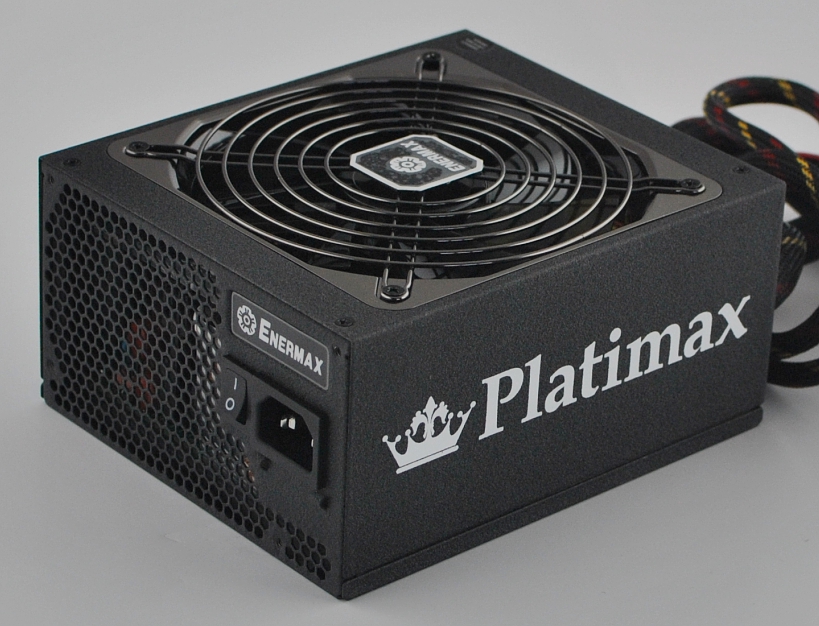
The Enermax Platimax 750W is a very efficient and expensive power supply. There are no significant disadvantages with the design and technology, though you'll have to pay for the privilege. The connector configuration is very good, and both the choice of components and the power supply case are very high quality. Enthusiasts looking for great performance will find this power supply a suitable solution.
Internally, Enermax uses a modified Modu87+ design with better semiconductors. The PCB material and the electrolytic capacitors in this PSU are top quality parts. The output side of the resonant converter is complemented by full-wave synchronous rectification (with MOSFETs), minimizing switching losses and the voltage drop the Schottky diodes usually have. There are a few other smaller changes as well, such as the buck converter for -12V and the "improved" EMI filtering with fewer components. We mentioned the low power output on the +3.3V and +5V rails, but this is not necessarily a disadvantage. As always, the required power depends on the system.
A modern PC pulls the majority of the current from the +12V output(s), so it's not so much the quantity but the quality of the smaller outputs that is important. Some sensitive logic gates on the motherboard need a stable 3.3V output but only low currents. The voltage drop under high load is negligible and is simply a reflection on the sizing of the converters. A low output ripple and noise is more decisive. During the load test +3.3V drops to a minimum of -3.63% below the reference value while +5V drops by as much as -2.4% to -2.60% during overload.
Even at 10% load the Platimax 750W reaches 86.93% efficiency, a remarkable value. The power factor is also very high. Low ripple and noise on most output voltages is advantageous as well. With 0.9% ripple (1% is allowed) +3.3V is the worst output. We would like to see better results here, since this is a high-end product. Apart from that the Platimax hardly blinks when confronted with our crossload tests. The voltages are always very close to their ideal value. If you don't put too many amps on +5V and +3.3V, you might even say Enermax shows flawless results.
In any case the noise of the fan is impeccable. Enermax has promised to use a low speed regulation for the Twister fan, which is true. Apart from the audible noise under full load the PSU is always nearly silent. There's also no noise from the electronics (not that we would expect anything less from a high-end PSU).
Enermax delivers an adequate cable configuration, similar to what other manufacturers offer. Four 6/8-pin PEG and 16 peripheral connectors are fairly average in this performance class, as are the 4+4-pin and 8-pin connectors for CPU power. The colorful sleeving can be described as high-grade (even if gold and red is the "wrong" color for this PSU) , and the contents of the package are satisfying. For the larger Platimax models you can even get a case fan for free. Enermax offers everything you might want from a PSU, with a few extras just for good measure.
The Platimax series includes 600W, 750W, 850W, 1000W, and 1200W models—and several of the lower wattage models have mail-in rebates available, if you're interested. The 750W we're reviewing can currently be had for $200, with a $30 MIR bringing the cost down to just $170. The largest competition for the 750W Platimax might just be Enermax's own Modu87+ 700W, which has a lower base price of $180 but no MIR. According to our research that model is not fundamentally different and is sometimes (depending on rebates) cheaper. However, when we are talking about power supplies, even small details make the difference.
Note that the only direct 80 Plus Platinum alternative comes from SuperFlower/Kingwin. The Kingwin LZP-750 (made by SuperFlower) is just as expensive as the Enermax Platimax 750W (slightly more, actually), and it's missing some features such as OCP, a MOV, and similar protections. Beyond that the LZP-750 (or SuperFlower Golden King Platinum—which is even worse than Platimax as far as names go!) offers fewer connectors. For that reason we would recommend the Platimax 750W, but only for those who demand every ounce of efficiency. If you're more of a mainstream user and can live with 1-2% less efficiency, you can certainly save some money, but it's clear that Enermax is a leading company for high-quality products.


 Facebook
 Twitter
 RSS
RSS


47 Comments
View All Comments
airmantharp - Friday, February 10, 2012 - link
Did you mean results?Only posted for the humor involved :).
JarredWalton - Saturday, February 11, 2012 - link
There are times when I miss our old CMS system where misspelled words were immediately underlined. Sorry for the error. ;-)Termie - Friday, February 10, 2012 - link
Did I miss it, or did you not actually list the price of the power supply in this article? I would think that would be a critical element of the review. You repeat several times that this is a very expensive power supply, but without a price stated, I don't think your readers will be able to draw any conclusions from this.I know Newegg currently has a paid add running at the top of this article showing its price for this product, but that is not the same thing as stating the price in your article.
JarredWalton - Saturday, February 11, 2012 - link
We linked to the lowest price we could find in the second to last paragraph, but you're right -- nowhere did we actually list the price. I have added that information to the same paragraph now. Thanks!DanNeely - Friday, February 10, 2012 - link
"Does anyone actually detach their CPU/mainboard cables?"2x12V cables is still a relatively high end mobo feature. Being able to get rid of one of these cables would be beneficial for many people.
Also putting jacks on the chassis for cables (GPU3, Peripheral5) only provided in high end models is rather lame in a high end model. A second plug board that leaves the two spaces unsoldered, and without cutouts in the housing shouldn't be prohibitively high as additional engineering work.
Amoro - Friday, February 10, 2012 - link
It looks like it actually failed the requirements for platinum specification at 20% load, achieving only 88.79% instead of the 90% required.Iketh - Friday, February 10, 2012 - link
I was disappointed I didn't learn what a Platinum Certification is in this article. That's the only reason I clicked the article was to get a rundown on the spec itself.Google to the rescue...
Galcobar - Friday, February 10, 2012 - link
Indeed, given the whole article is pitched as being about the arrival of a PSU able to meet the Platinum specifications, I was expecting to be told what the Platinum spec actually meant.As a result, I'm left with another question: did this PSU actually pass the Platinum specs, and at what temperature? Ecos Consulting (the company behind 80 Plus) tests at 23C, actually below the engineering standard room temperature of 25C; lower temperatures make for greater efficiency and slower fan speeds.
JarredWalton - Saturday, February 11, 2012 - link
Thanks for the comments -- I've added a bit of information to the text now.gwolfman - Monday, February 20, 2012 - link
But does this (the certification) have to apply to 120VAC/60Hz? If I remember correctly, 240VAC/50Hz is more efficient to convert to 12VDC, which will take this PSU to new heights.