



The OCZ Octane Review (512GB)
by Anand Lal Shimpi on November 23, 2011 12:00 PM ESTRandom Read/Write Speed
The four corners of SSD performance are as follows: random read, random write, sequential read and sequential write speed. Random accesses are generally small in size, while sequential accesses tend to be larger and thus we have the four Iometer tests we use in all of our reviews.
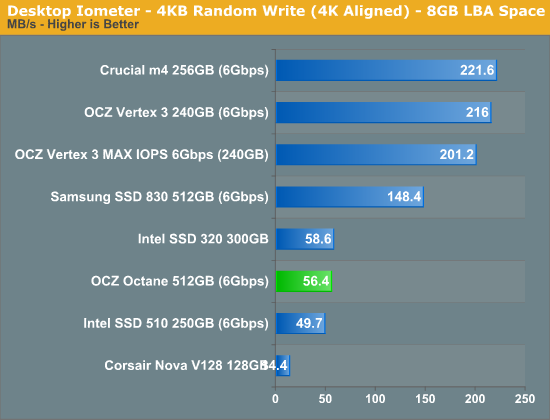
Our first test writes 4KB in a completely random pattern over an 8GB space of the drive to simulate the sort of random access that you'd see on an OS drive (even this is more stressful than a normal desktop user would see). I perform three concurrent IOs and run the test for 3 minutes. The results reported are in average MB/s over the entire time. We use both standard pseudo randomly generated data for each write as well as fully random data to show you both the maximum and minimum performance offered by SandForce based drives in these tests. The average performance of SF drives will likely be somewhere in between the two values for each drive you see in the graphs. For an understanding of why this matters, read our original SandForce article.
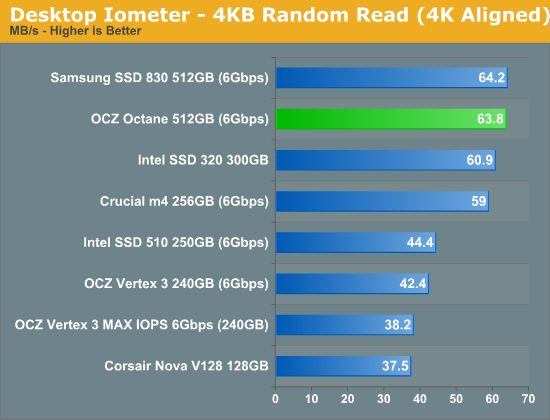
Random read performance is very good on the Octane, matching the Samsung SSD 830 and the Intel SSD 320. Random write performance is no where near as fast as the Samsung, Crucial or SF-2281 based drives, but as we've seen in the past this can be enough performance for a desktop workload.
Many of you have asked for random write performance at higher queue depths. What I have below is our 4KB random write test performed at a queue depth of 32 instead of 3. While the vast majority of desktop usage models experience queue depths of 0 - 5, higher depths are possible in heavy I/O (and multi-user) workloads:
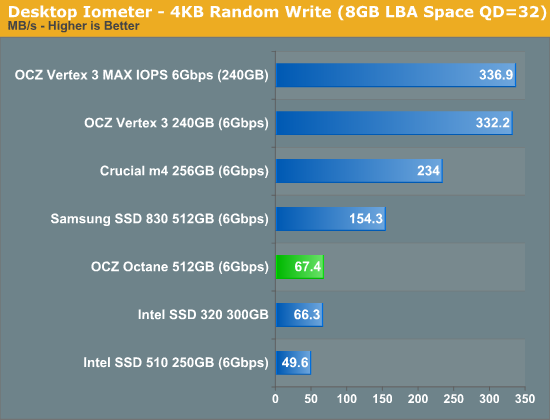
Random write performance at higher queue depths doesn't scale nearly as well as the SandForce based drives. This doesn't really matter for desktop users, but I am curious to see how OCZ will position Everest in the enterprise space against SandForce. Perhaps that's where OCZ will focus its SandForce efforts instead and leave the consumer market to Indilinx.
Sequential Read/Write Speed
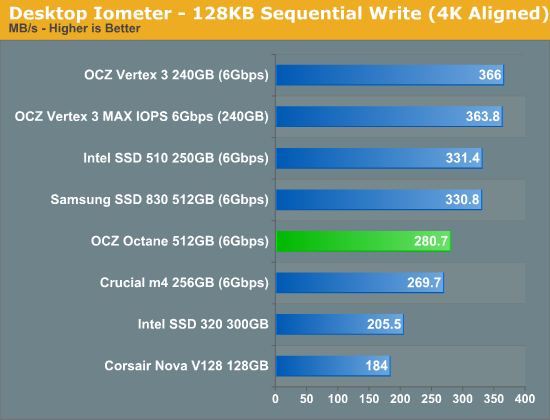
To measure sequential performance I ran a 1 minute long 128KB sequential test over the entire span of the drive at a queue depth of 1. The results reported are in average MB/s over the entire test length.
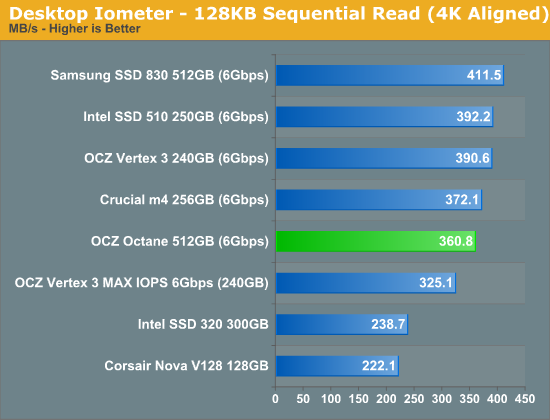
Sequential read and write performance is competitive, but not class leading. The Octane effectively performs like a Crucial m4 here, which isn't bad considering the m4 is a far more mature platform.


 Facebook
 Twitter
 RSS
RSS


75 Comments
View All Comments
Chloiber - Wednesday, November 23, 2011 - link
...now let's wait what Indilinx has learned from the Barefoot fiasco. The performance looks good - so does the performance of the competition. The only things that matter now are 1) reliability, 2) price and 3) performance over time.IceDread - Thursday, November 24, 2011 - link
Reliability is very important, performance and price are as well of course but without reliability the later two does not really matter.So it will be interesting to later know the statistics there.
Zane K - Sunday, November 27, 2011 - link
I work at quite a large computer shop, and we sell a heap of OCZ drives. Unfortunately we see 12-14% of these come back compared to 2-4% for out corsair force 3 and Silicon Power drives, until this works its self out, I will neither buy or recommend a ocz drive.dj christian - Monday, November 28, 2011 - link
I agree completely!This says it all
http://www.hardware.fr/articles/843-7/ssd.html
- Intel 0,1% (contre 0,3%)
- Crucial 0,8% (contre 1,9%)
- Corsair 2,9% (contre 2,7%)
- OCZ 4,2% (contre 3,5%)
dj christian - Monday, November 28, 2011 - link
Sorry forgot the above is the reliability indexTranslated for you
http://translate.googleusercontent.com/translate_c...
happycamperjack - Friday, December 2, 2011 - link
Comparing last gen SSD with this Gen of SSD is hardly fair. But I guess Vertex 3 series had suffered earlier this year from a firmware bug, but it''s solved now. Should be smooth sailing from now. I would probably get Vertex 3 over Octane though.maxgrax - Wednesday, November 23, 2011 - link
Definitely going to wait for reliability results before I jump back onto OCZ. They still have the best performance / $ but that has little meaning when data security is at risk. Was hoping after yesterday's preview that you would have more than just the 512GB drive benched :( , I hope the speed doesnt degrade too much going down to 256 and 128Marlin1975 - Wednesday, November 23, 2011 - link
How about testing with a SB950 AMD 6Gb controllerLike to see what diff the newwest Intel vs AMD controllers are.
That and more 128gb reviews. most don;t have SSDs and even fewwer have 512gb models.
inighthawki - Wednesday, November 23, 2011 - link
I would love to see a lot more tests runs on SSDs with less storage. Many of the drives have higher performance in the higher capacity models, and it's pretty obvious that your even your above average tech savvy user isn't going to be dishing out one thousand dollars for the 512GB version of the drive.You should perhaps try to keep all of the tests in the same size range (IE, test all 120/128GB drives, all 250/256GB drives, etc in a single batch).
Anand Lal Shimpi - Wednesday, November 23, 2011 - link
I agree completely, but all we got this round was the 512GB drive. I'm still waiting for lower capacities :)Take care,
Anand