



G.hn Gains Momentum with Marvell Silicon
by Ganesh T S on September 27, 2011 3:01 AM EST- Posted in
- Powerline Adapters
- G.hn
- HomePlug
We have covered the home networking battle between HomePlug and G.hn in various articles before. Peter White has an excellent piece analyzing the positions of the respective camps here. G.hn is quite an attractive proposition, aiming to get a networking device work over multiple media (coax, phone lines and power lines). As such, it has the ability to fully replace MoCA, HomePNA and HomePlug in the networking space. G.hn is an ITU standard which was ratified in June 2010.
While the G.hn consortium was working on the standardization and getting silicon ready, HomePlug has quietly been expanding its install base. It is finally the extent of market penetration which will decide the winning standard. Will service providers be ready to start afresh for technology / silicon which might currently appear superior on paper? While G.hn compliant silicon can have a PHY rate of 1 Gbps, the IEEE P1901 compliant Qualcomm AR7400 has a PHY rate of 500 Mbps. The upcoming HomePlug AV2 (HPAV2) standard is expected to match G.hn in terms of PHY rates.
G.hn Silicon
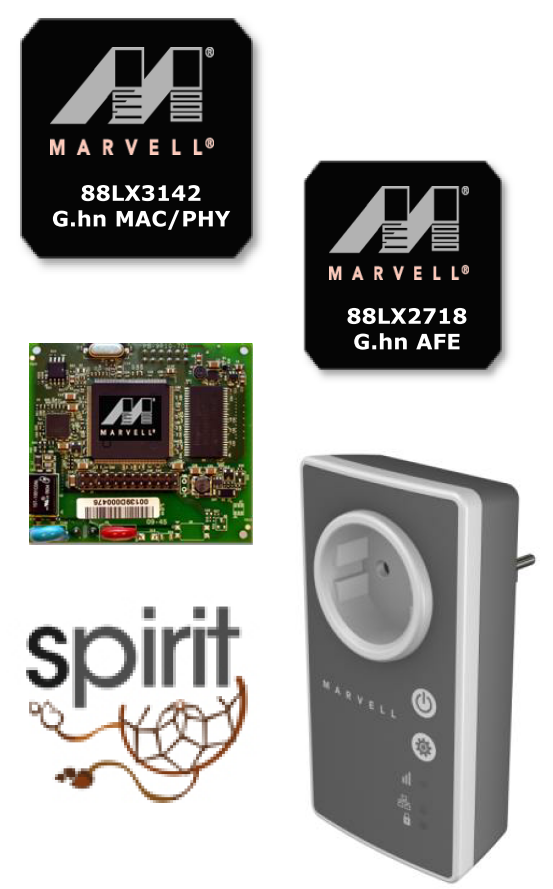
Sigma Designs took the early lead in introducing G.hn compliant silicon with the CG5110. We saw this chip in action at CES 2011. Lantiq also demonstrated their G.hn chipset at the same time. Today, Marvell is announcing the availability of their first G.hn chipset (the 88LX3142 digital baseband processor transceiver and the 88LX2718 baseband analog front-end) along with a reference design and firmware (SPIRIT) based on the UPA PLC (United Powerline Alliance's powerline communication device).
Marvell's presence in the G.hn market can be traced to its acquisition of the Spanish powerline networking firm, DS2 (Design of Systems on Silicon). DS2's powerline standards organization, the UPA, had been up against HomePlug till 2009. However, it could only strike base with some service providers like Telefonica and SinTel, and could never get into the retail market. The presence of HomePlug products in the retail market has served to extend its install base, making system manufacturers and also the relevant service providers hesitant to move on to non-interoperable, or worse, non-co-existing standards.
Marvell indicated that more than 20 early adopters (including OEMs and ODMs) have opted for Marvell's silicon and it probably includes a major chunk of the erstwhile UPA's customers. The fact that the 88LX3142 can coexist with the UPA installations should have made it easier for them. Retail availability of products based on this silicon is expected to be towards the end of Q4 2012.
G.hn's support for multiple media is also envisaged as the target for the IEEE P1905 standard. G.hn proponents cite P1905's drawbacks with respect to system and software complexity when dealing with systems talking to multiple media. IEEE P1905 proponents indicate the extra cost burden incurred by G.hn customers when dealing with devices which don't need to talk to multiple media.
Consider the usecase of a connected TV, where the antenna signal comes through a coax cable. In that case, the TV can connect to the home network via powerline. However, the coax is not active all the time. In this case, the TV can shift to the coax for networking because it would deliver higher throughput / QoS. With G.hn, this can be done with a single chip, but IEEE P1905 would require complex software and product design as shown below.

The use case definitely appears very interesting, and it is good that we are having multiple vendors coming out with silicon around G.hn. However, it takes more than a year to move silicon to deployment (especially with service providers). In the meanwhile, HomePlug / P1901 devices are expanding their base. This brings us to the next aspect, namely interoperability and coexistence.


 Facebook
 Twitter
 RSS
RSS


11 Comments
View All Comments
Anosh - Tuesday, September 27, 2011 - link
Considering that unless you use the same generation of homeplugs in your house the speeds you get are low and kind of unreliable I believe people will look at G.hn as if it's another/new generation of homeplug. In which case the huge install base of homeplug wont matter very much. In other words it's a matter of time before G.hn replaces homeplug unless homeplug manages to crank up the speeds and keep issues across generations to a minimum. Which historically they haven't done.Zak - Tuesday, September 27, 2011 - link
I thought this tech was dead, killed by WiFi. This is the first mainstream article I've seen in years. I've only known a handful of people who tried this tech at home, lured by it's simplicity, and it was always a failure due to unreliability of the equipment and problems with connectivity. I'd much rather recommend investing some time and effort in running network cables or extra access points/repeaters for WiFi (or combination of both).Denithor - Tuesday, September 27, 2011 - link
You really need to catch up on your tech before running off at the mouth like this.I use a 1 generation back Trendnet kit at home with perfect connectivity. Full internet speed on my office pc (shared from htpc in the living room like 50 feet away) with no latency issues or anything. Completely able to stream HD video, game, etc.
Completely different from my experience with WiFi across the same rooms, dropped signals, bad ping times plagued me constantly...
Zoomer - Tuesday, September 27, 2011 - link
Yes, dedicated ethernet will always be best, followed by non dedicated wiring, then wireless. Wireless by its nature will be the most unreliable.Wireless can be very unreliable and very slow in densely populated areas, ie. apts in cities. When tens of different & possibly misconfigured APs are crowding the same channels, good luck.
akedia - Tuesday, September 27, 2011 - link
Years? How 'bout three weeks ago on this very site: http://www.anandtech.com/show/4695/handson-powerli...akedia - Tuesday, September 27, 2011 - link
Or two days?: http://www.engadget.com/2011/09/25/switched-on-no-...kolepard - Tuesday, September 27, 2011 - link
The control ceded to service providers is very anti-consumer and a huge negative if this report is correct:http://www.engadget.com/2011/09/25/switched-on-no-...
The most bothersome section is:
"The service provider may then request that you call them for permission to install, may provide a portion of the bandwidth available over the power lines, or may even flatly tell you that you can't use the adapters. G.hn equipment providers are working with service providers to encourage a more relaxed stance, but operators reserve the right to do what they want."
Given the alternatives available, I think this my seriously impair adoption.
Zoomer - Tuesday, September 27, 2011 - link
One could just cancel the service.lowlymarine - Tuesday, September 27, 2011 - link
You say that as if your local cable provider isn't a monopoly on broadband for a huge percentage of Americans. Even if they aren't, it's usually not much of a choice anyways. Where I live, you can get 40/5 cable service through Bright House for $75/month that typically hits the advertised speeds, or 6/1 DSL through AT&T for $50/month that usually only hits about 3/0.5. Even without the massive disparity in service, something tells me AT&T wouldn't be more permissive than...anyone, really.ganeshts - Tuesday, September 27, 2011 - link
Irrespective of whether it is G.hn or IEEE P1905 which gets adopted, I think service providers will be able to do whatever is mentioned in the Engadget article with respect to future home networks./* Start of rant */
The only solution is to make the service providers into dumb pipe providers. Just use them for the Internet service and don't get any video or telephone service from them. Yes, one may complain about live sporting events and other similar stuff, but it is not difficult to envisage them becoming available online on a subscription basis (you pay directly to the broadcaster and not the middleman like Comcast or AT&T or any other service provider).
I personally believe that the way people watch TV will undergo a sea change in the coming years. While local TV channels (particularly of the news variety) will remain free-to-air and stay socially relevant, linear TV in any other form will be dead (strong words :P). I don't think the current TV service providers (be it cable or satellite or IPTV) are going to be relevant when linear TV goes out of fashion. Consumers must put these providers in the place and just haggle with them to provide bandwidth and access to the Internet in an unfettered manner. Then, there is the whole big issue of the governments supporting the consumers in this aspect, but that is a subject for another rant on another day...
/* End of rant */