



AVADirect Compact Gaming PC: Small Case, Big System
by Dustin Sklavos on October 4, 2011 2:00 AM ESTApplication and Futuremark Performance
Where the CPU is concerned, the AVADirect unit should be fairly predictable: any task that can leverage the extra two cores of the i7-990X is going to see a measurable lead, while tasks that lean on heavy IPC will give the i7-2600K-based systems the advantage. When we get into the graphics subsystem is where we'll begin to see some separation, and where our more interesting results will surface.
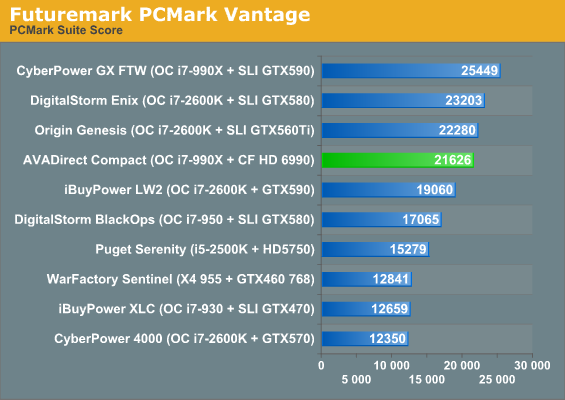
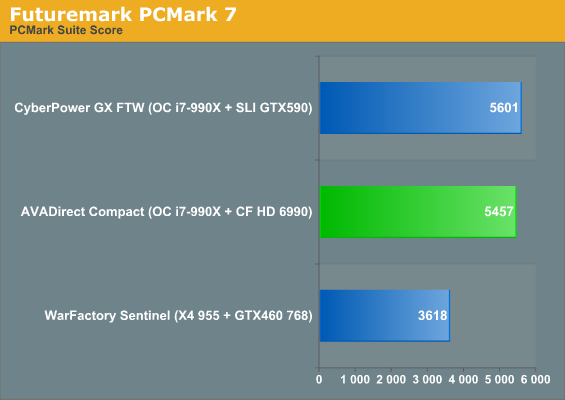
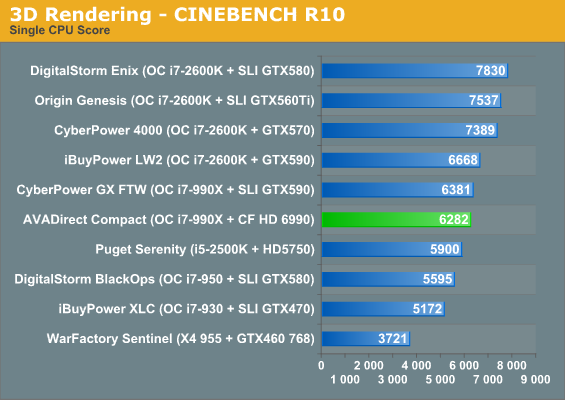
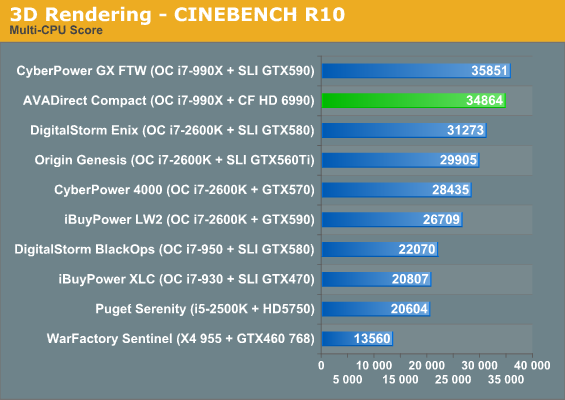
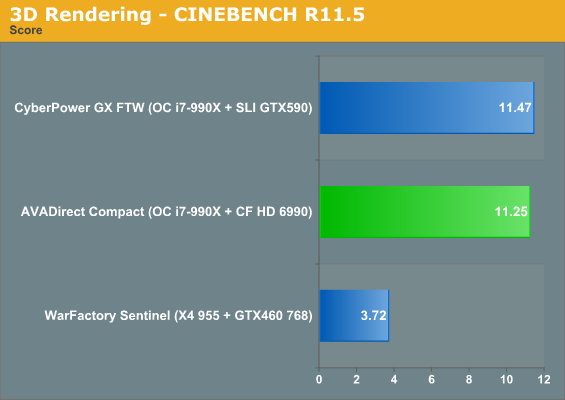
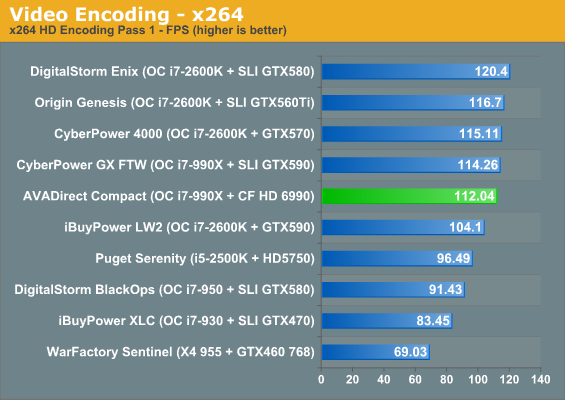
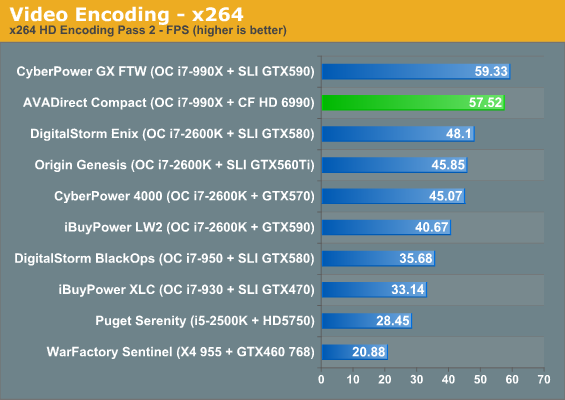
Systems pretty much fall in line where you'd expect them to, just as predicted. The CyberPower unit enjoys a slight lead due to a slightly higher overclock on the CPU than AVADirect's, but we're in the realm of 4.4GHz and 4.5GHz overclocks, where performance can begin to depend largely on just luck of the draw with the processor.
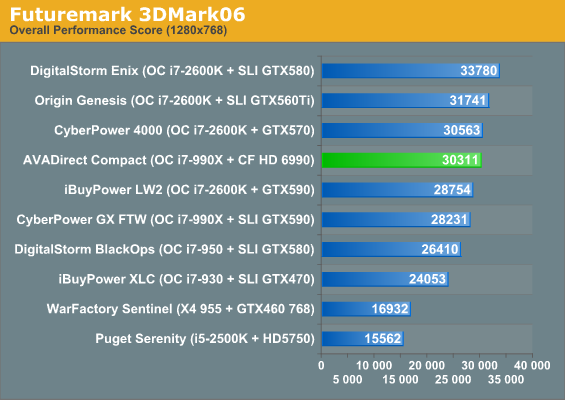
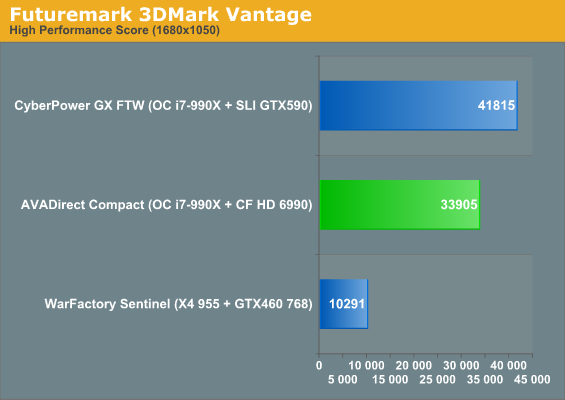
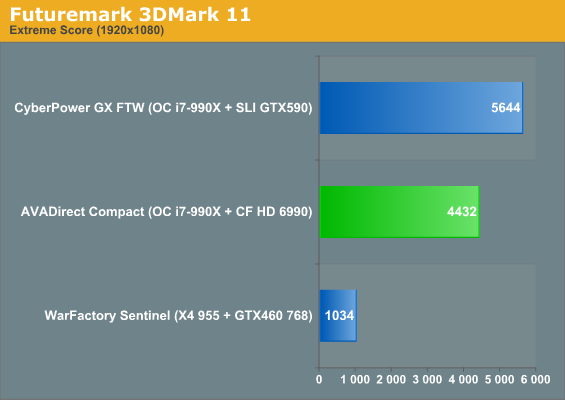
Things also start to spread out when we get to quad-GPU scaling. 3DMark06 is clearly CPU-limited (if you think a GeForce GTX 570 is faster than four Cayman cores, I have a bridge to sell you), but NVIDIA's GeForce GTX 590s seem to be handling quad scaling better than AMD's Radeons are. But hey, this is 3DMark, so let's look at actual gaming results, shall we?


 Facebook
 Twitter
 RSS
RSS


17 Comments
View All Comments
Alroys - Tuesday, October 4, 2011 - link
The I7-990X has 6 cores, not 4 as stated in the specs.Taft12 - Tuesday, October 4, 2011 - link
For added confusion, AMD has a chipset called 990X (that you would probably pair with a 6-core CPU, natch!)dragonsqrrl - Thursday, October 6, 2011 - link
...it's 990FXDustin Sklavos - Tuesday, October 4, 2011 - link
You'd think I'd've caught that since I actually have a 990X. Fixed!Menty - Tuesday, October 4, 2011 - link
"AVADirect opts to set the top front fan as an intake and the bottom as an exhaust."Really, I don't understand why they did this. Surely this just creates a circular air pattern that cools, at most, the HDD cage? At the very least the bottom fan should have been the intake to try to force some air between the 6990s, and I can't help but feel this may have been a factor in the high GPU temps.
Nice review though, and a scary amount of hardware crammed into such a small case o.O.
marc1000 - Tuesday, October 4, 2011 - link
i agree. in such a small case, it could be better to put as much cool air in as possible. with the bottom fan as intake too, it would force more cool air to the gpus, and the gpus would be the exhaust of the case.that is what i believe makes the 990x so cool: direct cold air intake over the cpu heatsink. this is a great idea.
livingplasma - Tuesday, October 4, 2011 - link
The 6990 has it's fan in the center and exhausts hot air from both ends, with the front bottom fan as intake there would be no direct path for it to exit and the GPU's would probably heat up even more than it did since it'd just be recirculating the hot air back to the GPU and PSU. The front top fan as intake was probably to cool at least the HDD and balance intake/exhaust airflow since a side intake fan could not be added, though maybe if you're handy enough a case bottom intake could be cut.marvdmartian - Tuesday, October 4, 2011 - link
VERY pink, isn't it? Of course, this being "Breast Cancer Awareness Month", I guess that's appropriate (though not nearly as much fun as volunteering to squish a boob!).Oh, and the price point. I guess I just don't understand the passion of gamers to spend whatever's necessary for "the best system". $5000?? What is this, the early 90's again, when a ho-hum system would run you $1500+???
TinyRK - Tuesday, October 4, 2011 - link
"AVADirect's engineers were able to put together a smart, clean design..."So they can assemble a computer, but that doesn't make them engineers. OR are they actual engineers? You know, with a college-diploma and stuff? And if yes, in what?
ggathagan - Tuesday, October 4, 2011 - link
If you're older than 12, you are surely aware of the fact that the use of the term engineer has not been limited to those with genuine engineering degrees for quite some time.Blame the PC movement, the artifical self esteem movement or any number of marketing/management fads, but it is what it is.
Garbagemen have been "Sanitation Engineers" for quite some time now.
Why this is germane to the review escapes me, but at least you got to demonstrate your superior intellect, right?