



Hands-On Powerline Networking: How Well (Or Not) Are Latest-Generation Devices Working?
by Brian Dipert on September 1, 2011 12:41 AM EST- Posted in
- Networking
- Powerline Adapters
- NetGear
Call me a Luddite, but I've always found the whole idea of setting up a dedicated wired connection just to get a gadget on the network to be a superfluous hassle. At least with Wi-Fi, as both Brian Klug and Jarred Walton have exemplified in recent days, all that's normally involved is twiddling a few software settings to bring a widget online. The approach is particularly attractive for mobile devices, which by their inherent natures are incompatible with wired tethers. But, as wireless networking veterans already intimately realize, the process is rarely that simple. First off, there's interference to consider; from Bluetooth transmitters, cordless phones, microwave ovens, and neighbors' access points. Don't forget about reflection and attenuation; glass, metal and tile, chicken-wire mesh in walls, and the like. Finally, consider the fundamental physics-induced range limitations, which no amount of antenna array augmentation and DSP signal boosting can ultimately surmount. All other factors being equal, for example, you're not going to be able to successfully bridge as lengthy a span at 5 GHz as you can at 2.4 GHz.
AC-powered devices aren't portable, of course; they're permanently mated to a nearby wall socket. Here's where hooking up a network-dedicated Ethernet, coax, phone line or other connection has always annoyed me. I've already hooked up one (thick) wire, the AC power cord. Why can't I just use it for network packet-shuttling purposes, too? In fact, I can; that's the whole premise of powerline networking, although few devices (save the occasional router) currently integrate power-and-packets within them. Instead, indicative of the still-embryonic state of this particular market, you're forced to externally connect a dedicated Ethernet-to-powerline bridge adapter, which you then connect to a different AC socket.
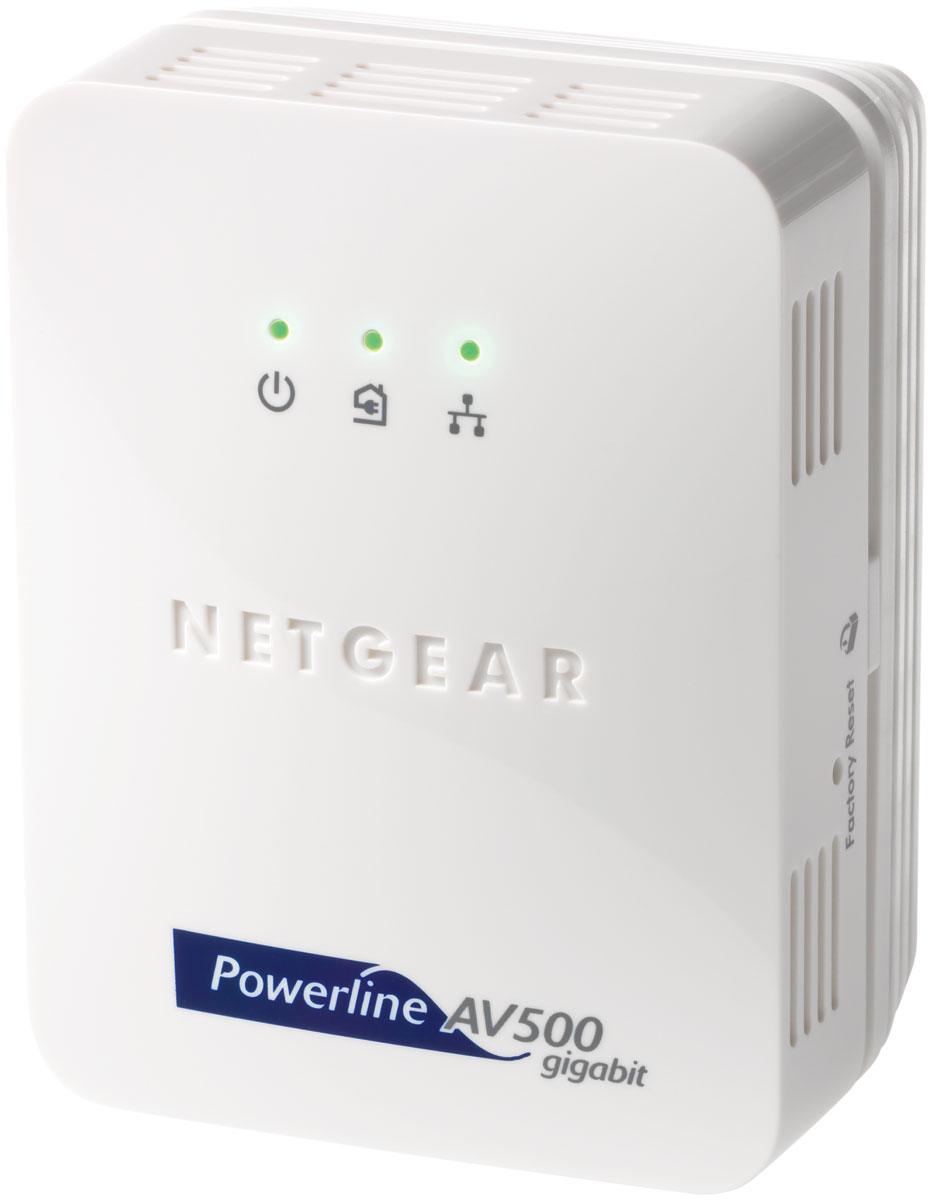
Conceptually, however, the single-connection vision remains valid. And I've noticed encouraging signs of market maturation in recent months. Now-conventional '200 Mbps' powerline adapters are now advertised on sale for around $50 for a two-pack; that's less than half the price that manufacturers and retail partners were promoting them at not so very long ago. And latest-generation '500 Mbps' adapter two-packs are selling for not much more moola; $75 or so. I've been daily using as well as periodically evaluating various powerline networking technologies since the early portion of the last decade, back in the '14 Mbps' HomePlug 1.0 days (say hi if you ever see me at a show, and I'll show you my scars ;-) ). Given recent trends, I figured it was high time for an evaluation revisit. How well do latest generation adapters fulfill their marketing promises? Is it finally time to dispense with burrowing through dirty, spider- and snake-infested crawlspaces and drilling holes in walls and floors in order to route Cat5e cable around?


 Facebook
 Twitter
 RSS
RSS


53 Comments
View All Comments
claytontullos - Thursday, September 1, 2011 - link
I have a netgear XAV1004 -200 system set up for my ps3.When the main unit is on the same breaker as the receiver I get around 35Mb/s. When I had the unit setup a few breakers away I received around 3.1Mb/s. Making the change as made all the difference in the world as I could not stream HD content before.
You really have to take these 200Mb claims as a joke... my gigabit switch tells me the main unit is connected to it at 100Mb/s... You'd expect if it was truly capable of 200Mbs/ speed it would connect at the gigabit level.
bersl2 - Thursday, September 1, 2011 - link
Maybe it only implements Fast Ethernet, and marketing is adding Tx and Rx bandwidth together.fireboy92k - Thursday, September 1, 2011 - link
It's 100 Mbps full duplex (just like fast ethernet), hence the claim of 200 Mbps as you stat.See answer 10 at http://support.netgear.com/app/answers/detail/a_id...
bdipert - Thursday, September 1, 2011 - link
Thanks for writing, claytontullos. The '200 Mbps' (or for that matter, '500 Mbps') claims of the powerline folks are analogous to the '54 Mbps' and above claims of the Wi-Fi folks...or for that matter the '100 Mbps' and '1 Gbps' claims of the wired Ethernet folks. The peak theoretical PHY rate (or even close to it) is rarely if ever achievable in real-life usage environments, due to protocol overhead, distance- and otherwise-derived attenuation, destructive interference from other 'transmitters' in the same frequency bands, etc...p.s...'200 Mbps' powerline networking adapters usually if not always contain 100 Mbps wired Ethernet transceivers. 'Nuff said ;-) Note, however, that the XAV5001 '500 Mbps' adapters contain GbE transceivers...therefore making it important that I mated them to Endpoint systems (my MacBook and MacBook Pro) which ALSO have GbE capabilities
JarredWalton - Thursday, September 1, 2011 - link
I wouldn't lump the 100Mbps and 1Gbps Ethernet stuff in with the WiFi and Powerline networking. I routinely hit >100MBps transfer rates on my GbE setup, and basically peg any 100Mbps connections at 98% of their maximum throughput (around 12.3MBps). And that's using HDDs. Transferring files from an SSD-based system to another SSD over GbE, I can hit around 120MBps. Fastest I've ever managed on WiFi is around 30MBps with a "450Mbps" connection -- or around 53% of the theoretical rate.Per Hansson - Thursday, September 1, 2011 - link
Yea, I agree, don't talk down Ethernet like thatI have a 100mbps internet connection and I can routinely hit 12MB/sec transfer speeds...
I've also used those "Gigabit" Powerline networking devices and they managed an astonishing 5mbps throughput, while at the same time killing my FM reception on my radio, even the cars radio was interferred with when I tried it out to my garage (throughput was then ca 1mbps, somewhat shy of the 1000mbps claim...)
bdipert - Thursday, September 1, 2011 - link
Ok, ok, ok...so maybe I was a little harsh on wired Ethernet...;-) In this regard, a compare-and-contrast is perhaps of some value. Wired Ethernet is a media specifically designed to carry network packets. The AC power grid, on the other hand, or the atmosphere, in both cases with who-knows-what attenuators and spectrum contenders in-between transmitter and receiver...And even with wired Ethernet, protocol overhead (TCP's handshaking scheme, for example...this is why I REALY wished I could have gotten some meaningful UDP data in this study) will retard the effective transfer rate, even if the media and the transceivers on either end are up to the task. And speaking of the receiver, a slow NAS (for example) does a good job of putting the brakes on things, too...
el1x - Thursday, September 1, 2011 - link
As far as i am aware its 100Mbps Full Duplex and the marketing states the Tx & Rx together as bersl2 has said.Any chance of looking at the NetComm range of powerline? The NP202, 203, 204 & 206.
I have a set of the NP204's not only are they a solid reliable unit they have AC passthrough so i don't lose a power point.
jigglywiggly - Thursday, September 1, 2011 - link
The problem with this is that it isn't that much better than wifi, lol.akedia - Thursday, September 1, 2011 - link
My apartment is long, narrow, and fully of radiators. It's also over a century old, and power outlets are distressingly sparse and often tucked half-behind the radiators. Right now I have to have coax strung across half my apartment to get from the bizarre place the cable for my internet connection enters the wall to the only outlet in a good enough position to have my WiFi adapter plugged in and get a signal that's still only serviceable throughout half of my apartment. In a perfect environment, yeah, powerline and WiFi are comparable in performance. In reality, though, there are real advantages and disadvantages to each that can dramatically affect their relative utility. Lots of radiators... only one breaker.