



OCZ Agility 3 (240GB) Review
by Anand Lal Shimpi on May 24, 2011 2:53 AM ESTTRIM Performance
In practice, SandForce based drives running a desktop workload do very well and typically boast an average write amplification below 1 (more writes to the device than actual writes to NAND). My personal SF-1200 drive had a write amplification of around 0.6 after several months of use. However if subjected to a workload composed entirely of incompressible writes (e.g. tons of compressed images, videos and music) you can back the controller into a corner.
To simulate this I filled the drive with incompressible data, ran a 4KB (100% LBA space, QD32) random write test with incompressible data for 20 minutes, and then ran AS-SSD (another incompressible data test) to see how low performance could get:
| OCZ Vertex 3 240GB - Resiliency - AS SSD Sequential Write Speed - 6Gbps | |||||
| Clean | After Torture | After TRIM | |||
| OCZ Agility 3 240GB | 238.6 MB/s | 206.1 MB/s | 213.2 MB/s | ||
| OCZ Vertex 3 240GB | 284.4 MB/s | 278.5 MB/s | 286.3 MB/s | ||
The 240GB Agility 3 behaves similarly to the Vertex 3, although it does lose more ground after our little torture session. There's a sharp drop after about 60 minutes of random writes on these 240GB drives, so performance can definitely go lower if you torture for longer - most users should be just fine though.
Power Consumption
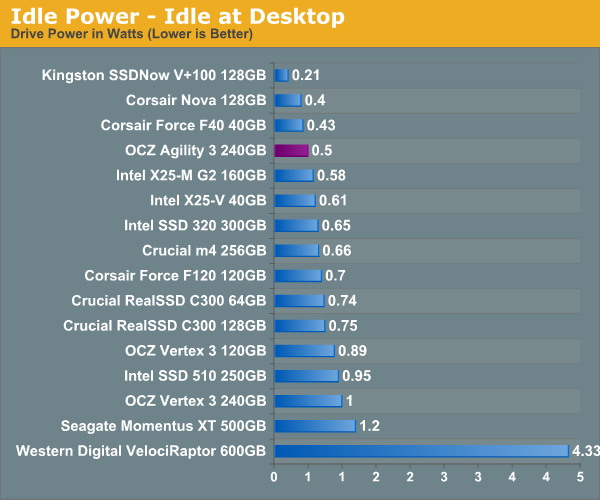
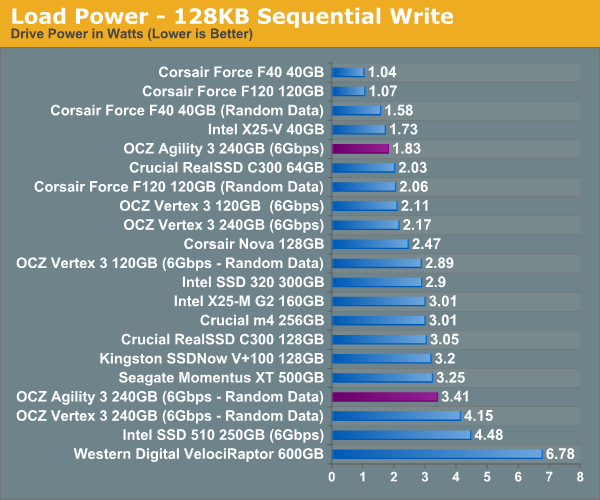
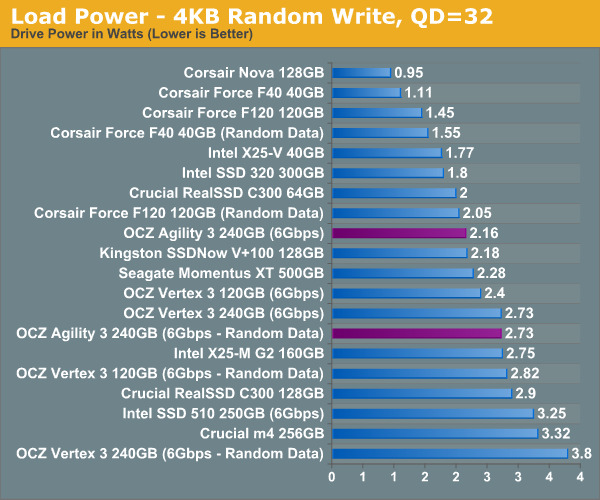
One benefit of the asynchronous NAND is much lower power consumption. The Agility 3 posted the lowest idle power draw of any modern drive we've tested and load power is better than any other SF-2200 drive.


 Facebook
 Twitter
 RSS
RSS


59 Comments
View All Comments
cactusdog - Tuesday, May 24, 2011 - link
Anand can you get hold of the new Corsair Force series 3, preferably the GT version to test?A lot of us are waiting for a non-ocz sandforce 6 GBs drive.
Reiker - Tuesday, May 24, 2011 - link
I agree! I would really like to know if there will be ANY 120Gb SF2k drive that is up to spar with the 240Gb version...Love the work you´re doing Anandtech!
Minion4Hire - Tuesday, May 24, 2011 - link
I'd like to see how much of a performance difference exists between the 60 GB and 240 GB Agility 3s. I don't need 240 GBs for my OS and my important apps, so I'd be more interested in two or three 60 GB drives in RAID 0.... assuming the drives aren't horribly crippled and I'm not bandwidth limited by my controller.Mr Perfect - Tuesday, May 24, 2011 - link
Yes, please. The Force drives look interesting.Also, in the opening you touched briefly on the importance of the 64GB drives, could you test them as well? Looking at the difference between the 240GB and 120GB drives, you can't help but wonder what the 64GB drives will end up like.
Dracusis - Tuesday, May 24, 2011 - link
Yeah, Anand's SSD reviews are the best, they really make me feel like I know what I'm buying into. Would love to see more SF-2200 series drives benchmarked and discussed. Some performance numbers/thoughts on the Agility 3 60GB & 120GB variants would be nice too as there's a lot of performance differences between the Vertex 3 120 vs 240.Having all the Corsair Force 3's new drives on here would be brilliant - It must take a hellish amount of time to do all of these benchmarks though.
MrSpadge - Tuesday, May 24, 2011 - link
A roundup of 60 GB drives would be nice: Agility 3, Solid 3, some Sandforce 2 (34 and/or 25 nm) and Crucial C300 and C400.MrS
dhanson8652 - Tuesday, May 24, 2011 - link
+1 on the 60/64GB roundup. Definitely want to see those and the 120/128GB for any that don't fit like the X25V/M, Intel 320.Oxford Guy - Tuesday, May 24, 2011 - link
What I don't understand is why we have reviews of the 240 GB Vertex 3 and the 240 GB Agility 3 and yet...The 240 GB Vertex 2 is nowhere to be found in the charts!
anonapon - Tuesday, May 24, 2011 - link
I'm really interested in a review of the Corsair Force 3, too, or of any new Sandforce drive which can play well with the IRST drivers, which the OCZ V3 doesn't seem to do with consistency.gayannr - Tuesday, May 24, 2011 - link
Does Intel Stand a chance ? Probably NO! :-/