



Hauppauge Colossus: HD PVR with HDMI Support
by Andrew Van Til on April 14, 2011 5:40 PM EST- Posted in
- HTPC
- Home Theater
- Hauppauge
Testing and Evaluation
With an original HD PVR and Ceton InfiniTV 4 Digital Cable Tuner (DCT) on hand, it provided us with the opportunity to record the same content using MediaInfo and perform visual inspections to document differences in quality. For the results above, the Colossus and HD PVR were configured in-line using the YPbPr/TOSLINK pass-through from the STB. They were set to use the highest recording profile in SageTV, with SageDCT used to capture the raw TS stream from the InfiniTV 4 as a reference point. The settings used by the various devices are summarized in the following table.
| Device Recording Profile Summary | |||
| Video Resolution | Colossus | HD PVR | SageDCT (RAW) |
| 480i | 3985 Kbps 720x480@29.97 AVC (Main@L3.2) (CABAC/2 Ref Frames) | 4695 Kbps 720x480@29.97 AVC (Main@L3.1) (CABAC/4 Ref Frames) | 2948 Kbps 528x480@29.97 MPEG2 (Main@Main) |
| 720p | 7924 Kbps 1280x720p@59.94 AVC (High@L4.0) (CABAC/2 Ref Frames) | 11.8 Mbps 1280x720@59.94 AVC (Main@4.0) (CABAC/4 Ref Frames) | 10.5 Mbps 1280x720@59.94 MPEG2 (Main@High) |
| 1080i | 12.7Mbps 1920x1080i@29.97 AVC (High@L4.0) (CABAC/2 Ref Frames) | 11.7Mbps 1920x1080i@29.97 AVC (High@L4.0) (CABAC/4 Ref Frames) | 16.5 Mbps 1920x1080@29.97 MPEG2 (Main@High) |
There are differences in the bitrate and AVC profiles used by the two Hauppauge devices; the Colossus uses a higher rate for 1080i and the HD PVR uses higher bitrates for 720p and 480i. The InfiniTV 4 was a third set of values. With three points of reference and digital source content, there is little noticeable difference between the captured files in real terms. (If you’re interested in seeing clips of the videos, let us know and we’ll see about including download links.
Alongside the comparative testing, the Colossus was also evaluated for the overall quality and “watchability” of recordings captured at native resolution from the STB. We recorded sixty files with a 33% distribution per resolution at random intervals and channels, and then sampled at five to ten points in each file for issues related to audio and video. We looked for A/V synchronization problems, stutter, and dropouts, and the final result is an 8.33% fail rate. Most of the “fail” issues only occurred in specific locations in the files, and while annoying they were not severe enough to abandon playback. However, there were also entire recordings with no audio or significant enough issues with audio drops or video playback that continued viewing was very unpleasant or impossible.
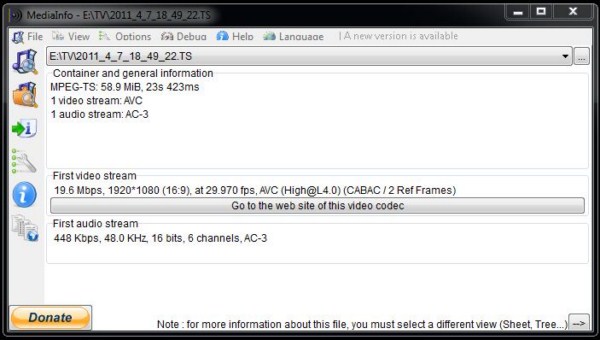
Before moving on it is interesting to note that the maximum bitrate available in ShowBiz and via the encoder’s property page (shown below) is quite a bit higher (~20Mbps) than what is used by SageTV when selecting the best rate (~14 Mbps). It is unlikely that the value of encoding at this high a level would result in a great enough pay off to justify the increased file size given the bitrate of most TV content, but it is good to know that it is possible if the content warrants it.
Additional Testing
I love it when my interests in the HTPC space overlap, so having observed the difference in bitrate capabilities and issues with file capture it provided an easy excuse to start writing code against the Colossus and figure out how to drive the device. For anyone who has done any playing with DirectShow, the following screenshot of the capture graph in GraphStudio should be very familiar. It demonstrates the four components necessary to enable file capture from the device with the property pages for the “Capture” and “Encoder” filters (which are what ShowBiz exposes through its GUI) displayed. The file sink—the component at the end that writes the TS packets to disk as they are output from the encoder (in this case a slightly customized version of the “Dump” sample included in the Windows SDK)—is the only filter not provided by the drivers.
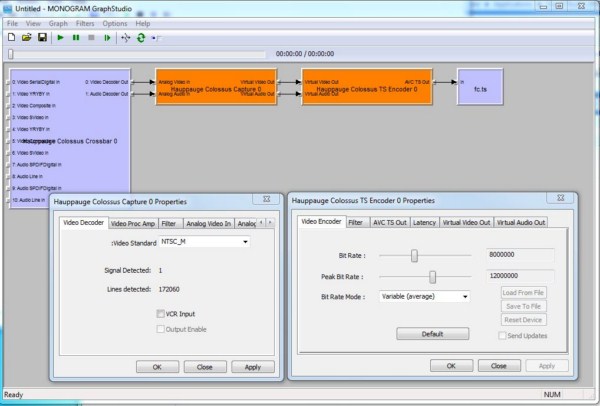
Using that as a starting point I wrote a simple application to prototype input selection (it supports component + S/PDIF or HDMI) and filter configuration. Using standard DirectShow interfaces, I was able to reproduce both the capture issues and the inconsistent bitrate values observed with ShowBiz and SageTV, where after setting the device to the maximum bitrate (~20Mbps) through the encoder interface it actually uses ~14Mbps. I have asked Hauppauge to provide documentation for programming against the device in case there is a different, non-obvious, mechanism for configuring the card, but they did not provide it in time for this review. For anyone interested in looking at the source code for the application it is available here.
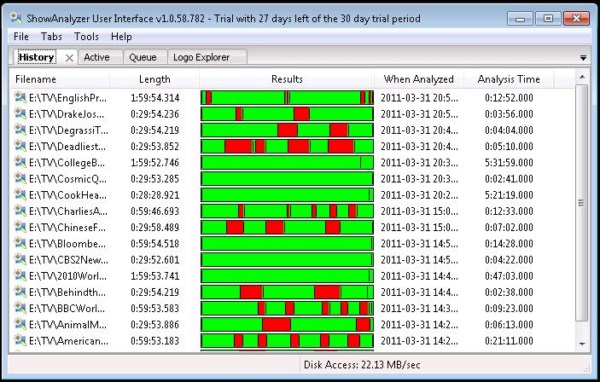
Anyone who made the jump to the original HD PVR when it was released will remember that the commercial scanning story was a bit troubled. Fortunately, the work that was done to support the AVC TS files created with it carries over to those generated using the Colossus. Applications like ShowAnalyzer are able to scan the files and detect commercials in them.


 Facebook
 Twitter
 RSS
RSS


60 Comments
View All Comments
fri2219 - Thursday, April 14, 2011 - link
An HTPC with a quad processor bearing an actual 105W TDP?Just one 60mm fan?
Really?
Get ready to RMA your PVR card. Often.
JarredWalton - Thursday, April 14, 2011 - link
"It is more difficult to create a “worst case” environment with a full height card than would be possible if it were low-profile, since we can’t put the Colossus into some of the smaller HTPC cases. However, we did try to simulate use in a hotter chassis by utilizing the highest TDP CPU we had on hand as well as removing all but one of the case fans in the Ahanix D4 used in testing."The CPU was chosen specifically to put the card under duress. That's what "worst case" means. Would we recommend that sort of setup? Not necessarily, but at least it worked reasonably well in our testing. Now stick several Colossus cards next to each other and you could be in for trouble without additional fans.
babgvant - Thursday, April 14, 2011 - link
Couldn't have said it better :)vol7ron - Thursday, April 14, 2011 - link
Heh. Much love Jarred.vol7ron - Thursday, April 14, 2011 - link
Wait ... I'm just now reading the article... when did you get the Ceton InfiniTV 4!? I've been asking Anand about that for a year :)Have you guys had a review - did I miss it!?
dagamer34 - Friday, April 15, 2011 - link
http://www.amazon.com/Ceton-Infinitv4-Digital-Cabl...Your welcome
Anthony Toste - Friday, April 15, 2011 - link
Jarred Walton"Now stick several Colossus cards next to each other and you could be in for trouble without additional fans"
Only a dumdee would try using a small HTPC cases with several Colossus card beside that it better suite for a media sevrer any way with that min card that if you can find a motherboard with that min slot that dosen't cost a arm and leg.
How did come up with that when dosen't even run hot at all in fact I can put my finger on main chip when it even recording and it bearlee even gets luke warm unlike USB HD-PVR model and min other Hauppauge card from pass days.
"Not all recordings are watchable"
That maybe the bitstream issue and they are looking in to this which also has to do the BSOD issue to so best thing to do is reboot ever day I know not idea way of doing things and I couldn't aggree more on that one.
"Software/hardware bundle adds unnecessary cost with not additional value for DVR use"
Don't you mean just the Software?
I find Arcsoft’s ShowBiz very useful but it not for DVR use it capture only for DVR use you used WinTV 7 or any 3rdparty you like
Who know maybe they do OEM ver where get nothing other then drivers.
"No HDMI pass-through"
And do you plan add that when there no room for it.
"BSOD when continuously recording for more than sixteen hours"
This being address
"Full height card leaves low-profile HTPC users out"
Who know maybe there plan on one but you see they have dump HDMI and all Audio/Video output
Any way Andrew nice review.
bobbozzo - Saturday, April 16, 2011 - link
"Software/hardware bundle adds unnecessary cost with not additional value for DVR use""Don't you mean just the Software?"
Seems like the reviewer didn't like the remote as well.
babgvant - Saturday, April 16, 2011 - link
That is correct - it is not useful in most HTPC scenarios.dastruch - Friday, April 15, 2011 - link
-1