



NVIDIA’s GeForce GTX 590: Duking It Out For The Single Card King
by Ryan Smith on March 24, 2011 9:00 AM ESTCrysis: Warhead
Kicking things off as always is Crysis: Warhead, still one of the toughest games in our benchmark suite. Even three years since the release of the original Crysis, “but can it run Crysis?” is still an important question, and for three years the answer was “no.” Dual-GPU halo cards can now play it at Enthusiast settings at high resolutions, but for everything else max settings are still beyond the grasp of a single card.
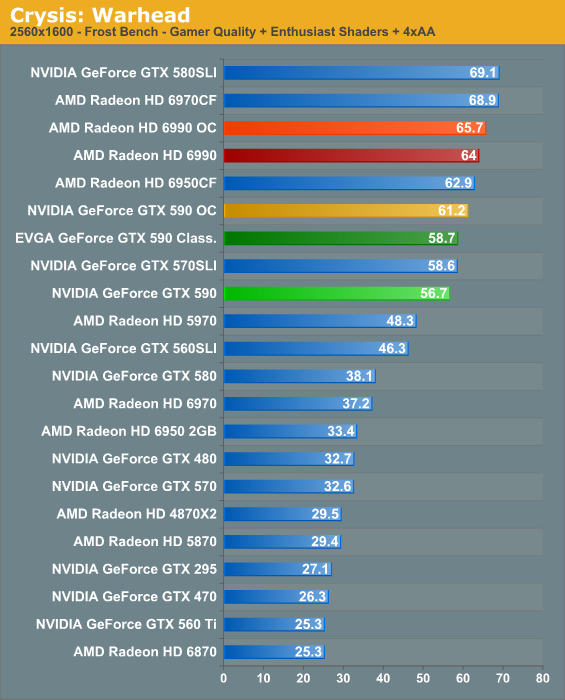
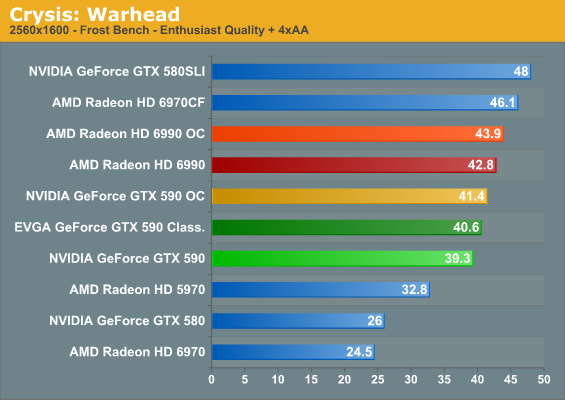
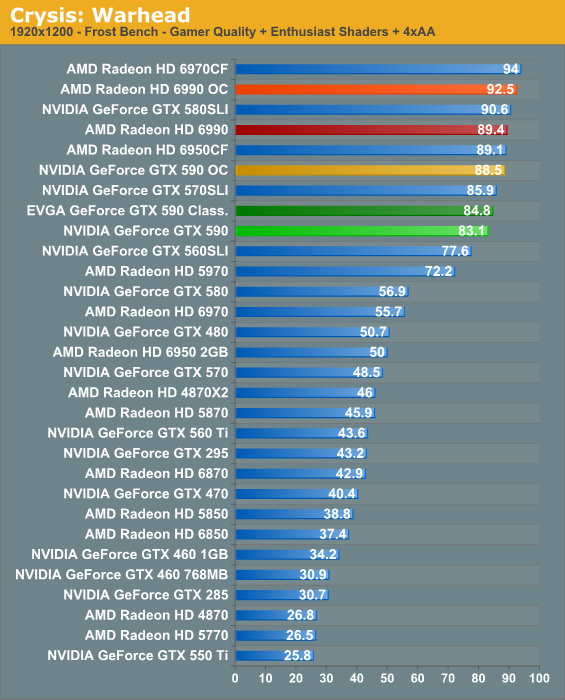
Crysis is often a bellwether for overall performance; if that’s the case here, then NVIDIA and the GTX 590 is not off to a good start at the all-important resolution of 2560x1600.
AMD gets some really good CrossFire scaling under Crysis, and as a result the 6990 has no problem taking the lead here. At a roughly 10% disadvantage it won’t make or break the game for NVIDIA, but given the similar prices they don’t want to lose too many games.
Meanwhile amongst NVIDIA’s own stable of cards, the stock GTX 590 ends up slightly underperforming the GTX 570 SLI. As we discussed in our look at theoretical numbers, the GTX 590’s advantage/disadvantage depends on what the game in question taxes the most. Crysis is normally shader and memory bandwidth heavy, which is why the GTX 590 never falls too far behind with its memory bandwidth advantage. EVGA’s mild overclock is enough to close the gap however, delivering identical performance. A further overclock can improve performance some more, but surprisingly not by all that much.
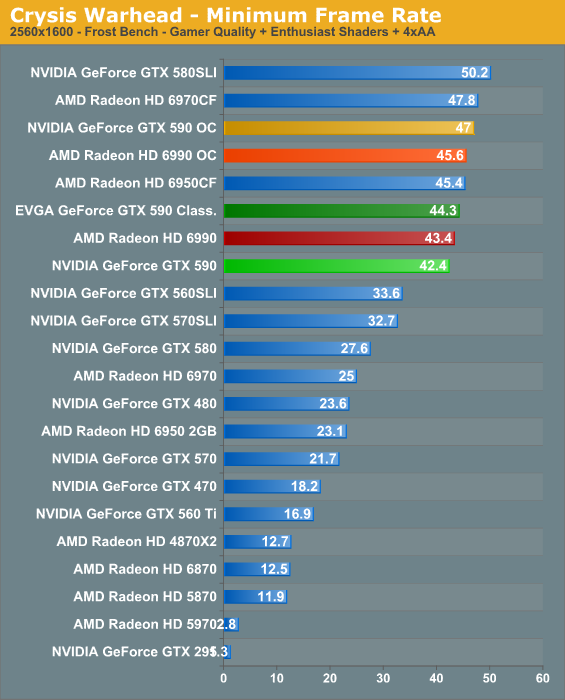
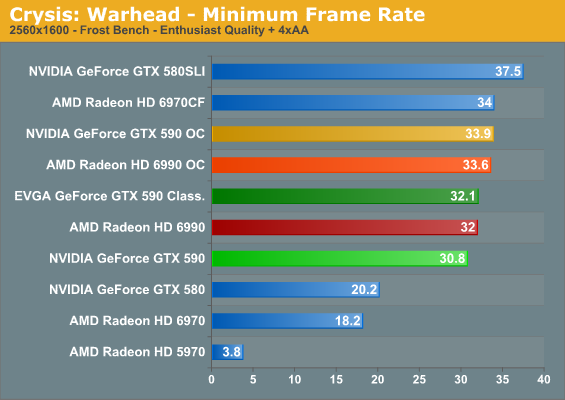
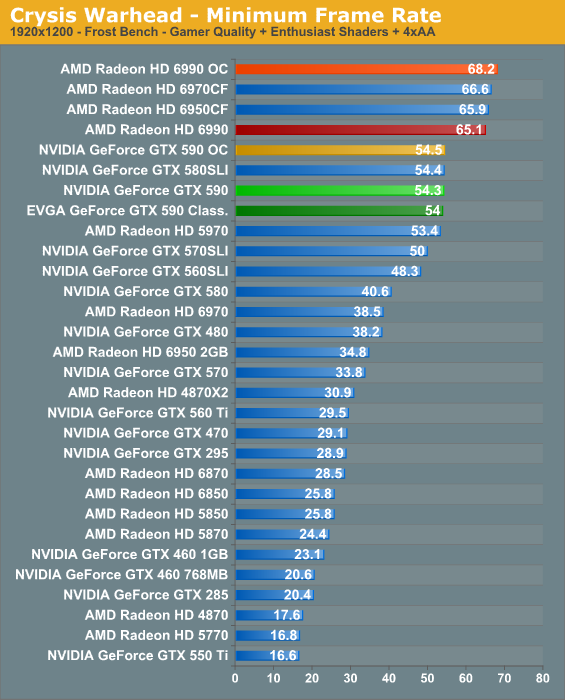
The minimum framerate ends up looking better for NVIDIA. The GTX 590 is still behind the 6990, but now it’s only by about 5%, while the EVGA GTX 590 squeezes past by all of .1 frame per second.


 Facebook
 Twitter
 RSS
RSS


123 Comments
View All Comments
Cali3350 - Thursday, March 24, 2011 - link
Last Page you have a seeming paragraph that says "Quickly, let's also..." and then stops.tipoo - Thursday, March 24, 2011 - link
Also "Unlike AMD isn’t using an exotic phase change thermal compound here" on the meet the card pagetipoo - Thursday, March 24, 2011 - link
Another one "This doesn’t the game in any meaningful manner, but it’s an example of how SLI/CF aren’t always the right tool for the job." on the computation page.ahar - Thursday, March 24, 2011 - link
Page 2"...NVIDIA’s advice about SLI mirror’s AMD’s advice..."
mirrors
beepboy - Thursday, March 24, 2011 - link
"Quickly, let's also"Nice review.
slickr - Thursday, March 24, 2011 - link
For $700 I'd rather buy a whole new PC.Whats the point of playing games at larger resolutions than 1600x1050.
In fact I'd say that 720p resolution is probably the best to play games at, because it tends to be easier to follow since pixels kind of move faster and you have more precision and smoother gameplay experience.
I'd be keeping my AMD 6870 that is for sure!
HangFire - Thursday, March 24, 2011 - link
I've once heard that the secret to happiness is learning to like the taste of cheap beer.nyran125 - Sunday, June 19, 2011 - link
did you know thats actually true lol. If you can have your coffee black, then if milk runs out you still get to enjoy life......cjl - Thursday, March 24, 2011 - link
That depends entirely on your GPU. Several can push high resolutions at >60fps, and it's just as smooth. Gaming at 2560x1600 is just an awesome experience.Azethoth - Sunday, March 27, 2011 - link
Exactly, some of us have panels with native 2560x1600. I _could_ game at some miserable 1600x1050 resolution, or I could play at my native resolution. I choose 2560x1600 and ignore all review results at inferior resolutions. Damn you Crysis, damn you!