



Samsung Galaxy Tab - The AnandTech Review
by Vivek Gowri on December 23, 2010 9:48 AM ESTSamsung Galaxy Tab - Oh, That Screen
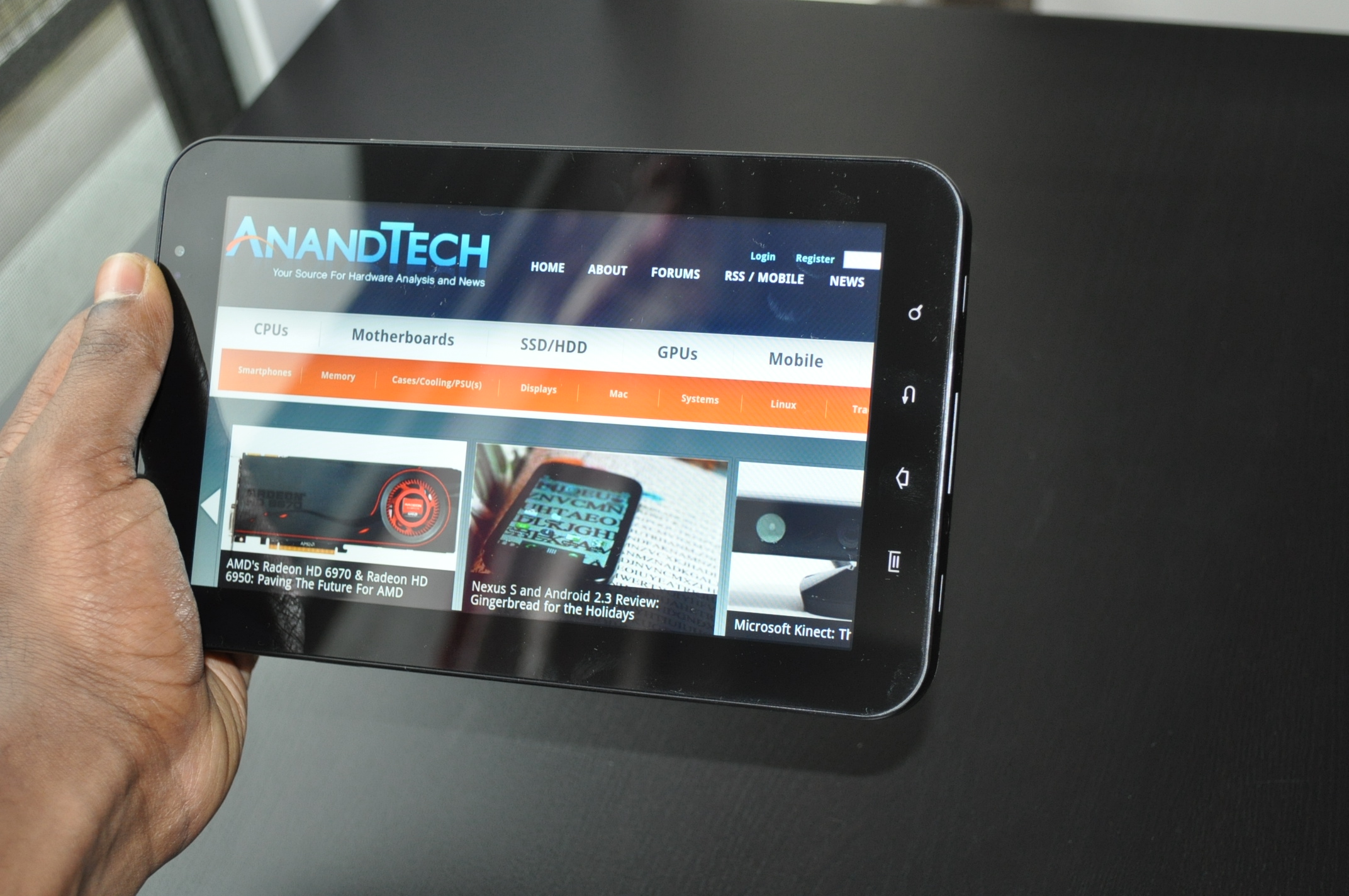
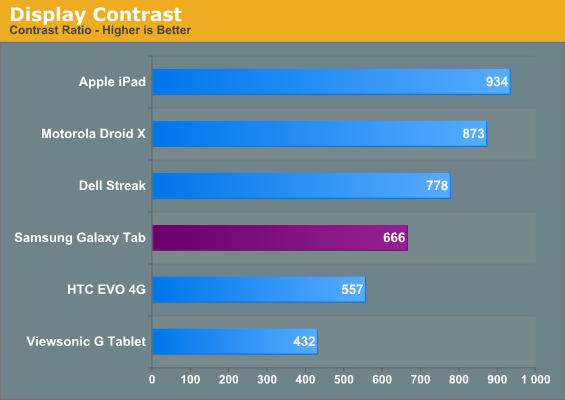
Really, I have to commend Samsung here. There’s no AMOLED, no IPS, and no S-LCD, but they managed to put a very high quality LED-backlit LCD panel into the Galaxy Tab. The contrast ratio is a devilish 666:1, neatly splitting the difference between the EVO 4G and the Dell Streak, but well short of the iPad’s stellar 934:1 number. But the best thing about the screen is that even without any of the more advanced display technologies, viewing angles are still excellent. As we’ve mentioned before, viewing angles are significantly more important for tablets than netbooks or notebooks, so it’s reassuring to see that Samsung recognizes this.
The 7” display packs the same WSVGA resolution as most 10” widescreen tablets, so the pixel density is relatively high at 170ppi (versus 138 for the iPad and 116 for most 10” WSVGA tablets). Current rumors put some of the upcoming 10” tablets at 1366x768 or 1280x800, so we’ll see pixel density rise for the industry as a whole, but overall the Galaxy Tab has a pleasantly crisp screen.
The end user experience of any tablet really begins with the screen, and it’s probably one of the most overlooked components in any given device. The display can really make or break any tablet, so it’s important to note that the Galaxy Tab has a very good one.


 Facebook
 Twitter
 RSS
RSS


97 Comments
View All Comments
sciwizam - Thursday, December 23, 2010 - link
Wikipedia has:Dimensions 190.09 mm (7.484 in) (h)
120.45 mm (4.742 in) (w)
11.98 mm (0.472 in) (d)
Weight 380 g (0.84 lb)
These make a lot more sense.
VivekGowri - Thursday, December 23, 2010 - link
Fixed, so sorry - it got pushed live before I had a chance to edit that part.medi01 - Friday, December 24, 2010 - link
"HD video recording is sadly not supported"Having in mind how "huge and powerfull" are the lens "HD resolution" would make sense, wouldn't it?
I understand, when this BS comes from usual customers, but when it comes from a reviewer, sigh...
VivekGowri - Friday, December 24, 2010 - link
Why Samsung decided to spec their bigger, better device with a lower end camera than the Galaxy S phones is an openly debatable question that I have no real answer to, but it doesn't support HD video recording. What else am I supposed to say?medi01 - Friday, December 24, 2010 - link
Obviously neither HD video nor 5+ megapixels photos make any sense on devices with tiny lens.Whether they upscale or produce "HD" noise is completely irrelevant, mentioning "lack of HD video" as a real disadvantage reiterates the myth and confuses the customers.
NesuD - Thursday, December 23, 2010 - link
You're getting things wrong on the other comparison units as well. Droid X Nand is 8GB integrated and a 16 GB micro SD. This is a well publicized spec of the Droid X from launch. Fact checking and verification is an essential part of Journalism that seems to be slipping here at Anandtech of late.VivekGowri - Saturday, December 25, 2010 - link
I copied that part of the table out of the Fascinate review, so I'll look into it. But I'd like to point out that this is literally just a spec table, don't call our journalistic integrity into question based on that alone.aniallator - Thursday, December 23, 2010 - link
You have posted the dimensions and weight values for the iphone 4 (well those values match) all other areas of the Samsung galaxy tab hardware information appear to be correct.veri745 - Thursday, December 23, 2010 - link
The posted dimensions have to be wrong.misterjohnnyt - Thursday, December 23, 2010 - link
Listing Proper Dimensions FAIL