



The Windows Phone 7 Review
by Anand Lal Shimpi & Brian Klug on October 20, 2010 7:00 PM EST- Posted in
- Smartphones
- Windows Phone 7
- Microsoft
- Mobile
Battery Life
With everyone sharing the same base hardware and software there are only two items that will ultimately impact battery life between vendors: screen type and battery size. The pecking order is pretty easy to follow. Smaller LCDs will be the best on battery, larger Super AMOLED screens will be the worst. The battery scale is even easier to define: bigger is better, but heavier.
We’ve been testing three Windows Phones: HTC’s Surround, Samsung’s Focus and the LG Optimus 7. The HTC and LG use standard LCD displays, while the Focus uses the same type of Super AMOLED screen we saw in the Fascinate and Epic 4G.
The LG uses a 5.55Whr battery compared to 4.55Whr on the HTC Surround. As a result LG gets the best battery life out of the three with the Focus coming in last due to its Super AMOLED display.
Microsoft mandates three discrete display brightness settings on all phones: low, medium and high, coupled with an automatic brightness mode. The three phones delivered very different levels of brightnes at each setting:
| Brightness Comparison (White Point) | |||||
| Phone | Low | Medium | High | ||
| HTC Surround | 10.4 nits | 183.1 nits | 405.7 nits | ||
| LG Optimus 7 | 130.4 nits | 259.1 nits | 381.2 nits | ||
| Samsung Focus | 61.9 nits | 143.1 nits | 234.3 nits | ||
| Brightness Comparison (Black Point) | |||||
| Phone | Low | Medium | High | ||
| HTC Surround | 0.03 nits | 0.39 nits | 0.88 nits | ||
| LG Optimus 7 | 0.28 nits | 0.56 nits | 0.82 nits | ||
| Samsung Focus | 0 | 0 | 0 | ||
Overall battery life of these Windows Phones ranges from average to above average in the case of the LG Optimus 7. The use of Qualcomm’s 65nm SoC definitely doesn’t help battery life, but Microsoft appears to have done a reasonable job with power management.
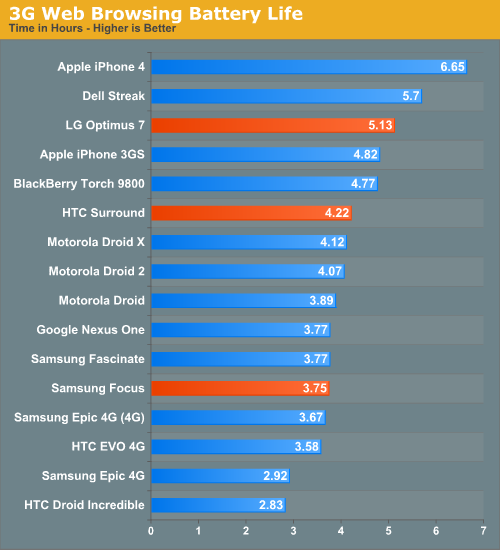
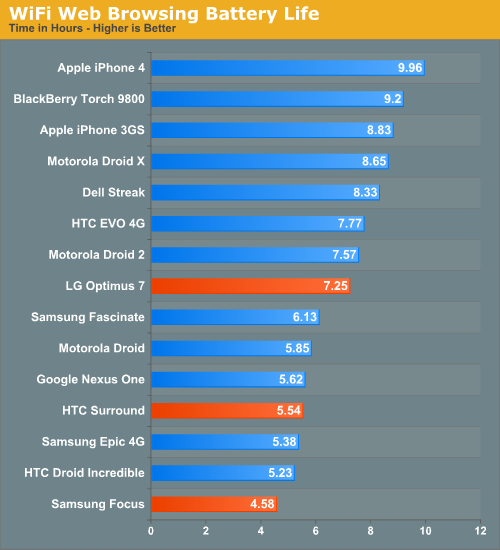
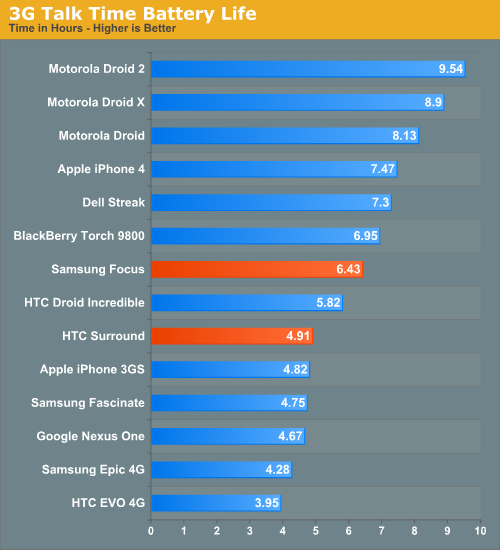
The first Windows Phones won’t be in the same realm of battery life as the iPhone 4, but it’s a reasonable starting point. Given a normal/light workload you can easily make one of these things last a full day on a single charge, but heavier users will probably find themselves charging once in the early evening. As with most aspects of the platform, we need to see significant improvement in the next 6 months for Microsoft to be taken seriously. Luckily for Microsoft, where it is today isn’t a bad place to be.


 Facebook
 Twitter
 RSS
RSS


125 Comments
View All Comments
wharris1 - Wednesday, October 20, 2010 - link
Web site is great; now I need to read articledeputc26 - Thursday, October 21, 2010 - link
Where are the actual load times (in seconds) for web pages? Synthetics never tell the whole picture... seems like you might be embarrassed for WP7 on this front ;)GoSharks - Wednesday, October 20, 2010 - link
Are there supposed to be images in this article?jimhsu - Wednesday, October 20, 2010 - link
Article seems to be half done as Anand makes a huge number of edits. Guess that's normal.SelesGames - Wednesday, October 20, 2010 - link
I see images just fine.Btw, I don't know whether any app reviews will be done, but for anyone who has access to a phone, check out some of our apps. Search for "Seles Games" to see all our apps, or check out any of the apps we have demoed here:
http://www.youtube.com/user/aemami99
Mumrik - Saturday, October 23, 2010 - link
So you decided to advertise in the Anandtech comments... Classy move.Termie - Wednesday, October 20, 2010 - link
The HTC Surround page seems to be missing, or at least it's not coming up when I click on the link to that page.Anand Lal Shimpi - Wednesday, October 20, 2010 - link
Images are incoming, please bare with us :)atmartens - Wednesday, October 20, 2010 - link
"please bare with us :)"Skinny dipping? Or just streaking?
Zstream - Wednesday, October 20, 2010 - link
Do you know what the talk time is for the LG? It's not showing on the graph.