



Motorola Droid X: Thoroughly Reviewed
by Brian Klug on July 20, 2010 4:27 PM EST- Posted in
- Smartphones
- Motorola Droid X
- OMAP
- Mobile
Hotspot Use

The EVO’s has more eye candy but really no additional functionality. It’ll be interesting to see how HTC and Motorola integrate the WiFi tethering features from froyo into their platforms. For an extra $20/month, the X will allow up to 5 devices to connect, with a 2 GB per month cap. The EVO allows 8 users to connect.
I decided we needed to do some real-world hotspot testing and find out what battery life really looks like. To do so, I loaded up four tabs of our page loading suite which loads through a set of more than a dozen pages every 20 seconds. Two tabs with 1-4 flash ads, two tabs with no flash ads. I also fired up a 64 kilobit/s streaming radio station. All of this was on one wireless client in the same room. The screen is off, and any other background applications were killed before launch.
It’s a heavy load, but not unlike what you could potentially see in the real world. I also tested my Nexus One, but had some instability and lost connection before the test completed. After tweaking my setup, I got some numbers.
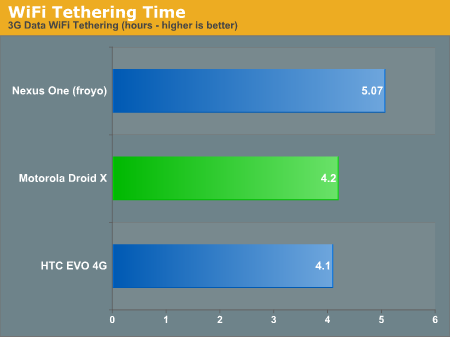
We see that the EVO and X alike have very similar tethering lifetime. I noticed that the EVO’s wireless range was notably less, however. Looking at the numbers, it seems possible that Android's native implementation in Froyo offers a small but notable battery life benefit.
When I tested the original Droid, I was shocked by the long call time battery life. True to form, the X also has impressively long CDMA talk time. For being a big phone, the X also pulls some impressive other battery numbers thanks to being the second device on the market with a 45 nm process SoC.
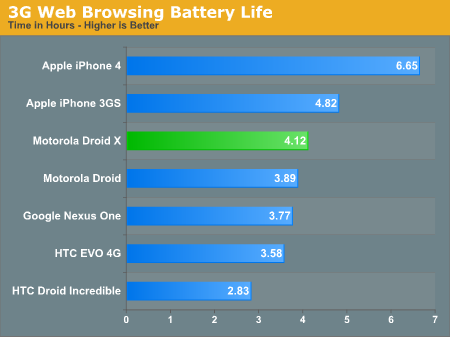
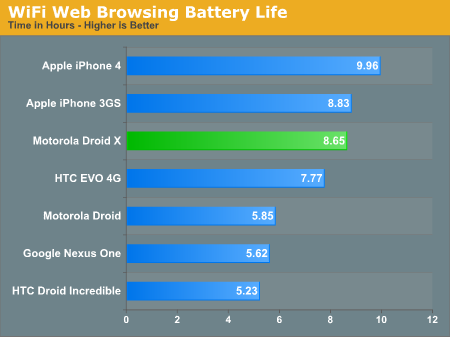
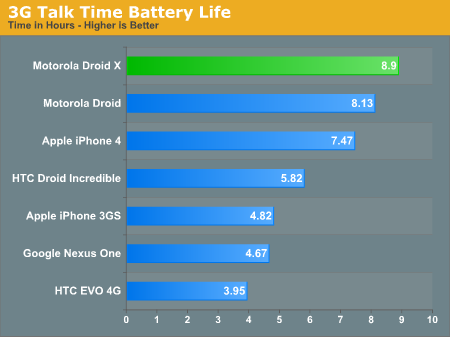
The results are definitely interesting - the X has the longest battery life among devices running Android 2.1.


 Facebook
 Twitter
 RSS
RSS


89 Comments
View All Comments
czesiu - Tuesday, July 20, 2010 - link
great review!higher res version for this please:)
http://images.anandtech.com/doci/3826/DROIDX-Anand...
Brian Klug - Tuesday, July 20, 2010 - link
I'm actually going to dump all the screen comparison photos I've got (there are quite a few) into a gallery, then you can peruse at native resolution. Should be up in a little bit ;)-Brian
hatter_india - Tuesday, July 20, 2010 - link
Fantastic review but I expect no less from AnandTech. But there are a couple of bloopers:1- OMAP 3630 is third mobile chip to use 45nm process. First is of course A4. But second is Samsung's Hummingbird, a chip that the korean company designed with help of Intrinsity. This chip is found in Galaxy S or its variants. Samsung is the same company that also tweaked A4, which incidentally is fabbed by Samsung. Too many coincidences ;-)
2- A comparison to PowerVR SGX 540 found on Galaxy S would have been interesting as according to Samsung SGX 540 is almost three times more powerful than SGX535.
3- Droid X should have also been compared with Galaxy S or any of its variants like Captivate, Vibrant etc
hatter_india - Tuesday, July 20, 2010 - link
This line: Samsung is the same company that also tweaked A4, which incidentally is fabbed by SamsungShould read: Intrinsity is the same company that also tweaked A4, which incidentally is fabbed by Samsung
Goty - Tuesday, July 20, 2010 - link
Does AT have any plans to review any of the Galaxy S phones? I just picked up a Captivate on Sunday and I'd love to see how it stacks up. I just ran the Neocore benchmark and got around 55 FPS, which speaks well of the GPU, but I'd like to see results from the other tests you guys do.Brian Klug - Tuesday, July 20, 2010 - link
Hey Goty,We definitely have plans to do reviews of all of the Galaxy S phones we can get our hands on. I'm working on getting them as soon as possible ;)
I'm also pretty excited to explore that SoC and compare.
-Brian
Ram21 - Tuesday, July 20, 2010 - link
Really enjoyed this review. Keep up the great work! Being as thorough as you guys are really helps to make good decisions on purchases.SonicIce - Tuesday, July 20, 2010 - link
lol how long before we can attach an external mouse and keyboard to a phone to use it as a pc and play 3d games online with itstrikeback03 - Tuesday, July 27, 2010 - link
How about this?http://www.androidcentral.com/dell-streak-logitech...
ltfields - Tuesday, July 20, 2010 - link
Guys, another gold standard review. I may not be able to pick up an X because I'm still under contract with another carrier, but the reviews are riveting. Keep up the excellent work!