



Alienware M11x R2: A Legend Reborn
by Jarred Walton on July 9, 2010 4:05 AM ESTApplication Performance: Arrandale ULV beats OCed CULV
While the gaming performance was generally a wash, application performance shows some clear improvements. Granted, we have the more expensive model with an i7-640UM instead of the i5-520UM, so besides a 133MHz higher base clock it also comes with Turbo Boost that up to 333MHz faster. Subjectively, the M11x R2 feels plenty fast, though the use of a conventional hard drive makes it less snappy than it otherwise could be. In fact, the R2 takes longer to boot than most other laptops, clearly hindered by the various Alienware applications that control the lighting and other features. Once in Windows, though, things settle down and the laptop runs well, launching applications and games noticeably faster than CULV laptops. We ran through our standard application benchmarks just to confirm our impression.
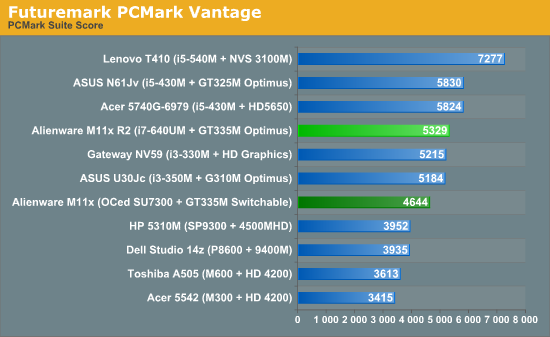
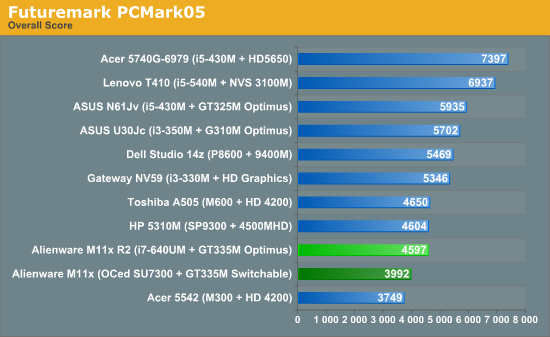
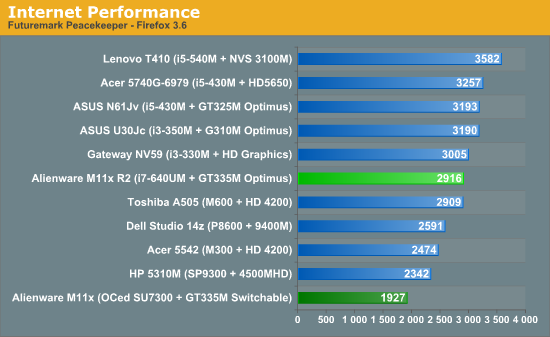
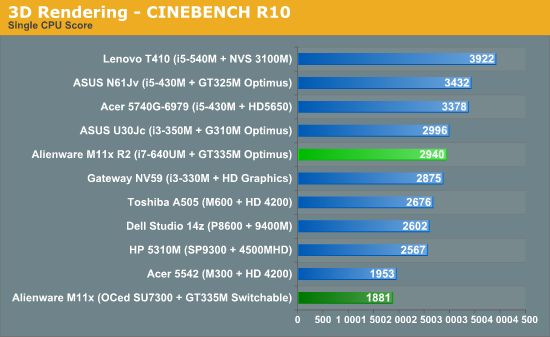
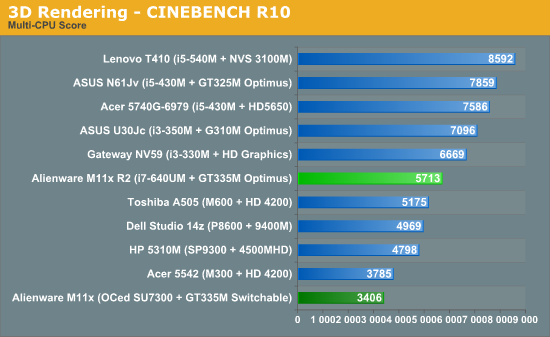
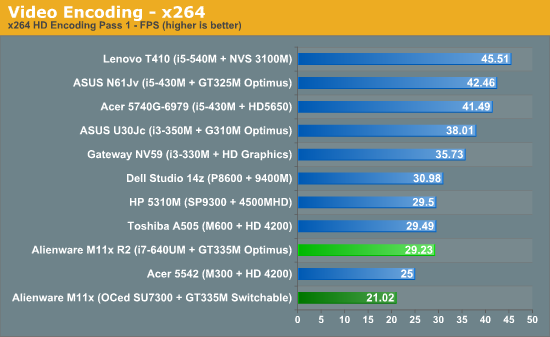
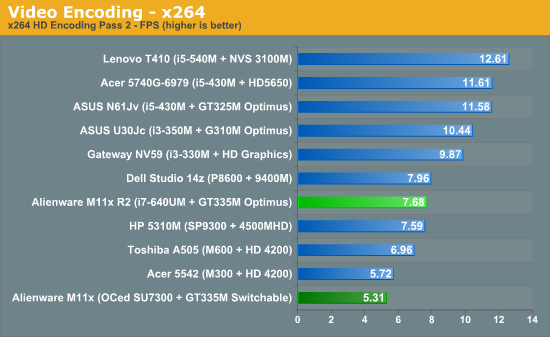
Both PCMark results improve by 15%, but they're at the lower end of the improvement scale. Peacekeeper shows the benefit of Turbo Boost, with 51% faster scores on the R2. Likewise, Cinebench is 56% faster on the 1CPU test, and Hyper-Threading plus Turbo Boost improve the multi-core rendering score by 68%. Rounding things out, x264 encoding also benefits from HTT and Turbo modes, with 39% and 45% faster encoding in pass one and two respectively. If you opt for the standard i5-520UM model, we expect scores will drop at least 10%, and perhaps as much as 20%, so keep that in mind.
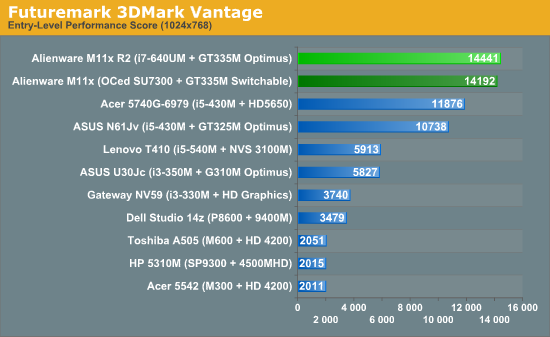
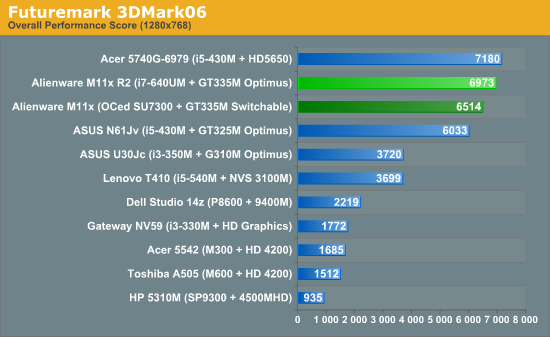
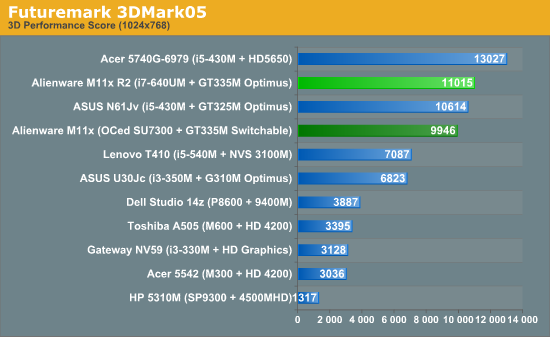
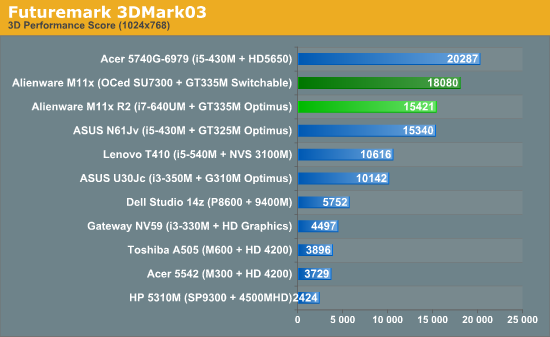
A quick look at 3DMark results confirms our gaming scores. 05, 06, and Vantage all have the R2 leading by a small amount—11%, 7%, and 2% respectively. Meanwhile, again we have a situation where an older application with higher frame rates runs slower on the R2. 3DMark03 is 17% faster on the original M11x, and while we don't "play" 3DMark it suggests that the process of transferring frames over the PCI-E bus to the IGP frame buffer is likely limiting performance. If you recall, Optimus doesn't have any direct connections to the displays, letting all of those go through the IGP. It's what allows the instantaneous switch between IGP and dGPU with no screen flicker. The catch is that all the frames go over the PCI-E bus. That's not a problem when you run at reasonable settings and get frame rates of under 60FPS, as you're only looking at around 250MB/s of data on a bus capable of handling 8000MB/s. However, theoretical performance and practical performance are different matters, and with the game tests on 3DMark03 running at anywhere from 110 to 350 FPS congestion seems likely.
We looked at the detailed results for 3DMark03, and sure enough it's the Game 1 test that shows the biggest drop. On the original it ran at 348FPS while it gets just 179FPS on the R2. The other results are closer; Game 2 runs at 136 vs. 128, Game 3 at 112 vs. 110, and Game 4 at 135 vs. 108—with the R1 beating the R2 in all four tests. This also appears to confirm that the lower scores in our Empire: Total War and STALKER: Call of Pripyat games (at minimum detail where frame rates are high) are not a driver issue so much as a PCI-E congestion issue. Again, this isn't a problem when you're playing games at reasonable frame rates (you don't really need more than 60FPS on typical LCDs), but we found it interesting nonetheless.


 Facebook
 Twitter
 RSS
RSS


55 Comments
View All Comments
blyndy - Friday, July 9, 2010 - link
Why the F**K does Alienware, for all its awesome customisability, poke a stick in the eye with reflective displays!?I would own a m17x if it wasn't for the shit screen. Give me the option for an RGB display but NOT for a matte finish? They can keep it.
plewis00 - Friday, July 9, 2010 - link
For everyone who complains about glossy displays there is someone who prefers them. I am one of those people. And if the majority disliked glossy displays the industry as a whole wouldn't use them.Matte displays attract dirt and fingerprints which are then harder to clean than glossy ones, that is a fact.
I don't know why everyone complains so much about them - true, in this instance the low contrast nature of the M11x display is bad but being glossy is a matter of taste, and given the choice, I would take the glossy display over the matte one, obviously you and others differ here, but whereas low-contrast is bad for all users, the display coating is definitely an opinion matter.
LaughingTarget - Friday, July 9, 2010 - link
Sounds to me the problem can be resolved by, you know, not touching the screen.plewis00 - Friday, July 9, 2010 - link
Just because I don't touch my screen doesn't mean other people in the vacinity don't...Or if you are in a rush and grab the computer. Or if you sneeze on it. Any number of things can get dirt on the screen, but I'm sure you knew that and were just being facetious and annoying for no apparent reason...
quiksilvr - Friday, July 9, 2010 - link
First off, I don't know what matte screens you're talking about but glossy screens attract dust and fingerprints like no other.If you are using the glossy screen for mainly home use and have it set up so there is no reflecting light, then I would say that glossy is the way to go.
LaughingTarget was merely pointing out the holes in your logic. For on-the-go use and for viewing the screen more easily, matte is the way to go.
Gloss is only there to compensate for the poor screen quality beneath that most manufacturers don't want to spend extra money on. I've seen matte displays with great contrast ratios AND given that the screen isn't a mirror, makes it usable in a well lit environments.
And as for the whole cleaning thing, they are the same. Just use the LCD cleaner with the cloth and both get just as clean.
plewis00 - Friday, July 9, 2010 - link
Well, I agree with most of what you say, however 'LaughingTarget' was being a tool. Whatever I do, some moron will come across to my computer screen or laptop in the day and point with the fleshy part of their finger having previously been stuffing their face with something greasy and unhealthy, so 'not touching' it just doesn't happen.I'm sure matte displays have their place, but there are times when glossy screens have a price premium and people do pay that premium for them (not me personally). And I have a Dell 2005FPW attached to one of my computers which is (as far as I know) a S-IPS panel with a great contrast ratio and matte finish, far outpacing most of the TN panels built 3-4 years later I seem to come across.
Personally, I still prefer and will continue to use glossy screens where possible (one of which used to be the stunning RGBLED in the SXPS16). It doesn't matter what someone says, it is down to personal preference ultimately - I'm sure someone will spin me a load of rubbish about how I don't take graphics or image work seriously because I just said that but they would be wrong (and I hope that isn't you). What is universally agreed though is that high contrast and gamut is better.
And yes, I do own an M11x and my complaint is not with the glossy LCD layer but with the hideously poor contrast and terrible vertical viewing angle.
LaughingTarget - Friday, July 9, 2010 - link
Understand what tool means. Whom am I being a tool for, pray tell? Some secret international conglomerate of matte monitor manufacturers?At the end of the day, your piss poor behavior using your expensive piece of hardware is hardly a great reason to buy a lesser monitor. If you can't pop open the screen without grubbing the monitor and hang around people with a total lack of consideration, that doesn't somehow make the glossy mess any better. You shouldn't be buying the m11 if you regularly bring the unit to places where folks smudge Cheeto dust all over it. That's what $300 Netbooks were invented for.
As for dust, close the thing when not in use. Problem solved.
plewis00 - Friday, July 9, 2010 - link
Look it up on Urbandictionary if you don't get it.Yes, you are a tool for being undeniably facetious and smug with your response without adding anything to the conversation. You may not agree with my use of glossy screens as do others but slating it or making a pointless remark like 'don't touch it' doesn't add anything, just like your last comment.
And I wasn't talking about my M11x, I was talking about any LCD (matte or glossy), I mean at work people come to show you things and poke the screen - I work in an office where it's 90% women, they don't listen when I say 'don't touch the screen, it damages it' even if I do work in IT.
Dust appears on screens and keyboards even if you do close them after use, it's these annoying things called static electricity and gravity but being such a smartarse you must've already known that.
erple2 - Saturday, July 10, 2010 - link
Honestly, the initial response of LaughingTarget I thought was pretty reasonable, even funny.Clearly, the solution <i>is</i> not to touch it. Whether you can fully control whether people other than yourself touch the screen is a side issue, but you can at least prevent your own fingerprints on the laptop.
Regardless, glossy vs. matte is, I suppose, as much about personal taste. I personally think that glossy is exceptionally annoying (and inferior from a practicality standpoint), but that's my opinion. I also think my opinion is based on facts. Whether those facts are important to you is a different story.
BTW, touching a screen is not a male/female thing. I work in an office where it's about 80% men, and they still touch screens, even after being told not to.
blyndy - Friday, July 9, 2010 - link
The slight mirror layer over the whole display contents is what is unacceptable for me and others. They're obviously acceptable to some and that's fine, but for people who prioritise 'usable' over 'sleek' our options are negligible, hence the frustration."Matte displays attract dirt and fingerprints which are then harder to clean than glossy ones, that is a fact."
*turns off desktop lcd (matte)* ...I see a few smudges, but I have to shift my head from side to side to see them, and they're invisible when the screen is on, completely unobtrusive either way. I don't go poking the screen too much anyway, with that said it's simple to clean if ever I happen to rub my hands all over it. With a glossy screen though you HAVE to clean it if you don't want it to look dirty.
Anyway my main gripe is that for all of Alienware customisation options they don't include a matte screen, on machines that are supposed to be uncompromising and for hardcore users.
Especially when all they have to do is remove the clear plastic cover.