



2010 Value SSD (~$100) Roundup: Kingston and OCZ take on Intel
by Anand Lal Shimpi on June 3, 2010 12:01 AM ESTFinal Words
If you can afford it, you're still better off spending $300 - $400 on an SSD than trying to get your feet wet with one of these value drives. The performance difference is significant enough to warrant it. Even the upgrade to Intel's 80GB X25-M G2 is a better idea given the drive's low cost per GB. If you are trying to get into an SSD as cheap as possible, perhaps for an older machine or netbook then these value drives are worth considering.
I'm going to assume that the workload for such a machine is going to be lighter than what most high end SSDs are exposed to, thus random read performance will probably matter more than peak sequential write speed for example. Intel's X25-V is very attractive, but its overall price would keep it out of systems on a tight budget.
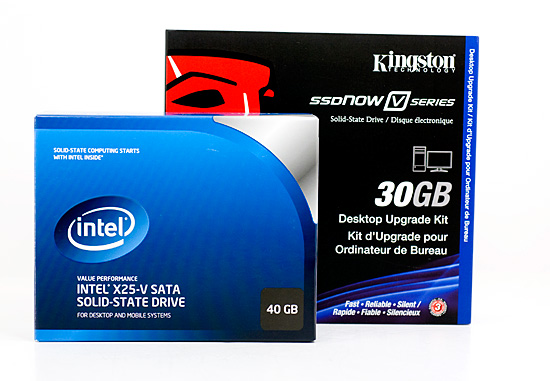
While OCZ and Kingston trade blows below $100 I'd give the overall nod to Kingston's SSDNow V Series Boot Drive. The 30GB drive is limited in capacity but provides very consistent performance, even under completely unrealistic workloads. You don't get great random read/write performance but you do get good overall performance. If you're building a machine for light workloads like web browsing then the Kingston drive should be sufficient. If you're going to be doing a lot of multitasking and have a heavier workload, the OCZ Onyx is a better bet below $100.
I wouldn't be doing my job if I didn't give you the disclaimer about waiting. Intel's X25-V will grow to 80GB in Q4, presumably at the same price point as the 40GB drive today (hooray for 25nm NAND). If you don't want to wait and can spend the money, the 40GB X25-V is a good solution. If you need a cheaper drive go for the Kingston for light use systems (e.g. web browsing netbooks) or the OCZ Onyx if you are running heavier, write intensive workloads. And if you're running an OS without TRIM support, Kingston's drive appears to be the most resilient of the bunch.


 Facebook
 Twitter
 RSS
RSS


49 Comments
View All Comments
fyleow - Thursday, June 3, 2010 - link
Anand,Thanks for using overall performance rather than random read/write to base your conclusions. Your earlier SSD articles slammed the Samsung controller chips pretty hard for the random read/write performance even though their real world performance wasn't too bad.
coolhardware - Thursday, June 3, 2010 - link
Just wanted to say "thank you" for each and every one of the SSD articles posted to AnandTech. Your thorough articles make purchasing a SSDs a much safer proposition :-).sparkuss - Thursday, June 3, 2010 - link
Anand,I have been following the TRIM driver issue with my C300-256 SSD on the Crucial forums. Based on the Test Bed chart can I assume you used only the ICH10R port(s). And which OS driver was used? The MSAHCI or the INTEL IMSM?
Thank You
RU482 - Thursday, June 3, 2010 - link
I understand the significance of the TRIM test that was performed....BUT...how realistic is this test. I'd be interested in seeing how well the TRIM and Garbage Collection functionality of the firmware work if, say, half of the drive endured a similar loading. OR, run the same units idle for 100hrs (yeah, ridiculous, just like the test) and see how much things have recovered.In the grand scheme of things, benchmarks are great for marketing. They do offer some credence in the fact that they offer a side by side comparison of various components under certain lab conditions. But the problem is, they do not often reflect real world usage performance. Or, more importantly, real world tangible differences in performance.
Chloiber - Thursday, June 3, 2010 - link
I can assure you, that these benchmarks to simulate TRIM aren't that far away from reality. On a small drive, you will see such crappy performance after several weeks, depending on your usage. I experienced this on the Indilinxdrives when they didn't have TRIM and better GC. 3 Weeks and my write was down to 35MB/s.Of course it depends, as I said, highly on your usage pattern. If you don't use it (idle, what a test?!?!), it won't affect the performance. Why should it...
TheGame240 - Thursday, June 3, 2010 - link
I'm not proposing anything that extreme, but I would like to see Garbage Collection tested on a TRIM-less OS. Something similar to the TRIM test used now, but ran under Vista/XP or Windows 7 with TRIM commands disabled and the drives left idle over night. OCZ has touted their aggressive Garbage Collection, while Intel just says it's there. It would be nice to have an actual measurement of their effectiveness. Especially in a budget review where these drives would likely be used as upgrades for older Vista desktops or netbooks running XP.rocky12345 - Thursday, June 3, 2010 - link
It was a good review/article but non of those drives are worth what you pay for them. They simply are way to small to be of any good to anyone. Also as a gaming drive 30GB or 40GB really!! Maybe back in 1999 that would float every ones boat but in this day & age 40GB just does not cut it & for the price a 1 or 2TB HDD is well worth the 7 or 8 seconds it takes longer to load a game. I do see SSD being a good thing someday but at this point if you have to give up your left nut to get one that is a good size then it is not worth it at all. Thankstherealnickdanger - Thursday, June 3, 2010 - link
If you haven't used one on your primary computer, then you really don't know what you're talking about. Buy and use one for a week or two (it won't take that long) and then go back to your slow-as-molasses hard drive. You'll feel like you're back in 1989 while you wait and wait and wait for your hard drive to access data.rocky12345 - Friday, June 4, 2010 - link
slow hard drive yea ok. I happen to have 2 sets of raid arrays in my system 4 in each set. first set is Seagate 1TB 7200.12 4 in total second set is Seagate Barracuda® XT 2TB 4 in total. So trust me I am not missing anything as you stated I have more than enough speed & most importantly I have the space my work requires me to have a SSD at this point can not give me the needed space at the same price point. ys the SSD drives are fast they just need to make them bigger & cheaper until then they are a niche product..Nataku - Friday, June 4, 2010 - link
I hate to say this... but you really should try before going off like that... X25 felt way faster than the RAID0 I've encountered over the years