



ASRock X58 Extreme3: An Enthusiast X58 Motherboard at a Budget Price?
by Ian Cutress on June 2, 2010 4:10 PM EST- Posted in
- Motherboards
- Intel
- ASRock
- X58
Basic comparisons in simple tests yield very similar figures for the ASRock board to the EX58-UD3R:
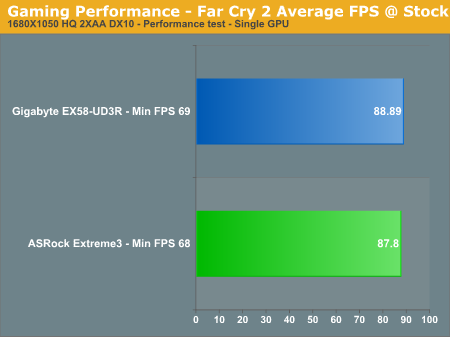
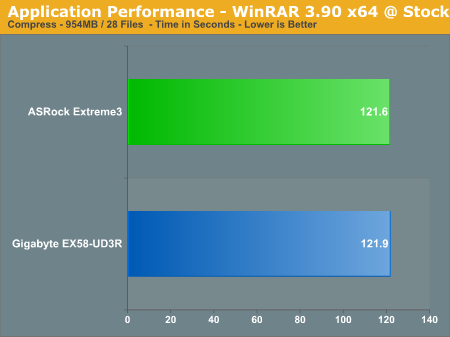
These results translate through our suite in general - the ASRock board performs similarly in 2D benchmarks, but is at a slight loss in all our 3D benchmarks.
Power Consumption
Our power consumption testing utilizes the same batch of components under similar circumstances in a bid to monitor variances between idle and CPU load conditions. We install the vendor supplied power saving utilities on each board (when available) and enable power saving modes that don't involve any kind of underclocking or CPU core frequency modulation in order to run an apples to apples comparison.
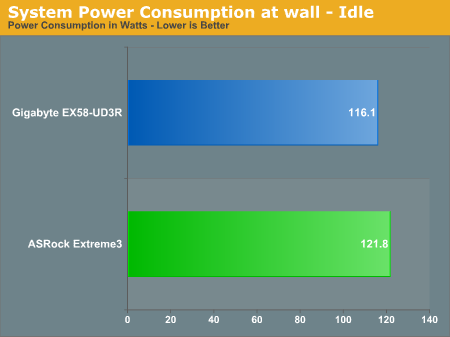
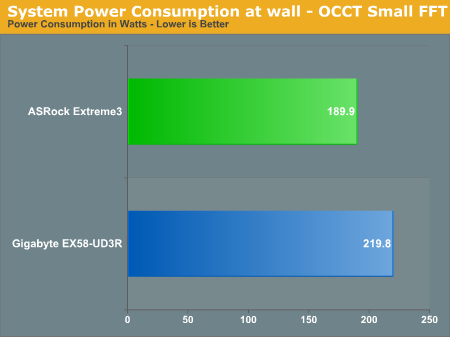
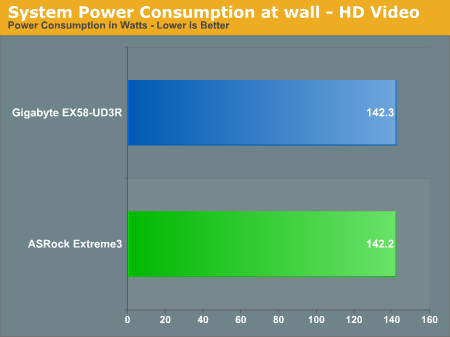
Under idle and normal loads, the ASRock board perfroms similarly to the Gigabyte. The biggest surprise here is the power usage under heavy load, where the ASRock draws approximately 30W less than the Gigabyte board - we’re not entirely sure the reasons behind such a difference are, given the HD Video power usage values are essentially equivalent. Any X58 folders may prefer the ASRock board, if the cost of 30W is extrapolated over the course of a year.
Overclocking
Alongside BIOS tools, ASRock also provides software on the bundled CD, called OC Tuner, to help manage overclocks in the Windows operating system. However, using simply the BIOS, which we prefer, we were able to provide a very decent overclock of 4.1GHz on our Core i7-920 D0:
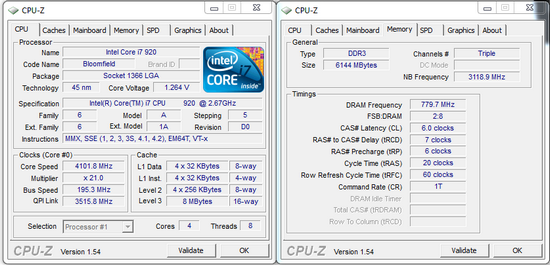
Using the Corsair H50-1 basic water cooling, on a push-pull fan arrangement, a 4.1Ghz clock speed reached a maximum of 80ºC under the Intel Burn Test (ambient 18ºC). The Intel Burn Test is overkill for temperature testing, but on an open test bench does go some way to modelling the overclock when it's in a case in the middle of summer. Under normal multi-threaded load, on the open test bench, temperatures rose to 75ºC. To achieve this setting, VCore was upped to 1.275V, IOH to 1.302V and VTT to 1.34V. With DRAM at 1.654V, all other voltages were switched from Auto to their lowest recommended setting. Left under the Auto setting, even at stock speeds, the VTT defaults to 1.48V and the CPU PLL to 1.92V, both above the lowest setting, which results in a hot-to-touch southbridge.
Overclock stability was tested with HyperPi, 300% MemTest and three hours of LINPACK, as well as the variety of benchmarks used in this review.


 Facebook
 Twitter
 RSS
RSS


35 Comments
View All Comments
Glenn - Wednesday, June 2, 2010 - link
I believe for $15 more I would go with the Gigabyte X58A-UD3R. I like asrock boards and have had good luck in the past using them, but they need to provide more wow at this pricepoint or be substatially less than the proven enthusiast boards.DigitalFreak - Wednesday, June 2, 2010 - link
Yep, it makes no sense. The comparison should have been with the X58A-UD3R, even if it is a few dollars more.You get 4 PCI-E x16 slots (x16+x16, x16+x8+x8, x8, x8, x8, x8), two PCI-E x1 slots and ONE PCI slot. How many people really need more than 1 PCI slot anymore?
bobvodka - Thursday, June 3, 2010 - link
Well, I do for one.. I'm currently using a Creative X-Fi Elite Pro sound card which is PCI. I'm sticking with it because it has an awesome IO console I can sit on my desk so I can swap quickly to headphones and between headphone sets (one set is better for general usage, but when I need to talk to people I've got a headset I use but the sound repro isn't quite as good). So, while it still works I'll stick with it, heck I don't even know if the later PCIe X-Fi cards can even drive the IO Console...On my current X58 motherboard my other PCIe slots are either;
- being used for graphics
- being used for a PCIe wifi card
- being used for a GTS-260 physx card
- blocked
bobvodka - Thursday, June 3, 2010 - link
oh, I totally misread the comment I was replying to... disregard the above, I thought it said 'requires one PCI slot'; sorry.Araemo - Thursday, June 3, 2010 - link
I have to agree. I have only had one ASRock board... it was so extremely picky, with misleading and undocumented BIOS settings that impacted stability and overclocking greatly, and nonexistant support.That said, for the price, it gave me a (after months of fiddling) 95% stable, high performance system for 2 years for a fraction of the price I'd have paid for another board. But it only lasted about those 2 years before it started showing random crashes, lock ups, disappearing DVD drives, and other odd issues.
Araemo - Thursday, June 3, 2010 - link
Also, since when is a $180 motherboard considered a budget price? Damn. I just built my wife a computer with a (now quad-core) AMD processor of decent performance with a very solid ASUS motherboard.. the motherboard cost $70. I can understand paying $100-$150 for a feature-rich overclocking motherboard, but that isn't what I'd call a 'budget' price at all. :PTaft12 - Thursday, June 3, 2010 - link
Spoken like someone who has never looked at X58 motherboard pricing. Core i7 is for a different market than your wife.Pessimism - Thursday, June 3, 2010 - link
What the original poster is trying to say is that intel should immediately drop the core2, i3, and i5 lines, cut the pricing of the i7 line to sub-$100, cut x58 board pricing to $75 and advance computing as a whole while wiping AMD off the map.Araemo - Saturday, June 5, 2010 - link
I've looked at it - but the performance difference isn't worth the extra $400 you have to spend on an X58 based system Vs. and AMD or Core 2 Duo system.Affectionate-Bed-980 - Sunday, June 6, 2010 - link
Wrong comparison. X58-UDR3 is just outdated. I don't care about price. It's like comparing this year's car against last year's competitor. Okay? But that's not a direct comparison when talking new cars.... sigh.