



Intel’s Core i5-655K & Core i7-875K: Overclocked and Analyzed
by Rajinder Gill on May 28, 2010 5:00 AM ESTHere's the idle/full load power consumption figures at stock speeds. VCC and VTT only, with VRM switching efficiency factored out:
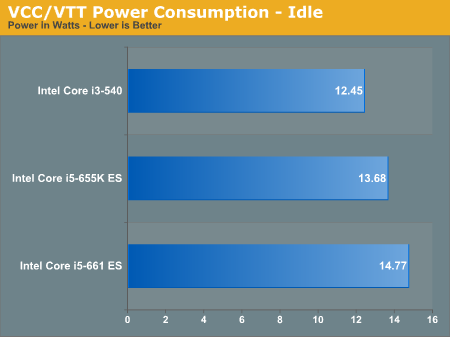
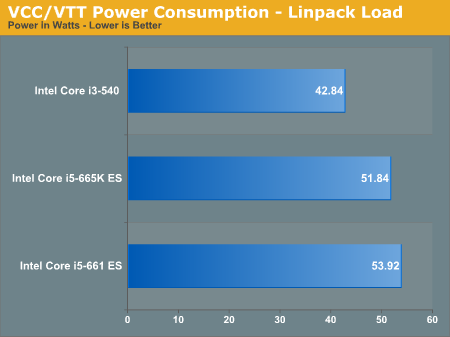
Now that we've got these figures as a reference point. We can start looking at how each processor reacts to over-frequency conditions and how this affects factors such as heat and stability.
The following graph shows processor power scaling versus frequency, using Linpack to load the cores – highlighting the maximum Stock VID overclock and the maximum overall overclock using the Intel heatsink:
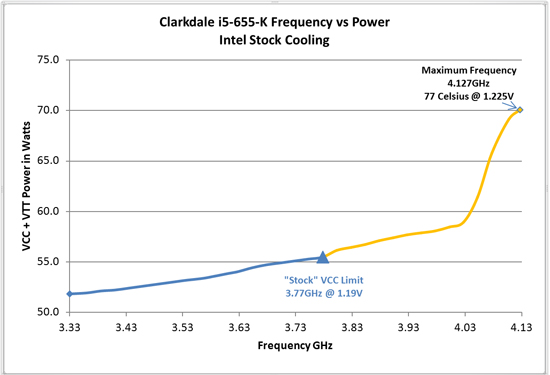
Using the BCLK method of overclocking (increasing the frequency of every associated bus), the power consumption ramp between 3.33GHz and 3.77 GHz is a mere 4 Watts at stock VID on our i5-655K – that’s why overclocking at stock voltages is wise if you’re working within the confines of stock cooling or concerned for processor longevity. In fact, only a small change in voltage is required to reach the 4GHz mark, coming in at a very sensible 7 Watt rise over stock power draw.
Over 4GHz, we see a sharp hike in power draw for every 20MHz increase in frequency, and by the time we get to 4.127GHz we’re tapped out on the stock Intel cooler. Increasing voltage at this point does not help, and we start seeing uncorrectable errors during Linpack. At this point, we need better cooling to extend our overclocking headroom. Before we experiment with improved cooling though, its worth taking a look at how things compare to a retail i3-540 using Intel’s stock heatsink.


 Facebook
 Twitter
 RSS
RSS


51 Comments
View All Comments
wavetrex - Friday, May 28, 2010 - link
In the table it sais $284 for the 980X, that MUST be a mistake!mianmian - Friday, May 28, 2010 - link
In a previous Anandtech aritical, it was $999, maybe it is $824 nowTexpat - Friday, May 28, 2010 - link
I think the price for the 980x might be wrong. $1,000 would be closer tot he truth.ltcommanderdata - Friday, May 28, 2010 - link
I'm really pleasantly surprised that the 2.93GHz Core i7 875K at $342 is cheaper yet has more features than the 2.93GHz Core i7 870 at $562. Although I'm guessing that's only temporary as the upcoming 3.06GHz Core i7 880 will probably take over the $562 price point, with the Core i7 870 dropping down to $284 and the Core i7 860 being phased out. There's also a Core i5 760 to replace the Core i5 750.DrMrLordX - Friday, May 28, 2010 - link
You guys really busted out the big guns with the dual-stage cascade! Please do this more often when overclocking. I would love to see a C3 Propus at -100C (or a Thuban).jleach1 - Friday, May 28, 2010 - link
On the second page, i believe in the 'test rig' table the proc is listed as a i5-870 instead of the i7-870Rajinder Gill - Friday, May 28, 2010 - link
Thanks - fixed!GeorgeH - Friday, May 28, 2010 - link
"it’s full of talk about voltages and harps on about overclocking"No need to be shy about that - Anandtech is bookmarked because of awesome articles and analyses like this one.
FlanK3r - Friday, May 28, 2010 - link
not bad, my x6 1090T is full stable 4300MHz 2800MHz NB with aircooling ,-)...for games and benchmarks 4400-4450 MHz :)AstroGuardian - Friday, May 28, 2010 - link
Guys, i think you should not hurry to release articles instead of taking them slow and sure. Many typos especially in the graphs.i3-530 vs i5-540