



OCZ’s Vertex Limited Edition Review & SSD State of the Union
by Anand Lal Shimpi on February 19, 2010 12:00 AM EST- Posted in
- Storage
Samsung Finally Gets TRIM
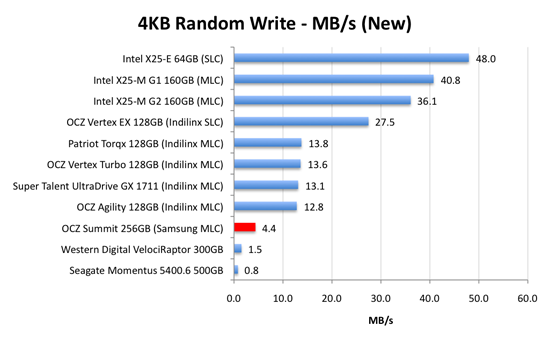
I haven’t been kind to SSDs based on Samsung’s RBB controller such as Corsair’s P256 or the OCZ Summit.
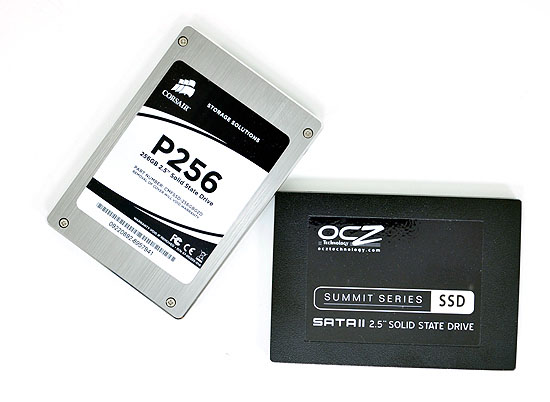
Despite great read and sequential read/write performance, those two drives never did very well in our 4KB random write tests:
The situation gets even worse with the SSDs in a “used” state:
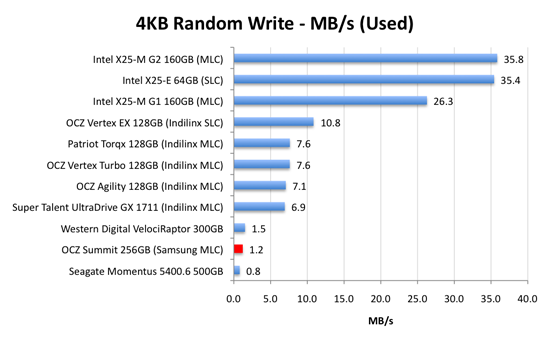
It’s unfortunate because otherwise the drives wouldn’t be that bad. Not to mention that being backed by Samsung is often preferable compared to other storage newcomers. These Samsung based drives have at least been validated by thousands of systems as they are the ones used in OEM machines including systems from Apple, Dell and Lenovo.
Earlier this year Samsung finally delivered a user upgradable firmware to all of its SSD vendors. It’s a destructive update, meaning you lose all of your data (just like the old Indilinx fw updates) but it’s worth it - you get TRIM support.
The update worked perfectly on my X58 testbed:
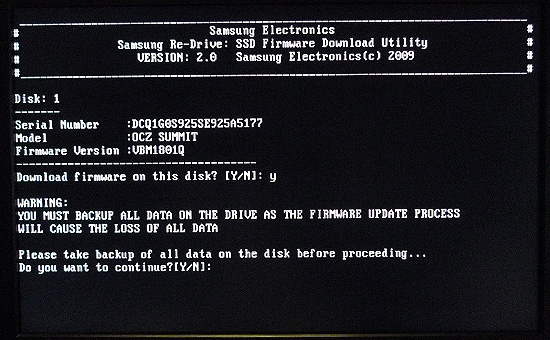
Remember that TRIM currently only works under Windows 7 (XP, Vista and OS X aren’t supported) and only with Microsoft’s AHCI driver. Deleting files or formatting your drive will TRIM its contents, so to test Samsung’s TRIM functionality I randomly wrote data to the drive and formatted it. TRIM worked as expected and all is finally well in the world. You can get the new TRIM firmware from Corsair here or OCZ here.
Score one for Samsung. I’ll gladly take these drives off of the do-not-buy list. Safe travels!


 Facebook
 Twitter
 RSS
RSS


83 Comments
View All Comments
mertl - Thursday, March 18, 2010 - link
The Sandforce Controller has hardware AES encryption, which could be used with OCZ Toolbox (which is not available).It's a self encrypting drive. No CPU Performance wasted with software encryption.
Why doesn't the Vertex LE support FDE (TCG OPAL Standard like a Seagate Momentus 7200 FDE.4)? The BIOS ATA PWD is passed to the drive, alternatively Pre-Boot Utilities like wave can be used.
jaggerwild - Saturday, March 13, 2010 - link
It's kinda sad that they will not at least replace the drive with an equal value SSD, I suggest to anybody considering buying any OCZ product to read through there forum before making a purchase!!! People are reporting waiting seven months for warranties on the Vertex series? Today more than ever people are not getting what they paid for and to even post a review of there product is a slap in our collective faces. But I guess Aandtech is selling out too as they have there advertisement up top of this section LOL!NandFlashGuy - Friday, March 12, 2010 - link
Hi Anand,I think your characterization of all IMFT flash as equivalent creates a false idea of quailty equilvalence for readers.
"It’s uses a standard Indilinx Barefoot controller but is paired with IMFT 34nm flash branded either as Intel or Micron. It’s the same flash that’s used in the X25-M G2s."
Intel does not sell enterprise-grade or SSD Nand to competitors. It does do more testing on the Nand used inside the X-25M G2s, ensuring it meets a higher quality level.
While nothing prevents SSD competitors from buying USB-key grade Nand and using it their SSDs, it's incorrect to call it the same Nand that Intel uses.
ayembee - Sunday, March 7, 2010 - link
Well, my 200GB LE lasted one week -- picked it up last Sunday, and now it's so dead the BIOS can no longer even find it. That's one seriously expensive paperweight...deBlanc - Friday, March 5, 2010 - link
Has anyone tried a Raid 1 (mirror) with an SSD and an HDD? I have a customer with a Dell R410 server which has very limited expansion capabilites, only one expansion slot which has a 4 port NIC in it. They are starting to run into disk I/O issues. Short of buying a new server, I was thinking of Raiding a 500 GB OCZ Colossus with a 500 GB Seagate 7200.12, the idea being much faster reads with failover to the HDD if the SSD bricks. I can't afford to buy the SSD to test this out. What do you experts say?Thanks
db
SeanFowler - Friday, February 26, 2010 - link
Overclockers UK has confirmed with Crucial that the 128GB version of the drive has a far slower write speed. They've been told that the write speed is up to 140MB/s.The details are on page 1 here: http://download.micron.com/pdf/datasheets/realssd/...">http://download.micron.com/pdf/datasheets/realssd/...
Compare this to 235MB/s sustained write on the LE, and 250MB/s max write, and there's no competition.
Yes the C300 still has amazing read speeds, but I think the LE is the better all-round performer.
Unless we find out that the numbers we've been seeing on the net for the LE are for the 256GB version and have been erroneously attributed to the 128GB version as well.
I had the LE on order, then cancelled it to order the C300, then found out that the 128GB drive has mediocre write speeds. Talk about a mess!
Beno - Thursday, February 25, 2010 - link
in Final Words, first paragraph, fifth line.Crucla
bizautomation - Wednesday, February 24, 2010 - link
I contacted the folks at SandForce for a comment on the un-ceremonious death of the OCZ test drive. Below is my question to them, and their response:My email to SandForce:
Dear SandForce,
This is more for the blog community, than it is for me personally (although I am considering Enterprise SSDs for our database servers). I don't think it warrants your phone time. If you can simply prepare a statement in reaction to the test drive going bellly up at Anantech's test center, which I can post, I think that would be more than enough.
Here's the main concern out there:
1. CTO's like me are seriously looking at these drives to consider putting their databases on (SaaS based applications can benefit from the performance improvements).
2. We are deathly afraid of the reliability issues, so when initial articles about SandForce controllers came out with the emphasis on reliability, everyone was cautiosly elated.
3. We see a follow-up story on Anantech (arguably THE source of impartial news on hardware), show that the OCZ drive just "died", and I think it's safe to say, there's significant concern.
Yes, everyone knows it was a pre-production drive (Anantech makes that clear), but the cat is now out of the bag, and without a proper forensic investigation, I'm concerned this would happen witth a production drive. Hence my reaching out to
your firm for an explenation beyond "Oh don't worry guys, that was pre-production hardware". As you know, our community is comprised of smart people, and that type of answer just doesn't cut it.
What say you ?
Their answer to me:
Dear Carl,
We appreciate the inquiry and definitely appreciate your concern. It was appropriate that Anandtech highlight the drive that failed was a pre-production drive. The drive used Beta firmware, which by definition, had known issues.
Since then, SandForce has released its ‘release candidate’ firmware to our customer base of SSD vendors with the intent for them to run their qualification process on the drives and intensive tests for stability. We have received positive feedback so far. We’ll take any issues that we hear of (and any that we find ourselves) and release a ‘mass production’ version of firmware with the intent for end user customer shipments and usage. We’re confident that with the large number of leading SSD vendors in both Enterprise and Client markets that are qualifying drives based on our silicon and FW, in addition to our own robust testing capabilities, production drives based on SandForce will be of the highest reliability.
anuraaga - Wednesday, February 24, 2010 - link
Looking at a Japanese retailer's listing for the RealSSD drives at http://bit.ly/clxvoa">http://bit.ly/clxvoa, the write speeds of the 128GB and 256GB versions differ by around 50%!Random 4K Write:
128GB - 140 MB/s, 30K IOPS
256GB - 215 MB/s, 45K IOPS
Out of curiosity, which version was tested in this article? The numbers are close to the listed 128GB specs, so that's what I'm guessing. What could result in such a big difference in write performance in this as well as other drives(DRAM size?)? Or is this just some retailer manipulating the numbers to sell a more expensive part (work in research long enough and you get to know the amazing things possible through the use of normalization)...
eldiablopotato - Tuesday, February 23, 2010 - link
Don't suppose C300 vs. Vertex LE review is around the corner?