



Adobe Photoshop CS4 Performance
To measure performance under Photoshop CS4 we turn to the Retouch Artists’ Speed Test. The test does basic photo editing; there are a couple of color space conversions, many layer creations, color curve adjustment, image and canvas size adjustment, unsharp mask, and finally a gaussian blur performed on the entire image.
The whole process is timed and thanks to the use of Intel's X25-M SSD as our test bed hard drive, performance is far more predictable than back when we used to test on mechanical disks.
Time is reported in seconds and the lower numbers mean better performance. The test is multithreaded and can hit all four cores in a quad-core machine.
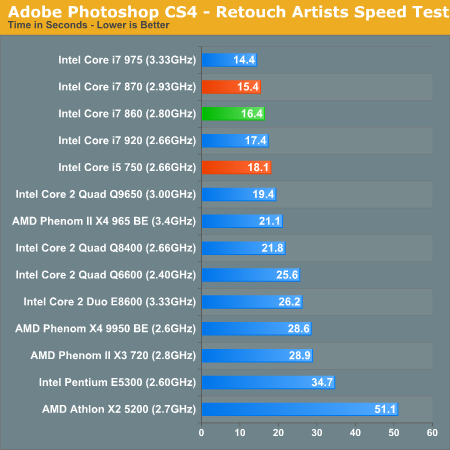
While the Core i5 750 couldn't beat the i7 920, the 860 can. Thanks to Hyper Threading and a higher base clock speed, Lynnfield proves to be an able performer.


 Facebook
 Twitter
 RSS
RSS


121 Comments
View All Comments
papapapapapapapababy - Monday, September 21, 2009 - link
THE stupid upgrading path.NO SATA 6 GB /s...
NO USB 3.0...
NO PCI Express 3.0...
NO THANKS. NEXT.
haplo602 - Monday, September 21, 2009 - link
Where are Athlon II X4s in the graphs ? Where's Phenom II X2 BE ?Where is a 785G mobo roundup ? I am still hearing only i5/i7/P55. This is frustrating. You are not keeping up with your name. Drop the Intel hype and do something for the normal people that try to build computers on a budget.
sicofante - Monday, September 21, 2009 - link
Sorry if this has been asked or commented before (I haven't read the full 11 pages).I build workstations for the animation and video industry and I factory-overclock them. Bloomfield has been very well received by my customers and I'm really happy with it. Now I'm studying Lynnfield and from what I've read, I don't feel quite comfortable with how Lynnfield is overclocked. Here are my two main issues:
1. Anand mentioned in past articles that overclocking Lynnfield would imply overclocking the PCIe bus, since the controller is integrated. How does this affect graphics and other cards? I'm not talking only about gaming cards but also Quadros or RAID controller cards.
2. Also, it seems Lynnfield OC needs voltage tweaking. This sounds not as nice as Bloomfield stock voltage overclocking, but what are the real consequences and drawbacks (if any) of voltage rising?
Thanks in advance for answering these two issues and thanks to the Anandtech's staff for such in depth articles.
ggathagan - Tuesday, September 22, 2009 - link
This seems to get lost frequently, but Lynnfield is all about the mid-tier market.Going down the Lynnfield road for the workstations you describe would be a BAAAAD idea.
Your industry is also one of the few that, in most reviewers opinions, has benefited from the triple-channel memory capabilities of the X58 platform.
7Enigma - Monday, September 21, 2009 - link
It's been going on for a while now but the price increase for minimal performance increase is getting pretty silly. Back during the <1000MHz days a 100MHz bump was nothing to sneeze at, and even during the 1-2GHz days a 100-200MHz bump wasn't that bad. But honestly they (both AMD and INTEL) have gotten rediculous with their gouging of the higher end. Honestly ~130MHz difference between the 870 and the 860?!?Their only saving grace (for stock clockers, or very moderate OC'ers) is the higher turbo levels of the 870, but again in most situations (that is those that do not task 3-4 cores simultaneously) the clock difference between the 860 and 870 is <150MHz, which on a ~3.5GHz core is virtually nil.
strikeback03 - Monday, September 21, 2009 - link
They have used pricing like this in the past, just that there were usually several options in the more sane ($300 and less) range before the final few clock bumps were disproportionately expensive.7Enigma - Monday, September 21, 2009 - link
But in the past the performance jump was greater. We're talking a (theoretical) 4% difference between the 870 and 860!strikeback03 - Monday, September 21, 2009 - link
When I bought my current E6600 it was a little over $300. The E6700 was over $500 for a 266MHz bump, so technically 10% but still nothing to write home about for the money. If the 870 were unlocked that price might be justified, as of now I agree with you that it is not so much.Proteusza - Monday, September 21, 2009 - link
Athlon X4: 300m transistors, no L3 cache, performs about 90% as fast as a Phenom X4Phenom X4: 758m transistors, 8mb L3 cache (or is it 6?)
Does anyone think AMD isnt getting their money's worth out of the 458 million transistors used on the Phenom II to provide the L3 cache? I mean, more than double the manufacturing complexity for a small increase in performance?
mapesdhs - Sunday, September 20, 2009 - link
Anand, the review shows overclocking results for the i7 860 with the
retail cooler, but I doubt anyone who intends to oc these CPUs will
stick with the retail cooler.
There is much comment on how the 920 compares to the 860. If I understand
correctly from earlier articles, the 920 should have an advantage
vs. the 860 if both are hard oc'd (ie. Turbo off) to aid in those
situations where the user is definitely going to be used all 4 cores,
in my case video encoding.
Thus, what I'd really like to know is, how does the 920 compare
to the 860 when both are oc'd using a _good_ air cooler such as the
Thermalright U120E or Cogage TRUE Spirit? And is there any real
difference in the maximum achievable overclocks when each chip if
oc'd using a good cooler? (only referring to air cooling here)
Thus, two questions, both aimed at tasks which do use all 4 cores
(video encoding, rendering, etc.):
1. If the 860 and 920 are oc'd to the same clock, presumably with
Turbo off being the most sensible setting, which is faster? How
does power consumption differ? (wrt to total power used for a given
task)
2. How high can each chip be oc'd using a good cooler? Does the 920
have a usefully higher limit? What difference does it make to the
test results?
I've still not found a site which has done this comparison. For me,
the comparison data of 860 vs. 920 at stock speeds with Turbo active
is interesting, but not useful.
And of course it would be most intriguing to see how the other
CPUs fit into this scenario when oc'd using a good cooler, ie. the
750, 975 and the various AMDs. Given the very low cost of the entry
AMD quad-core, maybe that would be a more productive platform?
My original train of thought before Lynnfield came out was that an
oc'd 920 for video encoding was worth the extra cost because it
would complete a task much sooner and thus overall use less power.
The results compared to the best AMD CPUs at the time bore this out
nicely. But with the 860 added to the mix, I can't work out whether
the 920 would attain a better oc than the 860 with a good cooler,
and/or be faster anyway when oc'd & Turbo off, and thus be a better
choice. Charts show the 860 often doing better, but that's at stock
speed. Other charts with oc'd results set the CPUs at the same speed
using the retail cooler, whereas I'd be trying to push the 920 as
high as I could within reason using a good cooler.
So, would it be possible please for you to compare the various CPUs
when overclocked to their best sensible extent using a good cooler,
not the supplied retail cooler?
For example, elsewhere I read of people attaining 4.2GHz for the 920
with little difficulty.
Ian.