



The Athlon II X2 & Phenom II X2: 45nm Dual-Core from AMD
by Anand Lal Shimpi on June 2, 2009 12:00 AM EST- Posted in
- CPUs
Fallout 3 Game Performance
Bethesda’s latest game uses an updated version of the Gamebryo engine (Oblivion). This benchmark takes place immediately outside Vault 101. The character walks away from the vault through the Springvale ruins. The benchmark is measured manually using FRAPS.
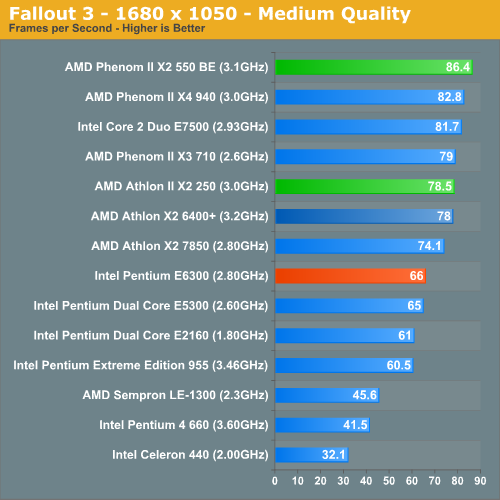
Gaming performance clearly goes to the Athlon II X2 and the Phenom II X2. Because of its high clock speed and very high core-to-cache ratio, the Phenom II X2 550 is actually faster than the Phenom II X4 940 in this test. Note that Fallout 3 isn't particularly heavily threaded so the X4's additional cores don't do much good here.
Left 4 Dead
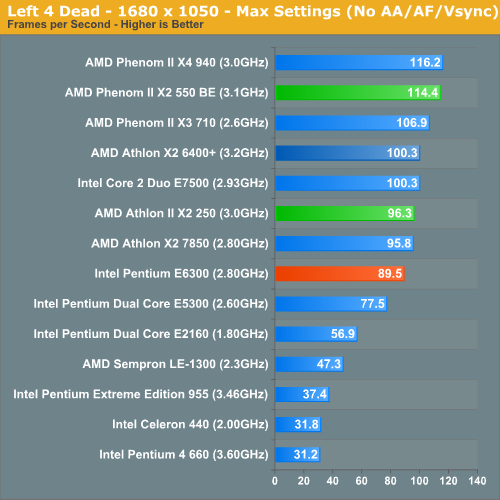
AMD continues to hold on to the gaming performance lead.
FarCry 2 Multithreaded Game Performance
FarCry 2 ships with the most impressive benchmark tool we’ve ever seen in a PC game. Part of this is due to the fact that Ubisoft actually tapped a number of hardware sites (AnandTech included) from around the world to aid in the planning for the benchmark.
For our purposes we ran the CPU benchmark included in the latest patch:
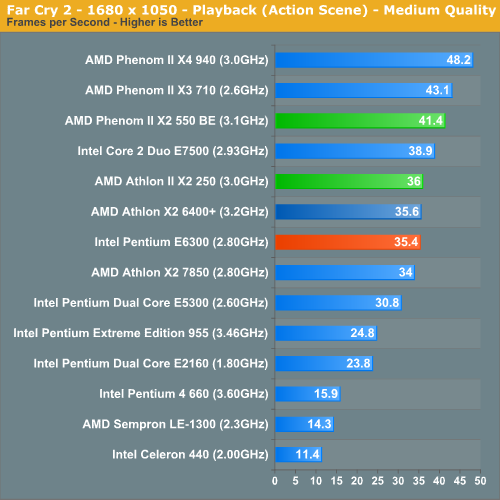
In the newer game engines we see the E6300 catching up to the Athlon II X2 250. The old Pentium 4 660 starves our testbed's GeForce GTX 280 for data; it's horrendously slow.
Crysis Warhead


 Facebook
 Twitter
 RSS
RSS


55 Comments
View All Comments
7Enigma - Thursday, June 4, 2009 - link
Hello Anand,In the article you seem to imply a tremendous difference in that 2meg to 3meg jump but your single data point doesn't show that conclusion.
In your example there is a ~9% increase in performance when going from 2 to 3 megs, but there is also a 4.5% increase in clockspeed between the 2 chips. So at best (in this example) you have a 5% difference, which while significant, I would't say it was tremendous.
Can you comment on whether you did any further tests with identical frequencies?
FlameDeer - Thursday, June 4, 2009 - link
Here are some corrections of AnandTech Bench.Refer to here:
http://www.anandtech.com/bench/default.aspx?b=25&a...">Adobe Photoshop CS4 results of few CPUs from AnandTech Bench
1. AMD Athlon II X2 250 results missing a dot, becoming slower than Intel Atom 230.
2. Better using "Intel Pentium Dual Core E5300" for E5300 as the name Intel printed on the CPU.
3. AMD Athlon LE-1620 notes (platform side notes) should be same as AMD Athlon LE-1640.
Thanks for adding more CPUs for comparison in AnandTech Bench, doing the full test in latest software is really time consuming especially for old CPUs. Take care.
MadAd - Wednesday, June 3, 2009 - link
would have liked to see phenom (non II) compared, especially the low end x3s, users may be thinking of upgrading from those about nowFlameDeer - Thursday, June 4, 2009 - link
You can always conveniently & interactively comparing them here.http://www.anandtech.com/bench/">AnandTech Bench
Elementalism - Wednesday, June 3, 2009 - link
I never had much luck running Cool n Quiet when I used to run AMD processors. Even in games the CPU was put into a low clock mode running at half speed. Sounds like a buggy implementation to this day.And I cant say in my experience it was the Mother Boards fault either. I enabled Cool and Quiet in the bios and nothing happened. It wasnt until I installed the Cool n Quiet driver all hell broke loose.
mino - Wednesday, June 3, 2009 - link
However one has to keep in mind the bug comes from Redmond.The Win 5.x scheduler is a piece of garbage and it allways was. It is just that it shows with different symptoms:
1 CPU core => crappy multi-tasking on heavy loads
2+ CPU cores => unable to get a grasp that power management not a thing of the future ...
A no, being from 2000 is no excuse, proper OS scheduler were there 30yrs ago.
Had MS decided to do so, their Win 5.x schedules would be a proper one from the start.
As for AMD, it is a price one pays for being ahead of the market.
Remember, it took Intel 5yrs (2003-2008) to get comparable power management capabilities as AMD with Nehalem.
mino - Wednesday, June 3, 2009 - link
sorry for the spelling mess..Hrel - Wednesday, June 3, 2009 - link
YAY 3D max, also that E7500 is beating the crap out of everything but AMD's top of the line. That really solitifies in my mind that picking the E8400 6 months ago for my friends gaming computer was the right choice. Stupid AMD, I REALLY want them to be competitive again so Intel is FORCED to stop overcharging for EVERYTHING.mmpalmeira - Wednesday, June 3, 2009 - link
Did you try to overclock the uncore of the AMD's CPUs?calyth - Tuesday, June 2, 2009 - link
Just like that article that you linked to with the name CnQ bug, I don't believe that a hardware manufacturer creates a bug if the OS scheduler can't seem to do the sensible thing and not bounce threads around. Although various factors in the AMD chips make the problem worse, bouncing threads across different cores on an Intel chip also has a bit of impact, since L1 and the L2 shouldn't be shared across cores on the i7 platform.So please, stop calling it a bug. The bug lies in Windows, not the chips.