



Intel's 32nm Update: The Follow-on to Core i7 and More
by Anand Lal Shimpi on February 11, 2009 12:00 AM EST- Posted in
- CPUs
Tick-Tock: U R Doin it Right
Let’s check the stats; Conroe in July 2006, Penryn in October 2007, Nehalem in November 2008. That’s a tock, tick, and another tock, each about a year apart. Note that the cadence does appear to be slipping a bit, but we’ll see exactly when in 2009 we get Westmere before making any accusations.
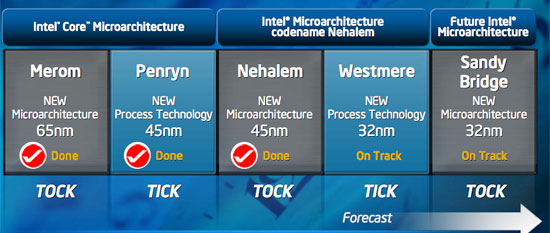
The next tick is, as I just mentioned, Westmere. It’s a 32nm shrink of Nehalem, much like Penryn was a 45nm shrink of Conroe/Merom. And it’s due out in the fourth quarter of this year.
Yesterday, Intel demonstrated working versions of its 32nm processors in both desktops and notebooks. The notebook aspect of the demonstration is very important, which I’ll get to later. Both mobile and desktop versions of Westmere will be shipping from Intel in Q4.
Getting Complicated with Code Names
Nehalem is the overall name for Intel’s 45nm desktop/mobile/server product family. At the high end we have Bloomfield, which is the quad-core, eight-thread, Core i7 processor we all long for. That’s the only Nehalem derivative that’s launched thus far.
| Segment | Manufacturing Process | Socket | Processor | Cores | Threads | Release Date |
| High End Desktop | 45nm | LGA-1366 | Bloomfield | 4 | 8 | Q4 2008 |
| Mainstream Desktop | 45nm | LGA-1156 | Lynnfield | 4 | 8 | 2H 2009 |
| Mobile | 45nm | mPGA-989 | Clarksfield | 4 | 8 | 2H 2009 |
| 4S Server | 45nm | LGA-1567 | Nehalem-EX | 8 | 16 | 2H 2009 |
| 2S Server | 45nm | LGA-1366 | Nehalem-EP | 4 | 8 | 1H 2009 |
| 1S Server | 45nm | LGA-1156 | Lynnfield | 4 | 8 | 2H 2009 |
By the end of this year we’ll see Lynnfield and Clarksfield. These are both quad-core, eight-thread Nehalem processors but at lower TDPs and price points. They will fit into Intel’s unannounced LGA-1156 socket and only support two channels of DDR3 memory (compared to LGA-1366 and 3-channels with Core i7).
On the server side we’ll have Nehalem-EX, an 8-core, 16-thread version. Nehalem EP a 4-core, 8-thread version. And Lynnfield again for the entry level servers.
These are all 45nm parts and all due out by the end of this year.
Note that there’s one name missing: Havendale. Havendale was supposed to be a 2-core Lynnfield + on-chip graphics, perfect for notebooks and low end desktops where quad-core isn’t necessary. Unfortunately, Havendale got delayed until Q4 2009 with systems shipping in Q1 2010. That just happened to coincide with Intel’s 32nm ramp so a very significant decision was made: Havendale got scrapped.


 Facebook
 Twitter
 RSS
RSS


64 Comments
View All Comments
Oyvind - Wednesday, April 15, 2009 - link
7 - 10 post are about the fact that todays sw don't use more than 2 cores in a efficent way. Well 2 - 3 years ago, there was close to none. Did Valve, Epic and others build frameworks for using multi cpu's before the hardware base was in place. The answer is no. Do most big software house today put a big effort in scaling over more cores? The answer is yes. Should Intel/Amd wait until the sw houses catch up? I don't understand it, but the spoken majority seems to answer this with a yes?My question: When the big sw house is done with the mulri cpu frameworks, do you son't belive they then will scale over n numbers of cpu's. Userinput, rendering/gpu stuff, AI x n the deept of today etc. All real lifte arhitechure is paralell, sw is not yet, but hopefully that will change.
----
If lifte is good, and you have insane to much money, you stop developing, you dont need to priortize and you slowly fall back in your pillow. Yes AMD fight uphill, but if they manage to survive, nature has proven that fhigting uneven odds, will give you and middel to long term edge (ok if you survive). Tons of money dont save anything. Not sure they suvive, but if they don't a new company with clever enginers will rise somwhere in the future. Yes we need competition and there always will be.
mattigreenbay - Friday, March 6, 2009 - link
This is the end of AMD. Unless this turns out like P4 (not likely), AMD will have to release their process first or soon after [or better yet, a 16nm ultra-fast processor, and while I'm still dreaming, make it free] and have it perform better (also not likely). Poor AMD. I was going to buy a Phenom II, but Intel seems the way to go, future-wise. AMD will be liquidated, as well as VIA and Intel will go back to selling way overpriced processors that perform less than a i386 [Windows 7 certified].mattigreenbay - Friday, March 6, 2009 - link
But it'll come with a free super fast Intel GPU. (bye bye Nvidia too) :(arbiter378 - Sunday, November 22, 2009 - link
Intel doesn't make fast gpu's. Even when they tried with that agp gpu ati and nvidia killed it. They won't let a new playing into a graphics market with out a fight. Lastly intel has been trying to beat amd for 40 something years, and there still not even close to beating them. Now that amd has acquired amd they have superior graphics patents.LeadSled - Friday, February 20, 2009 - link
What is really amazing, is the shrink proccess timetable. It looks like they will meet the timetable for our first Quantum DOT procersors. It is theorized to occure at the 1.5nm proccess and by the year 2020.KeepSix - Saturday, February 14, 2009 - link
I guess I can't blame them for changing sockets all the time, but I'm not sure if I'll be switching any time soon. My Q6600 hasn't gone past 50% usage yet, even when extreme multi-tasking (editing HD video, etc.)I'd love to build an i7 right now, but I just can't justify it.
Hrel - Thursday, February 12, 2009 - link
On the mainstream quad-core side, it may not make sense to try to upgrade to 32nm quad-core until Sandy Bridge at the end of 2010. If you buy Lynnfield this year, chances are that you won’t feel a need to upgrade until late 2010/2011.So if you buy a quad core 8 thread 3.0 Ghz processor you will "NEED" to upgrade in one year?! What?! It doesn't make sense to upgrade just for the sake of having the latest. Upgrade when your computer can't run the programs you need it to anymore; or when you have the extra money and you'll see at least a 30 percent minimum increase in performance. You should be good for at least 2 years with Lynnfield and probably 4 or 5 years.
QChronoD - Thursday, February 12, 2009 - link
He's saying that the people who have no qualms about throwing down a grand on just the processor are going to want to upgrade to the 32nm next year.However for the rest of us that don't shit gold, picking up a Lynnfield later this year will tide us over until 2011 fairly happily.
AnnonymousCoward - Thursday, February 12, 2009 - link
> However for the rest of us that don't shit gold, picking up a Lynnfield later this year will tide us over until 2011 fairly happily.My C2D@3GHz will hold me over to 2011...
MadBoris - Thursday, February 12, 2009 - link
I watch roadmaps from time to time and I know where AMD has potential.Simplify the damn roadmap, platforms, chipsets, sockets!
Seriously, I need a spread sheet and calculator to keep it all straight.
Glad Anand gave kind of a summary for were and when it makes sense to upgrade but I just don't have the patience to filter through it all to the end I get a working knowledge of it.
One thing AMD has been good at in the past if they continue, is to keep upgrades simple. I don't want a new motherboard and new socket on near every CPU upgrade. I'm not sure if mobo makers love it or hate it, obviously they get new sales but it's kind of nuts.
This alone, knowing I have some future proofing on the mobo, makes CPU upgrades appealing and easy and something I would take advantage of.
As far as the GPU/CPU it's nothing I will need for years to come. We will have to wait until it permeates the market before it gets used by devs, just like multicore. It will at least take consoles implementing it before game devs start utilizing it, and even then it's liable to take a lot of steps back in performance (it's only hype now)...