



Apple's Redesigned MacBook and MacBook Pro: Thoroughly Reviewed
by Anand Lal Shimpi on October 22, 2008 12:00 AM EST- Posted in
- Mac
Two GPUs
While the MacBook relies on the integrated GeForce 9400M, the MacBook Pro includes a discrete GPU as well (NVIDIA calls this a dGPU and the integrated one the mGPU): a GeForce 9600M. The 9600M features 32 SPs up from 16 in the 9400M, giving it more shader power and it's got its own dedicated frame buffer off of a 128-bit memory bus. The dedicated frame buffer is quite possibly the most important but the usefulness here is pretty much limited to games (which are mostly going to be Windows-only) and the high end professional applications that are GPU accelerated.
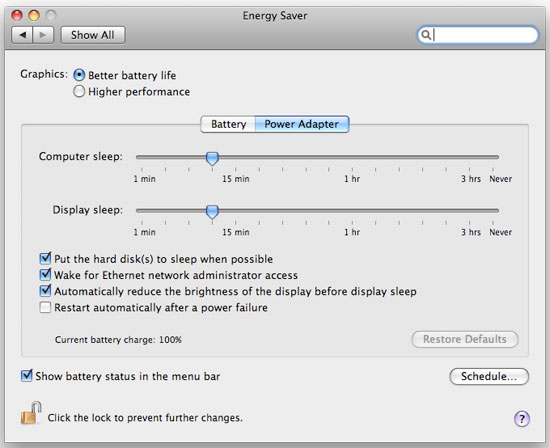
Apple gives you the option of switching between the two GPUs in the Energy Saver preference pane; unfortunately you have to log out and log back in to switch between the dGPU and mGPU. Other PC implementations of Hybrid Power (what NVIDIA calls the ability to turn off the dGPU and rely on just the mGPU) aren't so clumsy and can be done from within Windows, but for whatever reason Apple requires a logout/login.

The mGPU is preferable for battery life as you'll see in the section on battery life shortly.
Pulling an Apple out of a Hat: DisplayPort Standard
Apple has a tendency of doing this thing where it adopts new standards and gets rid of old ones well before their time is up. It's admirable and it allows Apple to pull off some neat tricks, but as Apple is a much larger manufacturer today than it was in the past we're starting to see examples of why companies like Dell don't take a similar approach.
Case in point is the video output on these two notebooks we're looking at today. Apple had a DVI output on its MacBook Pro but the connector itself was a little too big for the form factor changes that Apple wanted to implement. On the MacBook Air Apple used a mini DVI output, but on the new MacBook and MacBook Pro we have a mini DisplayPort connector.
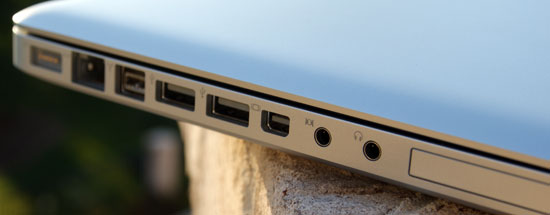
The mini DisplayPort connector is to the left of the mic-input
Unfortunately only Apple uses mini DisplayPort on its recently introduced 24" display; Dell still uses the full sized DisplayPort connector on its monitors - not to mention the many more that use standard DVI or VGA.
Apple's solution is to offer mini-DP to DVI, DVI, or DL-DVI adapters, which is acceptable; unfortunately neither notebook ships with a single adapter. In the long term this will hopefully be a non-issue, but until then be prepared to spend another $30 or $100 (dual-link DVI) to support an external display.


 Facebook
 Twitter
 RSS
RSS


66 Comments
View All Comments
MacMatte - Sunday, June 21, 2009 - link
For those of you who insist that Apple brings back the matte screen option, please leave a comment at http://macmatte.wordpress.com">http://macmatte.wordpress.com - it's a website solely focused on the issue of bringing back the matte screen. See the number of pro-matte comments already at the MacMatte website.drbrady63 - Thursday, June 18, 2009 - link
I am trying to identify if a new macbook pro 13" would be adequate for editing with Final Cut Express, and for that matter, Final Cut Studio. Unfortunately, it has a 5400rpm hard drive and that is not good for editing. But, I wonder if an optional ssd would be fast enough??I would use the 13" for more mobile work and dock it with a larger monitor for more involved editing work.
Any thoughts on this would be appreciated.
Dan Brady
richmoffitt - Sunday, November 9, 2008 - link
This is an uneducated guess, but I'm pretty sure that Quartz works in ways similar to X11, where changing graphics drivers requires a restart of the window manager.You're right though -- this is only a software problem and can hopefully be fixed in the near future (if it's a big enough issue for their user base anyway).
scipi - Monday, October 27, 2008 - link
Hope the quality of the components is better than the first gen MacBook Pro's. Mine is on its second H/D, gone through 2 logic boards and now needs a third, this time outside of warranty. Wont be buying another Apple again which is a pity because OSX is great.Zebo - Saturday, October 25, 2008 - link
Vista is bloated resource hogging junk - You should have tried the OS many of use still use - Windows XP for battery life. I get over 4 hours on my R31 thinkpad with winxp pro.Ronbo13 - Saturday, October 25, 2008 - link
You photos comparing the glossiness and reflection on the screens was not fair, though. Please notice that the laptop on the right (the new MBP) is reflecting a portion of wall that has direct sunlight shining on it, and the laptop on the left is reflecting stuff that's in shadows. So even if the screens were equally reflective, the one on the right would show tons more reflections.Come on, people. Normally you guys pay more attention to details. That's just sloppy.
ioannis - Saturday, October 25, 2008 - link
nop, you are wrong. Both of them reflect stuff that have direct sunlight. Notice Anand's reflection for instance, or the wall on the left hand side of the old MB and the wall on the right hand side on the new one.I'm referring to this:
http://images.anandtech.com/reviews/mac/MacBookPro...">http://images.anandtech.com/reviews/mac/MacBookPro...
Enrox - Saturday, October 25, 2008 - link
Anand, why don't you test Vista installing it on the new MacBook Pro without using Bootcamp, you need to wipe out the drive and create a MBR partition and use Vista x64 SP1 (it supporta EFI), the only thing you need to know is that at startup you have to press the Alt key and manually select the Windows disk in order to boot from it, beside that everything else seems to work just fine with the Vista native installation (tested on a white MacBook Penryn 2.4 GHz 4GB ram).It would be very interesting to see if you get the same exact battery life numbers bypassing Bootcamp.
JonnyDough - Friday, October 24, 2008 - link
Until Apple stops being so shady, I won't have anything to do with them.aos007 - Friday, October 24, 2008 - link
I have brand new Vaio Z laptop and I can get 5 hours battery life IF I disable Vista sidebar. It does not matter whether there's no widgets running, it seems to use 10-15% of CPU time no matter what. This translates into a big loss of runtime - I'd get 3.5 hours versus 5. Unfortunately, I like Sidebar as there are some useful widgets, as well as for eye candy so I feel Vista is crippled without it.So the question is whether you disabled Sidebar during Vista testing? I am guessing not since it runs by default and if so, that may be part of your answer.