



Intel Core 2 Extreme QX6850 and Massive Price Cuts
by Anand Lal Shimpi on July 16, 2007 3:04 AM EST- Posted in
- CPUs
Extremely, Mobile?
As a brief sidenote, Intel is announcing its first mobile Extreme Edition processor today - the Core 2 Extreme Mobile Processor X7800. The X7800 is based on Intel's Merom core (mobile version of the desktop Core 2 Duo), and runs at 2.60GHz on an 800MHz FSB. The chip features the same 4MB shared L2 cache as other high end mobile Core 2 processors, and like all desktop Extreme Edition CPUs, the X7800 is unlocked for more flexible overclocking.
Intel has been championing this trend of everything becoming more mobile for years now and is hoping to capitalize on users who want to configure high end gaming notebooks.
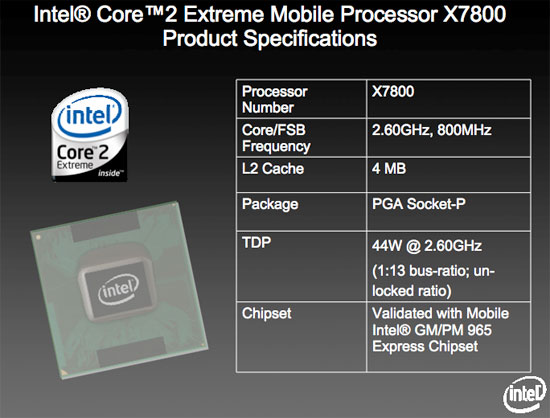
The first notebooks with the mobile Core 2 Extreme will start shipping in about two weeks. ASUS and HP will be among the first OEMs with systems available. You can expect the "Extreme" badge to carry a hefty pricetag as it does on the desktop, have fun lugging that burden around from one LAN party to the next.


 Facebook
 Twitter
 RSS
RSS


68 Comments
View All Comments
mbf - Monday, July 23, 2007 - link
I accidentally posted this in the comment section for the earlier article, but it seems to fit better here. Sadly I cannot delete the other comment...I've been wondering how older motherboards will work with the new FSB1333 processors. Specifically I'm interested how an ASUS P5W DH Deluxe without the latest BIOS would react to having e.g. an E6750 dropped in. ASUS claims support for FSB1333 processors for the P5W DH Deluxe as of 2205 beta.
Would the system boot and run using a pre-2205 BIOS (although not at peak performance), so a BIOS upgrade can be performed? Or would the system fail to boot at all, like when the first Core 2 Duo processors surfaced and needed a BIOS upgrade to run at all on certain boards.
The reason I ask this is that I've my eyes set specifically on that board (I have several reasons, ECC memory support being one of them). I had originally planned on getting an E6600 after the July 22 price cuts, but right now there's nearly no FSB1066 processor to be had locally. Also, I'd of course love to have a access to the latest processors in any case.
number - Wednesday, July 18, 2007 - link
Marvelous article. However, one benchmark is missing. Quad core processor may be used in the following way: two cores are working on a job that utilizes them to the max, while remaining two run a game. How well the processors fare under this scenario?strikeback03 - Wednesday, July 18, 2007 - link
Was the Q6600 compared to the E6850 at stock speed, and not with the boost from setting 1333 FSB? Is it really 10% faster in CS3 than the 3GHz E6850 (and therefore a lot quicker than my E6600)? And would similar improvements carry over to CS2, or did they improve multicore support in the transition from CS2 to CS3?IntelUser2000 - Tuesday, July 17, 2007 - link
Maybe you should also add scores of 1066MHz FSB on the P965 rather than showing 1066FSB on P35 only. Your earlier tests with P35 have shown that there is performance improvement just by moving from P965 to the P35 chipset. Moving to P35 showed greater improvements than changing P35's supporting CPU from 1066FSB to 1333FSB.
Bozo Galora - Monday, July 16, 2007 - link
http://www.tgdaily.com/content/view/31822/135/">http://www.tgdaily.com/content/view/31822/135/Bozo Galora - Monday, July 16, 2007 - link
(no edit button?)http://www.thetechrepository.com/showthread.php?p=...">http://www.thetechrepository.com/showthread.php?p=...
scott967 - Monday, July 16, 2007 - link
Seen various comments to "wait for G0" stepping coming out now or very soon. What stepping was used on this comparo and any comments on this stepping issue?scott s.
.
clairvoyant129 - Monday, July 16, 2007 - link
I love how all these AMD proponents claim that Intel motherboards are too expensive. Then they claim the difference can buy them a much better video card.There are tons of cheap Intel motherboards that are just as good as comparable AMD motherboards.
These fanboys are pathetic. Whats the next excuse?
mamisano - Monday, July 16, 2007 - link
Curious, anyone find these new Intel CPUs in stock, and if so are the prices in line with what has been listed?Bozo Galora - Monday, July 16, 2007 - link
I have to agree this was a superb article. Well thought out and logical in all repects. Answers all buying questions from various angles.Of course, IBM's 300GHz CPU perhaps may make all this irrelevant - heh
http://www.newtechspy.com/articles06/crystalcomput...">http://www.newtechspy.com/articles06/crystalcomput...
While I am at it, the article on 32 bit addressing was also very clear and informative explaining the 4GB "wall", and the 2GB/2GB split. I am sure many on the web will make reference this article in the future.
And the first power supply review was the third in this triad of superior investigation by the AT crew. Those graphs showing the PSU voltage vs wattage load are simply the best insight I've ever seen in a PSU review anywhere. Also interesting was the fact the Silverstone was advertised as a single 12V rail, but was in fact 4 separate.
AT seems to be reinvigorated for some reason - kudu's to you, top notch work.