



ASUS UL80Vt First Look: Mobility Redefined
by Jarred Walton on October 24, 2009 8:00 PM EST- Posted in
- Laptops
ASUS UL80Vt Benchmarked - Battery and LCD
Finally, we have perhaps the most interesting aspect of the UL80Vt. Decent performance and a reasonable size are nice, but there are plenty of laptops to offer those amenities. What truly sets the UL80Vt apart from most other Windows-based laptops is the battery life. ASUS claims "up to 12 hours", and we decided to check their claim.
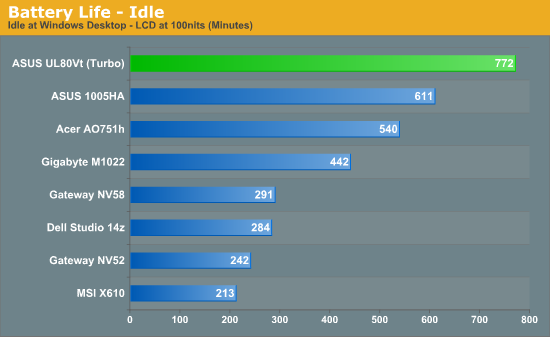
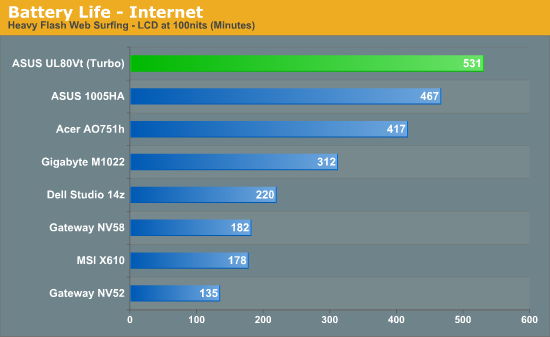
Idle battery life reached nearly 13 hours… and that's what Turbo mode (overclocking) enabled. Granted, the system was sitting idle -- hardly a realistic usage scenario for most users. However, light office use isn't going to be much more taxing than our idle battery life test, and if you decide to disable Turbo mode battery life can only improve. In the far more pertinent Internet battery life, ASUS still achieves record-setting performance. Our initial test (we haven't had time for multiple test runs) came just shy of nine hours of continuous Web surfing. That's with several flash ads on be active website page, which again should be a bit more taxing than what many users view.
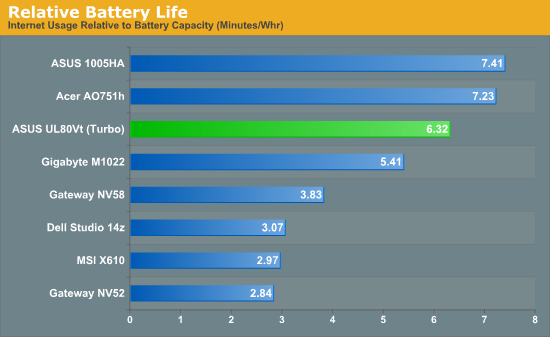
Looking at battery capacity and relative battery life, we finally have a true laptop that can actually trade blows with Apple's MacBook line. We never have been able to determine exactly what Apple does in order to achieve their high battery life, but clearly part of it has to be using lower voltage CPUs. ASUS follow suit by using the Core 2 Duo SU7300, which actually surpasses Apple by going with a 10W TDP CPU. Apple currently uses the 25W TDP SP9300, while some previous models used the 17W Core 2 Duo SL9000 series.
Even overclocked the SU7300 practically sips power in comparison to many other CPUs. We measured average power use of 9.5W for the UL80Vt in our internet test compared to 21.1W for the Gateway NV52 and 15.6W for the Gateway NV58. 10.1" and 11.6" netbooks only get down to 8.0-8.5W in the same test, and performance is obviously substantially higher with Core 2 Duo. What's truly impressive is that laptops like the UL80Vt previously sold for nearly $2000 -- sometimes more. With the boom in netbooks sales, manufacturers have apparently realized there's a real market for smaller laptops that get extremely good battery life.
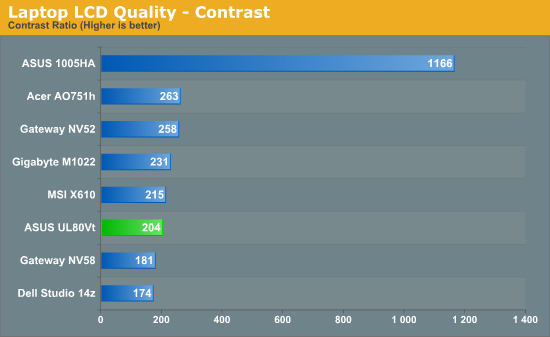
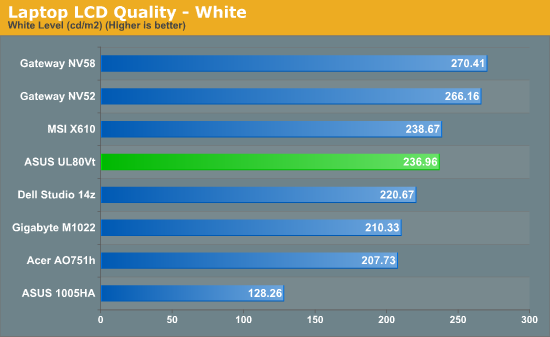
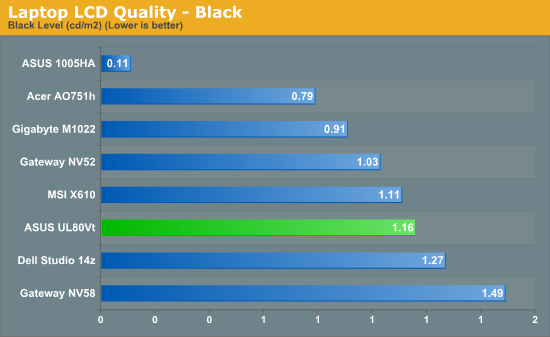
About the only fly in the ointment with the UL80Vt is the LCD panel. Here you can see our contrast ratio test results, and the results are down in the dumps with many other laptops. Sometimes I feel like a lone voice crying in the wilderness telling manufacturers that laptop LCD quality is a serious concern. I know from responses to previous articles that many of you agree, but unfortunately it's something that's difficult to quantify because many reviews don't ever look at LCD quality with quantitative results. ASUS has used very nice LCD panels on lesser offerings (i.e. the Eee 1005HA has an excellent LCD), and we have seen decent displays on other laptops and notebooks as well. If the system cost $25-$50 more but it had a 1000:1 contrast ratio (with an LCD that could still run at 250 nits), I wouldn't hesitate to give the UL80Vt an unequivocal recommendation. As it stands, it's a great laptop but it isn't quite perfect.


 Facebook
 Twitter
 RSS
RSS


100 Comments
View All Comments
HimeNoHogosha - Thursday, January 14, 2010 - link
Has the updated Best Buy model made an appearance yet? Didn't see it on their website..geok1ng - Sunday, December 6, 2009 - link
I am still not convinced that this nottebook from Asus ai better than the Dell Studio 14z: the processor is inferior and no amount of overcloking will make it better than Dell's. The dual VGA/IGP solution is terrible: it uses battery life for a VGA that is minimally better than the 9400M ( and there are softwares that allow overcloking the 9400M to 210 clock levels, but this is also a bad idea from a battery and heat management point. And we have the higher resolution option on the Dell Studio 14z, that can have a 14" 1440x900 LCD.Matiero - Monday, November 30, 2009 - link
For those in this thread whom believe glossy LCD screens are no big deal, consider this:Take a look at image #3 in the Photo Gallery for this computer. Notice how the image of the keyboard is reflected within the glossy screen? Well, when the computer is ON, this reflected image (or whatever background the screen reflects) is ALSO fully in view. In other words, the reflected image is ALWAYS superimposed over the image you're actually trying to view from the computer--creating visual confusion when using the computer.
Glossy finishes on any video/computer screen is just plain dumb and makes no sense whatsoever.
Asus, pay attention--at least change the LCD to a matte finish and win the business. Better yet, offer an option for a high-rez screen for those who care. But glossy finishes on viewing screens is stupidity personified.
- Saturday, November 28, 2009 - link
Wasn't there supposed to be an full review of this coming up?It has already been over a month. By the time it comes out, the laptop will be obsolete.
CheesePoofs - Monday, November 16, 2009 - link
I too would gladely pay a $100-$200 premium for a better screen. If this came with either a 1440x900 or 1600x900 matte screen I'd buy it in a heartbeat. As is I might have to go with the Dell Studio 14z for it's better screen.tasho - Friday, November 13, 2009 - link
So a Best Buy model is coming out, looking seriously at this notebook and would be nice to see it in person- anybody have a clue when this might be available- I'm guessing I shouldn't hold my breath!zxc367 - Friday, November 13, 2009 - link
mine sucks! all the colors are sooo dull.ArchAngel777 - Thursday, November 12, 2009 - link
Is this review ever going to get updated like it was promised? The review, while better than most, still has many things untested. I'd like to see the follow-up before christmas.JarredWalton - Monday, November 16, 2009 - link
Coming....ArchAngel777 - Wednesday, November 18, 2009 - link
Thank you Jarred. I am really looking foward to it. Anxiously...