



AMD vs. Intel: Battery Life Investigated
by Jarred Walton on August 5, 2009 5:00 PM EST- Posted in
- Laptops
AMD vs. Intel: Battery Life Investigated
Both laptops used identical power saving settings under Windows Vista's "Balanced" plan (with some minor tweaks to the defaults on both systems). We ran five different test scenarios, ranging from best-case idle battery life at the Windows desktop to a far more taxing DVD/x264 playback results, along with two different Internet surfing benchmarks. One Internet benchmark represents a "light" load while the other has far more Flash content and represents a "heavy" load. We set both LCDs to 100 nits brightness (40% in this case) and completed a couple charge/discharge cycles to break in the battery before beginning our tests. Here are the results.
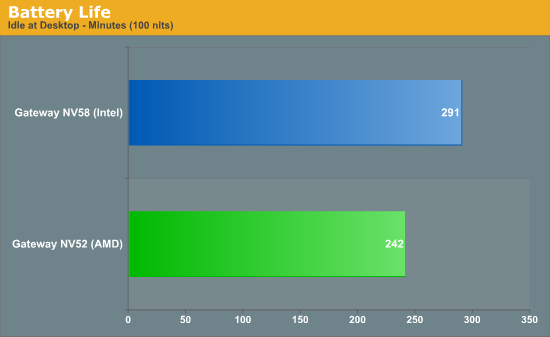
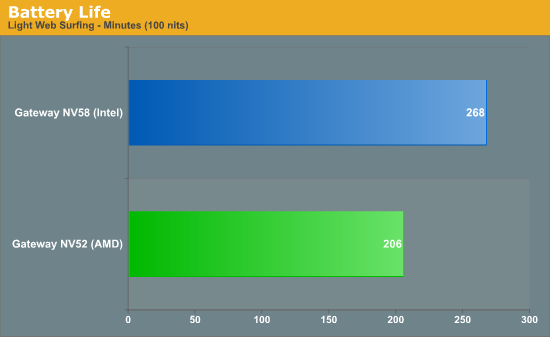
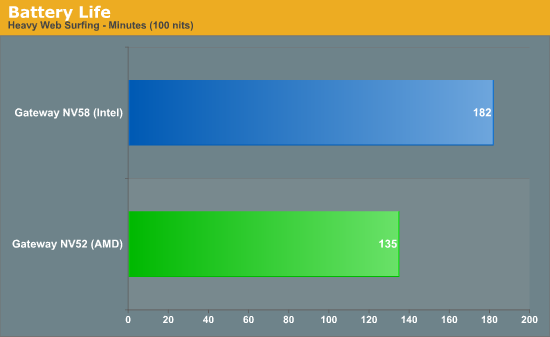
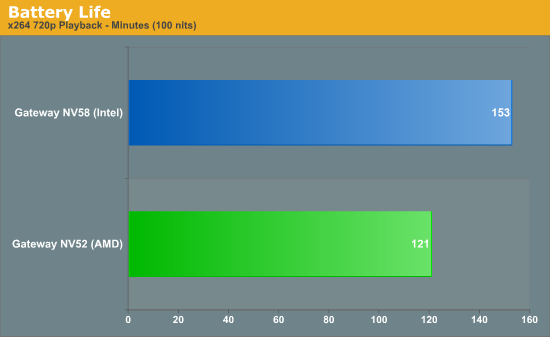
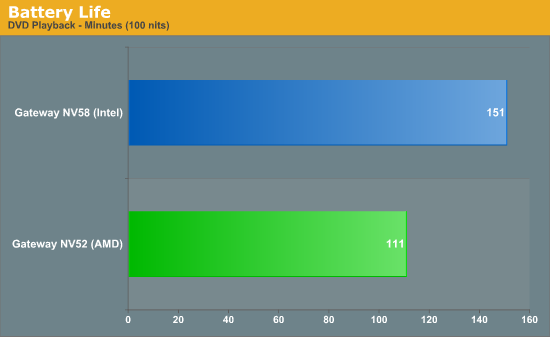
Considering these systems are as close as we can get to "identical", AMD takes a real pounding in battery life testing. The closest result (the idle test) has the Intel platform providing 20% more battery life, while the best Intel results (DVD playback and heavy web surfing) give about 35% more battery life. Averaging all five results, the Intel-based NV58 delivered 28% more battery life than the AMD-based NV52. Ouch.
Obviously, despite having identical clock speeds there are some real differences between the two processors. For one, Intel's T6500 is a 45nm part compared to the 65nm QL-64 (not that AMD has 45nm parts yet). We also don't know how much of an impact the various chipset and motherboard components might have. What we do know is that AMD's current mobile processor lineup consists of dual-core CPUs that range from 2.00GHz up to 2.50GHz, with most having a 31W TDP to 35W TDP rating; the TK-42 is a 20W 1.60GHz part and the QL-62 is a 25W 2.00GHz part. Intel on the other hand has many more options. 10W dual-core CPUs are available with clock speeds of 1.06GHz to 1.60GHz; 17W chips have clock speeds ranging from 1.33GHz to 2.13GHz; 25W processors start at 2.26GHz and end at 2.66GHz; and the 34/35W parts cover the gamut from 1.60GHz all the way up to 3.06GHz… and that's just the Core 2 Duo parts! Pentium Dual-Core, Core 2 Quad, and Core 2 Extreme parts are also available to flesh out the spectrum. Then again, some of those parts cost twice as much as the Gateway NV52 just for the CPU.
When Intel released Banias and the Centrino platform in March 2003, they started a revolution in their approach to mobile processor design. Power and efficiency became the focus rather than pure clock speed, and the result has been much better mobile processors when it comes to performance per Watt. Unfortunately for AMD, they appear stuck with the old way of doing things: build a generic architecture and then optimize it for power requirements on mobile chips. Essentially the same core K8 architecture that launched in 2003 continues to power AMD's mobile offerings, and while the ensuing shrink to 65nm has helped there's still a lot of ground to make up. AMD-based laptops are still more than fast enough for most users -- and let's make this clear, a $500 dual-core AMD laptop is tons faster than anything using Intel Atom (though it uses more power, obviously) -- but Intel has the upper hand. It's unfortunate there's not more competition in the mobile processor space, or we might start really start to see prices drop!
For now, if you're looking for an inexpensive laptop (not a netbook), you need reasonable battery life, and you don't care about graphics performance we suggest saving up the extra $50-$100 for an Intel-based system.


 Facebook
 Twitter
 RSS
RSS


80 Comments
View All Comments
wiak - Friday, August 7, 2009 - link
like the subject says, ati or nvidia graphics are superior to anything intel has, its a fact, just see any benchmark ;)tygrus - Monday, August 10, 2009 - link
Add in a low end nvidia GPU and the price goes up another $150+ and maybe 20% less battery life ?In future articles: consider performance per watt (you said performance will be in the final review); measure power load on battery/mains(minus battery) over time for different tasks/conditions; multiple configs to indicate scailing and normal trends.
Isolate system components: use external LCD to switch off local screen (acroos varying laptops); swap HD; USB DVD drive compared to internal; swap RAM and change speed (very minor); swap mini-card wireless if possible... Hours of fun for the whole familly ... Who's paying you ask ? .. Don't look at me :)
alexruiz - Tuesday, August 11, 2009 - link
Interesting article. I personally am at a loss regarding battery life in laptops. Let me tell you my experience:I bought an emachines M6805 in Jan 2004. As you remember, this machine was the darling of power laptop users in a budget (~$1600) The machine had a mobile Athlon 64 3000+ clawhammer (130 nm) rated at 65 W and 11W in idle. It had a discrete mobility radeon 9600 and a desktop chipset VIA K8T800. Intel had not a CPU that could compete in raw performance with the mobile clawhammer as it only had the mobile P4 or the P-M banias at the time of the mobile Athlon 64 launch, both of which the clawhammer handled easy. It wasn't until the P-M Dothan than Intel matched the mobile clawhammer in performance while achieving lower power consumption.
Back into power consumption, the M6805 could go 2:30 - 2:45 hrs running under battery. Some guys even managed to reach 3:10 hr. You would think to achieve that battery life with that kind of horsepower and hungry parts would reuire an immense battery, remember, the K8T800 was a desktop chipset and the mobility radeon 9600 was a discrete powerful videocard, plus the mobile Athlon wa srated at 65W!
Well, the battery was only 6 cells rated at 4400mAH.... not big at all. I managed 3:05 hrs after switching form xP to win2K as the powernow worked more efficiently. When I replaced the hard drive for a travelstar 7K60 I only lost 12-15 mins of battery life.
Fast forward 5 and a half years. I finally sold my trusty M6805, mainly because at its size flying couch class isn't too practical. After a ot of time spent in shopping comparison, its replacement was a Toshiba U405D-S2910. The Toshiba sounds years ahead in paper (and it really is years newer) Turionn X2 RM-74 65nm "Griffin" rated at 31 W, 780v chipsetd with integrated graphics, 13.3" screen... one of the very first thing I did when I got it was to check the battery capacity.. the same 4400 mAH.
If the M6805 with hungry components and a bulky frame managed 2:40- 3 hrs on the same batteyr battery, the U405D shousd easily manage over 4 hrs I thought.... big dissapointment. It never went beyond 2:40 hrs, in fact, 2:30 seems to be the average. Why much more efficient components in a very smaller chasis manage the same battery life is beyond me. :(
However, for the $649 I spent I would not have gotten such a well rounded machine with an intel CPU at that size. I do game on the laptop while on the road, and the game is not easy on the graphics.. it still runs decently. The machine feels faster than many other machines costing twice... clean install of vista ultimate AMD64 in a WD scorpio black works wonders.... It is very slim, looks very elegant and is very quiet. For the $80 premium of the intel CPU I can buy another battery and double my time away from an outlet... oh, and I have the better graphics. But still, why is not beating the M6805?
JarredWalton - Wednesday, August 12, 2009 - link
mAhr is only part of the battery capacity equation; you also have to look at voltage. Multiply mAhr by voltage to get mWhr, which is the true measure of capacity. (Divide by 1000 for Whr.)As for performance, there are plenty of options out there. See the follow-up article posting shortly....
strikeback03 - Friday, August 7, 2009 - link
And to many of us that really doesn't matter. What's your point?medi01 - Monday, August 10, 2009 - link
And for many of us it still does matter, so what's your point?When someone compares AMD laptop to Intel laptop, people think about CPUs. But it is actually CPU + Graphic card and the performance gap between graphic cards is much wider in AMD's favor than performance gap between CPUs is in Intel's.
JACKDRUID - Thursday, August 6, 2009 - link
Intel offers much better battery life... However, i would NEVER ever buy a Intel laptop. Why? because its IGP sucks! its at least 2 to 3 times slower than AMD counter part. you are very likely be running any game at 10 fps with Intel IGP, while with AMD you might get 20-30fps. thats a differece between playable vs non-playable...if you insist on getting an Intel part, make sure you get one with dedicated graphics.
fumigator - Friday, August 7, 2009 - link
I agree.I serviced a Pentium DualC. T4000 series laptop recently, it came with IGP GMA4500, and it could hardly handle winamp visualisations! in some segments I got less than 10 to 15 frames per second! Come on people,
I understand the intel laptop is perfect for browsing the web and email, but... are we a Grandma or what? Are we going to sacrifice 80 bucks just to get 30 minutes more of battery life? maybe I could buy a whole new battery with that amount. And even windows installation was slow on that thing, but I don't care too much as its a one time procedure, but... a minimal overpower for multimedia should always be welcome... Cheap Intel laptops are a no go for me...
On the other side, if the laptop is AMD based, I would go ATI 3200 or up (780G). I dislike those X1000 series of ATI videos, which also means they sport the old SB600 southbridge. I would avoid it.
garydale - Thursday, August 6, 2009 - link
One point that I think needs to made is that the Intel notebook costs $80 more than the AMD. Given the fact that we're talking a $500 AMD unit, that's a pretty hefty price differential.On the performance side, the article mentions that the Intel notebook has the faster CPU but the AMD has the faster graphics. This makes it a toss-up in terms of power so for your extra money.
IMHO a better comparison would be two similar notebooks at the same price point. This would allow us to see the power versus battery life trade-off which I think is more relevant to most people.
blackshard - Thursday, August 6, 2009 - link
Watching to the keyboards, the AMD notebook lacks the "Power Saver" logo. I wonder it means somethings. BTW QL parts are really the entry level and lacks some power management features that RM and ZM series have. A comparison between QL, RM and ZM would be really nice, at least to see if the claims about advanced power management on RM/ZM are true.