



Memory Scaling on Core i7 - Is DDR3-1066 Really the Best Choice?
by Gary Key on June 24, 2009 9:00 AM EST- Posted in
- Memory
And we begin, with a graph:
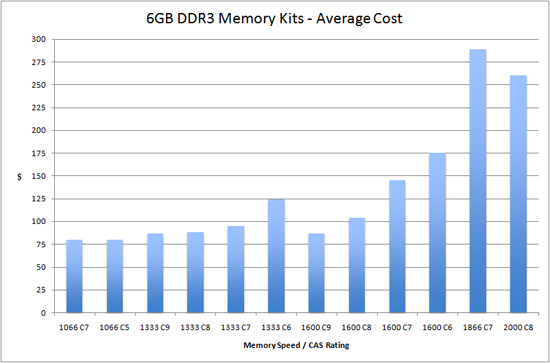
The graph above represents the cost, from Newegg.com, of 11 different 6GB DDR3 memory kits (1066 C7/C5 are the same kit). The only variables are the manufacturer and speed of the DDR3 memory included in the kit.
The least expensive DDR3-1066 6GB kit we purchased sells for $80, the most expensive 6GB kit? $289. That’s over a $200 difference; that and some pocket change is enough to pay for a sweet new video card, a nice 22” monitor, or even a iPhone 3GS.
All of that extra money is going somewhere: frequency and latency. The lowest end kit has a data rate of 1066MHz and a CAS latency of 7 cycles. The most expensive kit has a 1866MHz data rate at the same CAS latency; that’s a 75% increase in data rate.
A 10% increase in CPU speed rarely yields more than a 4 or 5% increase in performance, but what about a 75% increase in memory speed? We don’t have a single page on AnandTech to point you to that would answer that question. At least we didn’t, until today.
A Brief History of DDR3
We first met DDR3 alongside Intel’s P35 chipset. It’s performance at the time was at best equal to or usually worse than DDR2 while carrying a significant price premium. It wasn’t until the release of the Intel X48 and NVIDIA 790i chipsets that Socket 775 users could even see an advantage to using DDR3 and even then, it was primarily for benchmarking contests - hooray, because we all know how important those are.
There were some tangible advantages to DDR3 from the start, the biggest being it’s lower operating voltage. DDR2 memory required 1.8V while DDR3 could run at 1.5V, this made DDR3 particularly attractive for notebooks but on the desktop the advantage was sort of abused.
In order to take advantage of DDR3’s higher memory speed, benchmarking enthusiasts often had to use DDR3-1866/2000 kits that required voltages in the 1.8V~2.0V range to reach these clock speeds. Performance improvements in certain benchmarks were available through brute force use of voltages and ICs that allowed high memory speeds at decent latencies. In the end, improvements in actual applications were just not worth the cost or trouble of using DDR3 compared to DDR2.
Intel made no secret of its plans to move the vast majority of their processor lineups to DDR3 memory a few years ago. They truly wanted/desired that DDR3 would be the standard memory of choice by the time P45/X48 launched, but DDR3’s limited availability, middling performance, and a price premium that was truly prohibitive for the mainstream crowd, let alone the enthusiast market space made this desire impossible. As such, this left users with memory controllers not truly optimized for either memory technology that resulted in performance not significantly different from earlier Core 2 supporting S775 chipsets.
AMD recently released the AM3 platform and their AM3 based Phenom II processors support both DDR2 and DDR3 allowing users to either upgrade to AM3 boards or keep using their DDR2 based AM2+ boards, a simple if not elegant solution. With the recent release of new boards, BIOS optimizations, and near cost parity with DDR2, we now think DDR3 is a viable option for AMD users.
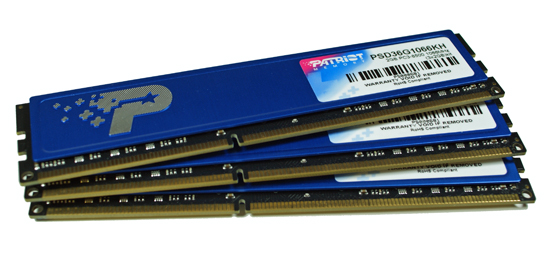
That said, DDR3 started coming into its prime last fall as the release of second and third generation DDR3 devices along with Intel’s Core i7. Core i7 and the X58 platform introduced Intel’s first on-die memory controller. Aside from other architectural improvements, Core i7 supports three DDR3 memory channels compared to the standard two channel setup, yielding some impressive bandwidth numbers.
There was one problem with this new design, a real fly in the ointment actually for the memory suppliers. Current JDEC specifications list 1.50V as the official voltage specification for DDR3 with a move to 1.35V in the near future and eventually to 1.20V. However, most of the performance oriented DDR3 modules released for the Core 2 platforms generally operated at 1.8V~2.0V in order to hit high speeds with decent latencies. In essence, the memory kits were already overclocked to hit clock speeds that made DDR3 a performance consideration on S775. The memory controllers on the Core 2 based Northbridge products could easily handle these voltages and surprisingly enough, so could the ICs.
Well, Intel officially released their recommended memory voltages for the Core i7 several months before launch with 1.50V as the recommended base voltage and 1.65V as the suggested maximum along with 1.35V for VTT (QPI) maximum. This left the memory suppliers in a bind as true high-speed low-voltage ICs were not going to appear until after the Core i7 launch. Intel extended official support to DDR3-800/1066 speeds only, although most current X58 motherboards support speeds up to DDR3-2133 or higher.
At the Core i7 launch, the market ended up with a bevy of DDR3-1066/1333 low-voltage kits with a sprinkling of higher speed DDR3-1600 and DDR3-1866 kits based on highly binned ICs that met the 1.65V recommendation. One other twist was that the memory suppliers had to package low-voltage higher-speed 3-DIMM kits instead of the normal 2-DIMM configuration in order to satisfy triple channel owners.
Fast forward to today and we see the wide availability of high-speed low-voltage DDR3 products with more choices coming on a daily basis. In fact, the availability of DDR3 products almost matches that of DDR2 with similar price points. By the end of this year, DDR3 products will outnumber DDR2 offerings although it will be a couple of years before DDR3 usage overtakes DDR2.


 Facebook
 Twitter
 RSS
RSS


47 Comments
View All Comments
BrianInfo - Thursday, July 30, 2009 - link
1.) The recommended DDR3-1066 Patriot PSD36G1066KH is non-ECC and unbuffered. Will this be an issue for the personal desktop use, mainly for video/audio transcoding/muxing?
2.) The article does not specify how to achieve the CAS5. Does anyone succeed the CAS5 with this Patriot DDR3-1066 and/or overclocked DDR3-1200?
3.) Is it possible to achieve the CAS5 with other brand, such as GeIL CAS7 GV36GB1066C7TC or Crucial CT3KIT25664BA1067??
4.) According to Tom's Hardware, not all the X58 motherboards support CAS5 http://www.tomshardware.com/reviews/cheap-x58-moth...">http://www.tomshardware.com/reviews/cheap-x58-moth...
so does it mean I cant obtain the ideal performance with the combination of "ASRock X58 Extreme" motherboard with "Patriot PSD36G1066KH" Tweaked-CAS5 DDR3? I really like the Asus P6T SE but the layout of the two (blue) PCI Express 2.0 x16 slots, too close to each other is killing me:(
iwodo - Sunday, June 28, 2009 - link
Spend the extra money on an SSD rather then faster Memory. Although i would love to see how Tri Channel differs from Dual Channel. ( Same results? )And how integrated Graphics differs in memory speed.
lemonadesoda - Friday, June 26, 2009 - link
Gary, you obviously get paid by wordcount. Too much waffle. Get to the meat faster.And what about this $200 between cheap and expensive DDR3 kits? How about seeing WHERE that $200 could have been spent in OTHER upgrades, ie. CPU or GPU, and running benchmark comparisons against THAT setup vs. the first.
Otherwise, thanks for running all the tests and creating the data for us to review :-)
PrinceGaz - Thursday, June 25, 2009 - link
As soon as I looked at the chart on the first page of the article, it was clear that the DDR3-1600 C9 memory would represent the best bang for the buck. It was only marginally higher priced than the DDR3-1066 C7 (and the DDR3-1066 C5 doesn't count as you overclocked the DDR3-1066 C7 for that purpose), and was sure to perform at least as good, and probably better than significantly higher priced DDR3-1333 modules at C8, and almost as good as the DDR3-1333 C7.Given that faster memory modules only ever have a negligible effect on real-world performance (unless you are a pirate and spend a lot of time using PAR2 checkers to rebuild damaged files from newsgroups, or WinRAR to then extract the original files, the sort of stuff I certainly won't say I do), then you may as well get the cheapest brand-name memory available. If you're spending in the upper mid-range on your CPU, then go for slightly faster (like the 1600 C9) but still quite cheap memory-modules. The only people who should be getting those top-of-the-range modules or anything close to that price level are those who have already decided on the fastest Core i7 CPU avilable (i7 975 currently), as otherwise they're wasting their money on the wrong bit of hardware.
Souka - Thursday, June 25, 2009 - link
I'm more confused than ever... what to buy?Putting together a new system...
Win7 or Vista x64
i7-920 CPU
x58 MB
ATI 4890 video
Memory? I'd like to go with 6GB (3x2gb), thought I had my choices narrowed down to:
Opt1: $138 mushkin 6GB(3x2GB) 1333(PC3 10666) Model 998706, Cas6, 6-7-6-18
Opt2: $175 mushkin 6GB(3x2GB) 1600(PC3 12800) Model 998691. Cas6, 6-7-6-18
But after reading this article, and your comments... I'm very uncertain....help!
PrinceGaz - Thursday, June 25, 2009 - link
Given a choice between either DDR3-1333 or 1600 memory with identical timings (6-7-6-18), but a $37 price difference, I'd probably go for the 1333, especially as you have decided on an i7-920. If you want to spend a little more to improve yours sytem performance, the memory speed is the last place to look at to do so.SiliconDoc - Sunday, July 5, 2009 - link
I took just the opposite from it - he has a 4980 there - overclockable nicely, is saving quite a bit with lower cpu, and what else can get him another 2,5,7,14 % in framerates, especially minimum in some cases ? I think the higher ram is much better and worth it after seeing this articles results.He will OC the 4890 and the cpu likely, so that fast ram will give it that great finisging kick and make it awesome.
Spend the $37 and be happy - definitely.
Hrel - Thursday, June 25, 2009 - link
G.Skill 1.5-1.6v 1333 Cas 8-8-8-21 = 65Crucial 1.8v 1333 Cas 6-6-6-20 = 64 (sold out right now)
OCZ 1.9v 1600 Cas 7-7-7-24 = 54 (after 20 mail in rebate)
Patriot 1.9v 1600 Cas 7-7-7-20 = 95 (free shipping)
Patriot 2.0v 1600 Cas 7-7-7-20 = 100 (Green, which I like)
So basically, it really ONLY makes sense to buy the OCZ 1600 Cas 7 for 54 bucks, why pay more for less?!!!
sonci - Wednesday, June 24, 2009 - link
Really boring for me,lucky, I didnt read it all
StraightPipe - Wednesday, June 24, 2009 - link
cough * troll*