



2.93GHz with DDR2-1067 Performance Comparison
It is clear enough that despite the poorer memory bandwidth, Core 2 Duo is the performance leader by a substantial margin at stock speeds. You have seen that in all of the results posted in this article. This conclusion will not satisfy all our readers, however. Many have theorized every incarnation of performance imaginable with AM2 having higher clock speed, higher bandwidth, or higher speed memory than it currently does.
To best answer these questions we put together the fairest comparison we could think of to directly compare Core 2 Duo and AMD AM2. This consists of running both processors at the exact same speed - 2.93GHz - achieved at the same ratios - 11x266. This involves overclocking the AM2 FX62 to 2.93GHz and raising the "bus" speed to 266. That allows an 11x266 ratio to match Core 2 Duo. The desirable side effect is that while AM2 does not really support DDR2-1067, by setting the memory to DDR2-800 we reach DDR2-1067 speed at the 266 speed setting. While this slightly stacks the deck in AMD's favor, it is as close as it is possible to get at running the two systems at the same speed, same memory timings, same memory voltages, same memory, and same video card. We are comparing two identically configured systems with AM2 powering one system and Core 2 Duo powering the other system.
Results are particularly interesting in that the fastest current AM2 processor, the FX62, is overclocked about 5% in CPU speed and 33% in "bus" speed over a stock AM2 system.
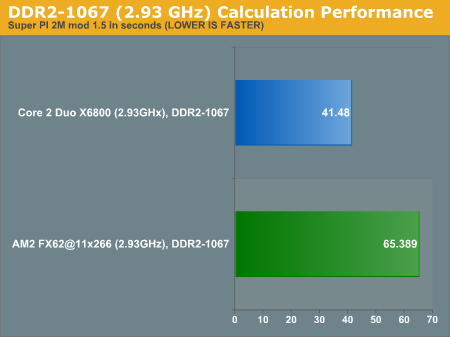
Frankly the gap that remains in Super Pi results when comparing AM2 and Core 2 Duo at the same speed was something of a shock. Clock for clock, with all other variables the same, Core 2 Duo is still almost 60% faster than AM2. There is nothing complex about calculating the value of Pi to 2 million places, but it does show the true power of Conroe in computation-intensive tasks.
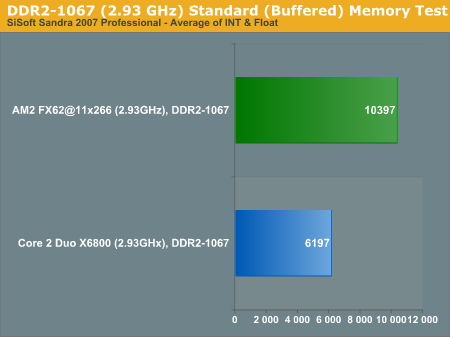
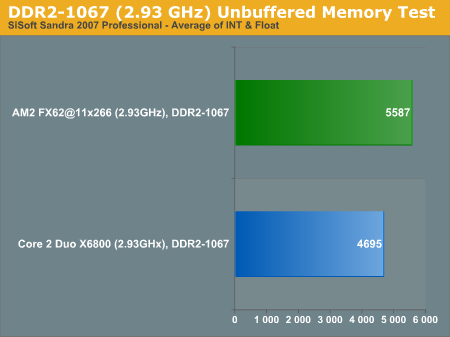
Despite the improvements Intel has made in intelligent read-ahead for memory, AM2 still has a huge lead in buffered memory bandwidth. This is a result of the superior on-processor memory controller used on AM2. The results become much closer in Unbuffered memory results, which is normally more revealing of performance in real-world applications, but AM2 still has a wider memory bandwidth. The unfortunate reality is AM2 is not starved for memory bandwidth and cannot really make effective use of this advantage. AMD clearly knows how to deliver memory bandwidth, so the task now becomes to modify their core logic to make better use of this advantage.
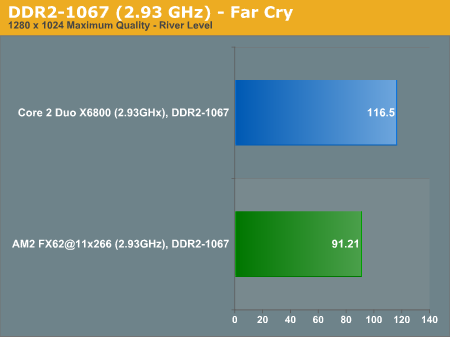
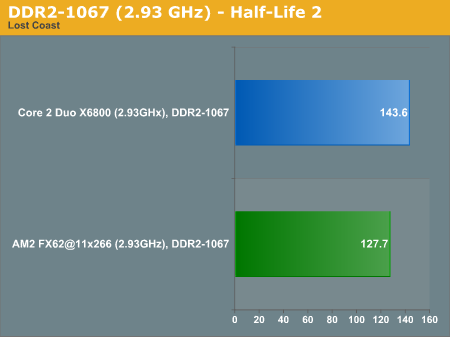
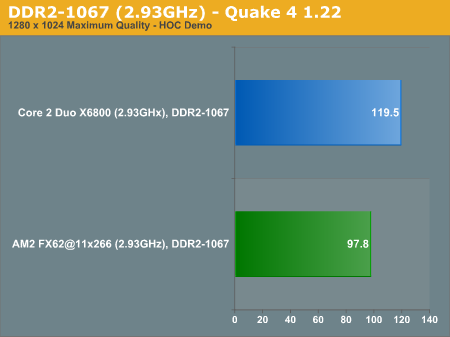
We can now say with authority that Core 2 Duo is the faster performer clock-for-clock across the board. At the same 2.93GHz Far Cry is 27.7% faster, Half-Life 2: Lost Coast is 12.4% faster, and Quake 4 is 22.2% faster on Core 2 Duo. Of course AMD does not currently have a 2.93GHz CPU, so we tested by overclocking FX62. This suggests that FX64, or whatever it will be called, will not help much at 3.0GHz with a 200 clock speed.
It is clear enough that despite the poorer memory bandwidth, Core 2 Duo is the performance leader by a substantial margin at stock speeds. You have seen that in all of the results posted in this article. This conclusion will not satisfy all our readers, however. Many have theorized every incarnation of performance imaginable with AM2 having higher clock speed, higher bandwidth, or higher speed memory than it currently does.
To best answer these questions we put together the fairest comparison we could think of to directly compare Core 2 Duo and AMD AM2. This consists of running both processors at the exact same speed - 2.93GHz - achieved at the same ratios - 11x266. This involves overclocking the AM2 FX62 to 2.93GHz and raising the "bus" speed to 266. That allows an 11x266 ratio to match Core 2 Duo. The desirable side effect is that while AM2 does not really support DDR2-1067, by setting the memory to DDR2-800 we reach DDR2-1067 speed at the 266 speed setting. While this slightly stacks the deck in AMD's favor, it is as close as it is possible to get at running the two systems at the same speed, same memory timings, same memory voltages, same memory, and same video card. We are comparing two identically configured systems with AM2 powering one system and Core 2 Duo powering the other system.
Results are particularly interesting in that the fastest current AM2 processor, the FX62, is overclocked about 5% in CPU speed and 33% in "bus" speed over a stock AM2 system.
Frankly the gap that remains in Super Pi results when comparing AM2 and Core 2 Duo at the same speed was something of a shock. Clock for clock, with all other variables the same, Core 2 Duo is still almost 60% faster than AM2. There is nothing complex about calculating the value of Pi to 2 million places, but it does show the true power of Conroe in computation-intensive tasks.
Despite the improvements Intel has made in intelligent read-ahead for memory, AM2 still has a huge lead in buffered memory bandwidth. This is a result of the superior on-processor memory controller used on AM2. The results become much closer in Unbuffered memory results, which is normally more revealing of performance in real-world applications, but AM2 still has a wider memory bandwidth. The unfortunate reality is AM2 is not starved for memory bandwidth and cannot really make effective use of this advantage. AMD clearly knows how to deliver memory bandwidth, so the task now becomes to modify their core logic to make better use of this advantage.
We can now say with authority that Core 2 Duo is the faster performer clock-for-clock across the board. At the same 2.93GHz Far Cry is 27.7% faster, Half-Life 2: Lost Coast is 12.4% faster, and Quake 4 is 22.2% faster on Core 2 Duo. Of course AMD does not currently have a 2.93GHz CPU, so we tested by overclocking FX62. This suggests that FX64, or whatever it will be called, will not help much at 3.0GHz with a 200 clock speed.


 Facebook
 Twitter
 RSS
RSS


118 Comments
View All Comments
HSuke - Thursday, July 27, 2006 - link
I hope this means that you're going to do the tests on the Core 2 Duo test platform IN ADDITION to your current platforms.
I hope this does NOT mean that you're going to do the tests EXCLUSIVELY on the Core 2 Duo test platform.
So are you going to stop doing memory tests with AMD processors? How scientific is that? If you go to page 7 and look at the performance charts, you'll see that memory speeds have a much greater impact (pertage-wise) on the AMD setup than the Core 2 Duo setup.
Well, I'm quite surprised that memory even made a difference. But since that is true (according to your tests), shouldn't be testing on AM2 instead of Core 2 Duo processors in the future because the difference is more marked? If there wasn't any significant difference on an Intel system, but a significant difference on an AMD system, you'd probably suggest that memory doesn't make a difference, commiting a type 2 error.
Now, I don't care about memory. I always buy whatever is on sale. But making that conclusion would just piss off so many memory enthusiasts and memory sellers. And aren't those guys the ones that would be reading this article?
Think about it.
Wesley Fink - Friday, July 28, 2006 - link
As we explained in the article, AM2 currently does not support the DDR2-1067 speed, while the Intel chipset for Core 2 Duo DOES support 1067. Since most memory we test can reach 900 to 1067 or 1100 or greater the 1067 ratio is an advantage. Also the current AM2 memory controller does not support settings of 2 for Ras-to-Cas or tRef - AM2 only supports to 3. Core 2 Dupo supports faster timings of 2 at these settings. Since these lower settings are often usable in fast memory they can be very important.For these reasons, we will be using the Core 2 Duo platform for testing DDR2 memory, since we can test more of the options that are available and may be important on high-performance DDR2 memory. If and when AM2 upgrades their DDR2 memory controller we will reconsider testing on AM2.
Kiijibari - Wednesday, July 26, 2006 - link
Hi everybody,first of all I have to admit that this is the best Anandtech article for a long time. Everybody blamed me for being an AMD fanboy latley, however I do not have any problems to admit that Core2 is faster.
If Intel would not have anything faster than AMD after 3 years of AMD lead, Intel would be best adwised to stop making CPUs and become an AMD chipset company ;-)
I have one question left: Which BIOS version did you use with the AM2 board ?
I recoginzed that DDR2 bandwidth scores increased quiet much compared to the initial tests. Now we have Sandra scores around 9.3 GB/s, however I remember that the initial ones were around 7.4 GB/s max.
In conclusion I assume that there is some optimization going on, due to bios seetings.
There was also a little test over at lostcircuits:
http://www.lostcircuits.com/motherboard/foxconn_c5...">http://www.lostcircuits.com/motherboard/foxconn_c5...
There the Asus board scored just ~7 GB/s, but a tested Foxconn board is again in the 9GB/s area.
It maybe that the BIOSes are optimized for different kind of RAMs, too, as lostcircuit used OCZ memory, not Corsair.
Anyways, I think the results are interesting enough to dig a little bit further ;-)
Thanks again for the great review.
regards
Kiijibari
Wesley Fink - Wednesday, July 26, 2006 - link
P5W-DH Deluxe BIOS is 701, dated 7/08/2006. The Corsair memory used in this review can do 4-3-4-11 timings at DDR2-1067, where most high-end DDR2 can only reach 4-4-4 timings at that speed.Kiijibari - Wednesday, July 26, 2006 - link
Sorry, looks like you misunderstood me, I was wondering about the AM2 platform bandwidth results @2.8Ghz and DDR2-800(page3). The Core2 scores are the same as "usual" ;-)So can you also say which bios you were using for the Asus M2N32-SLI ?
thanks a lot
Kiijibari
Gary Key - Thursday, July 27, 2006 - link
0603 - 6/29/06
OcHungry - Wednesday, July 26, 2006 - link
But I dont understand why you need DDR2 800 or 1000?DDR2 667 w/ tighter timings can run @ 333 1:1 ratio (333x9 for FX62).
Tell me what I am missing here?
zsdersw - Thursday, July 27, 2006 - link
Understatement of the year.
zsdersw - Wednesday, July 26, 2006 - link
Interesting notion. If it ever came to be, you can kiss price cuts (and innovation) on AMD chips goodbye.
Shizen - Tuesday, July 25, 2006 - link
Intel Core 2 comes out and AMD slashes prices across the board... the months ahead look like a great time to buy a new rig! Finally, I can retire my aging 2.8GHz Northwood and move on to PCI-E and DDR2. *_*Many thanks to the AnandTech dudes for keeping us abreast with the CPU wars, and I personally hope you guys come out with more articles geared for the midranged ($1000-$1500) buyer.
Yeah, I like the idea of being a PERFORMANCE fanboi rather than a brand-centric one. o_o