



abit AB9 QuadGT: Test Lab Update
by Gary Key on February 21, 2007 10:00 AM EST- Posted in
- Motherboards
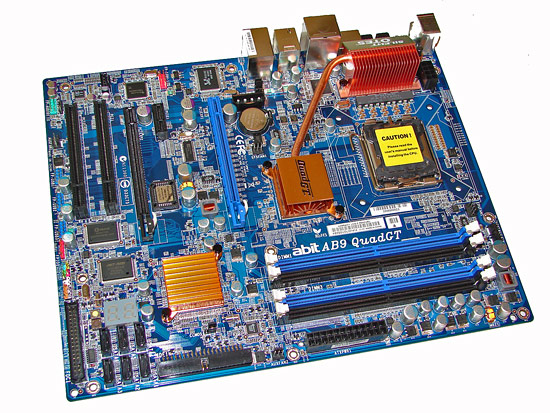
Our recent look at the abit AB9 QuadGT motherboard revealed several surprises; most of these were pleasant but a few were not. We found abit had released an impressive follow up to the much maligned AB9 Pro but the shipping BIOS still required a great deal of maturity before we could fully recommend the board. We have been testing several beta BIOS releases since our initial review and have come to some interesting conclusions about this board and abit.
We will say up front that this motherboard has become one of our favorites in the P965 category even with the few remaining warts. We really like the layout, feature set, BIOS design, and most importantly the stability provided by the board. It manages all this while generating excellent performance numbers. Abit has worked diligently at addressing the issues we found in testing and those of users who have reported additional issues. Our update today will address these issues, fixes, and also provide a couple of performance updates.
Our first noticeable problem with the board and one that caused the loss of equipment is the memory voltage issue with the shipping version of µGuru. We basically fried two 1GB modules of Corsair's finest PC2-6400C3 after increasing the voltage from 2.350V to 2.400V in µGuru which ended up being an actual BIOS setting of 2.7V. Needless to say, our normal eight hour Orthos testing session ended early. Abit quickly diagnosed the problem and updated µGuru to version 3.038 that fixed this problem. The latest version of µGuru is 3.101 and can be downloaded here. We highly suggest updating to the latest version of µGuru if you have not done so already. Unfortunately, abit has not updated the AB9 QuadGT product information page so follow the link above.
Our second issue with the board revolved around USB port problems. If the BIOS was changed from USB keyboard or mouse support via OS to BIOS then Windows XP would refuse to load if it was installed, nor could we complete a new installation from our CD drive. Additional USB testing revealed that any USB drive attached that was not a bootable device would result in the same behavior with the operating system refusing to load. Once again, abit engineering quickly diagnosed the issue and released beta BIOS version 1.1 B02 that solved the USB problems. In our follow up testing, we have not had any further problems when switching USB control from OS to BIOS except with one pesky Microsoft Comfort Curve 2000 keyboard that refuses to play nice. However, this keyboard has also given us issues on other boards at times.
Our third major problem centered on the storage controllers and the inability of the Intel ICH8R and JMicron JM363 chipsets to work together in certain situations. In essence, if the user enabled RAID on the ICH8R chipset then any use of the JMicron JMB363 for IDE drives (storage or optical) was prohibited. This issue was solved with the version BIOS version 1.1 B06 beta BIOS. Unfortunately, the use of a SATA optical drive on the Intel ICH8R chipset with RAID enabled is also a problem and this continues to be an issue that abit is working on addressing.
Other minor annoyances include optical drives on the JMB363 controller not being recognized or operating only in PIO mode unless the JMicron IDE drivers are loaded. We found during testing with numerous optical IDE drives that changing the JMB363 controller to RAID in the BIOS and loading the latest JMicron RAID driver improved compatibility tremendously with our IDE drives. Normally, we would not suggest doing this but it seems to work well with the current BIOS. We also had a problem with our QX6700 processor and not being able to load Vista 64-bit. This problem was also solved with the B06 BIOS release.
There have been user reports of the Realtek RTL8810SC LAN controller not being recognized properly, not at all, and in some cases having intermittent operation. We have only been able to replicate one particular issue with this chipset not being recognized while running MemTest but after a shutdown and restart the LAN controller always worked perfectly for us. A few other issues ranging from the board not posting to slow recognition of RAID arrays at boot time have been mentioned on the forums but once again we have not been able to fully replicate these issues.
Problems and fixes aside, let's see if performance has changed with the latest beta BIOS release and answer a couple of reader questions about this board.
We will say up front that this motherboard has become one of our favorites in the P965 category even with the few remaining warts. We really like the layout, feature set, BIOS design, and most importantly the stability provided by the board. It manages all this while generating excellent performance numbers. Abit has worked diligently at addressing the issues we found in testing and those of users who have reported additional issues. Our update today will address these issues, fixes, and also provide a couple of performance updates.
Our first noticeable problem with the board and one that caused the loss of equipment is the memory voltage issue with the shipping version of µGuru. We basically fried two 1GB modules of Corsair's finest PC2-6400C3 after increasing the voltage from 2.350V to 2.400V in µGuru which ended up being an actual BIOS setting of 2.7V. Needless to say, our normal eight hour Orthos testing session ended early. Abit quickly diagnosed the problem and updated µGuru to version 3.038 that fixed this problem. The latest version of µGuru is 3.101 and can be downloaded here. We highly suggest updating to the latest version of µGuru if you have not done so already. Unfortunately, abit has not updated the AB9 QuadGT product information page so follow the link above.
Our second issue with the board revolved around USB port problems. If the BIOS was changed from USB keyboard or mouse support via OS to BIOS then Windows XP would refuse to load if it was installed, nor could we complete a new installation from our CD drive. Additional USB testing revealed that any USB drive attached that was not a bootable device would result in the same behavior with the operating system refusing to load. Once again, abit engineering quickly diagnosed the issue and released beta BIOS version 1.1 B02 that solved the USB problems. In our follow up testing, we have not had any further problems when switching USB control from OS to BIOS except with one pesky Microsoft Comfort Curve 2000 keyboard that refuses to play nice. However, this keyboard has also given us issues on other boards at times.
Our third major problem centered on the storage controllers and the inability of the Intel ICH8R and JMicron JM363 chipsets to work together in certain situations. In essence, if the user enabled RAID on the ICH8R chipset then any use of the JMicron JMB363 for IDE drives (storage or optical) was prohibited. This issue was solved with the version BIOS version 1.1 B06 beta BIOS. Unfortunately, the use of a SATA optical drive on the Intel ICH8R chipset with RAID enabled is also a problem and this continues to be an issue that abit is working on addressing.
Other minor annoyances include optical drives on the JMB363 controller not being recognized or operating only in PIO mode unless the JMicron IDE drivers are loaded. We found during testing with numerous optical IDE drives that changing the JMB363 controller to RAID in the BIOS and loading the latest JMicron RAID driver improved compatibility tremendously with our IDE drives. Normally, we would not suggest doing this but it seems to work well with the current BIOS. We also had a problem with our QX6700 processor and not being able to load Vista 64-bit. This problem was also solved with the B06 BIOS release.
There have been user reports of the Realtek RTL8810SC LAN controller not being recognized properly, not at all, and in some cases having intermittent operation. We have only been able to replicate one particular issue with this chipset not being recognized while running MemTest but after a shutdown and restart the LAN controller always worked perfectly for us. A few other issues ranging from the board not posting to slow recognition of RAID arrays at boot time have been mentioned on the forums but once again we have not been able to fully replicate these issues.
Problems and fixes aside, let's see if performance has changed with the latest beta BIOS release and answer a couple of reader questions about this board.


 Facebook
 Twitter
 RSS
RSS


8 Comments
View All Comments
Jodiuh - Thursday, February 22, 2007 - link
Remember that board? I fell in love w/ that and the IC7, AS8, and AA8XE. When will we see a nice C2D board from DFI?Lord 666 - Wednesday, February 21, 2007 - link
Have they given any time frame to get the next official BIOS out? Love this board, but disappointed with abit's slow release schedule.Still using the 1.0 release. Bored last night and connected my OS Drive Raptor 150 that was normally setup using ICH8R in IDE mode to the JMicron eSATA connection. Much faster booting when doing the "reach around" with cable to the eSATA when compared to the ICH8R in IDE/ACHI/RAID.
RAID issues did not affect my build since using a 3Ware 9650SE-4 card with 3x Raptor 150s in RAID 5.
Overall, good board.
Hlafordlaes - Wednesday, February 21, 2007 - link
I am posting from an overclocked Abit VP6 dual P-III, which I have tweaked quite a bit. It is stable, and fast enough for me to play Oblivion happily on high settings (6800U vid card).Abit's commitment to quality support seems real from the article and from other forums, and the new Universal funding should help, too. And I like the all-solid caps.
This board is on my short list for purchase. (The PCI slot issue raised above will not affect my planned use.)
sprockkets - Wednesday, February 21, 2007 - link
reviewing the abit nfs2 6150 AMD AM2 board soon?Zak - Wednesday, February 21, 2007 - link
Exactly. What the hell is with mobo designs/layouts these days? They're awful. Besides, after several disasters couple of years ago I wouldn't touch Abit board even if it was free. Z.MadAd - Wednesday, February 21, 2007 - link
*sigh* another board that, with any decent vid card in slot2, has only 1 workable PCI slot. Great.....NOT.JarredWalton - Wednesday, February 21, 2007 - link
Theoretically, if you utilize all seven expansion card slots, you could have a CrossFire dual-slot GPU configuration and still get 3 expansion slots open. The problem is, moving the top GPU slot up that far interferes with HSFs, RAM, etc. and pretty much no one does it anymore. So for people that want two dual-slot GPUs, they will get two open expansion slots, and the mobo makers have to decide whether they want a shortsighted PCI-only layout or one each of PCI and PCI-E.Personally, I just wish more boards used X16 slots on all PCI-E connections, even if they're only X1 data paths. Very few people I know plan on having high-end CrossFire (or SLI) plus sound card plus PCI TV tuner. People that run CrossFire usually aren't worried about TV tuners, because they have a relatively noisy gaming PC. HTPC people that use TV tuners usually only need one GPU, and often not anything more than X1650 or GeForce 7600 class.
Long term, we are going to see more parts move to PCI-E slots, and then people will start to complain about board layouts that waste space on PCI slots. Damned if you do, damned if you don't.... ;)
Geraldo8022 - Wednesday, February 21, 2007 - link
don't these companies do ANY simple real world testing of these boards before release? How hard would it be for one of the employees to build a computer using the prototype board and use it at home for a week or two to see if it can actually function? There must be thousands of AnandTech readers who would volunteer for free to test these boards for them. It just makes no sense.