



ASRock Core 2 Duo: AGP/PCI Express Graphics Performance, Part Tres
by Gary Key on August 15, 2006 6:30 AM EST- Posted in
- Motherboards
AGP and PCI Express Performance
In our first article we compared the performance of DDR versus DDR2 on the ASRock 775Dual-VSTA motherboard and found there was very little difference between DDR-400 and DDR2-533 on this platform. In our second article we compared the performance of DDR against DDR2 on several different platforms that included the VIA PT880 Pro, Intel 865, Intel 945P, Intel P965, and Intel 975X chipsets. Our results showed that while there were differences in memory performance between each chipset and speed setting, it mattered little in the overall performance of our system. This was mainly due to our selection of mid-range components that likely would be used when upgrading to our motherboard and processor choice.
Our article today will look at the performance differences between AGP and PCI Express graphics cards on the ASRock 775Dual-VSTA motherboard with Intel's E6300 Core 2 Duo. We will state up front that our article today is not a video card review. Instead we are verifying if AGP performance on our test motherboards is acceptable when comparing it to PCI Express performance on the VIA PT880 Pro chipset used on our ASRock test platform. Our tests today will be utilizing the EVGA 7600GS and 6800 Ultra series of video cards in both PCI Express and AGP configurations. Both series of cards offer decent performance that is well suited for 17" or 19" LCD monitors running at resolutions up to 1280x1024. While both cards will struggle with current games such as Oblivion -- a game that will bring most systems to their knees -- they still offer a fair amount of performance for games released the past couple of years and can certainly handle any normal desktop application work with ease.
The typical user who will purchase a motherboard of this type or the AGP only ASRock 775i65G are primarily concerned about extending their current component investments while upgrading to the latest Core 2 Duo processor series from Intel. These component investments usually include AGP graphics, DDR memory, along their current power supply, storage, and optical drives. Based upon this profile our tests will utilize DDR memory only and video cards that represent typical performance in the mid to lower range of graphics capability at this time. Additional graphics performance results when utilizing DDR2 memory combined with other chipsets can be found in our last article.
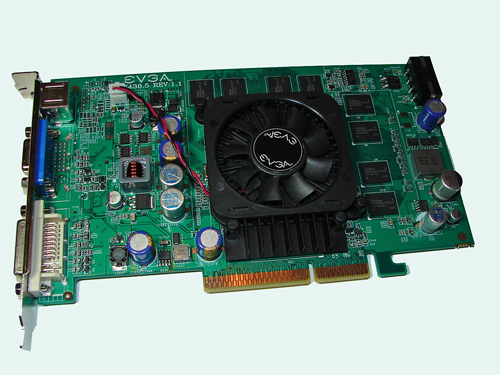
The ASRock 775Dual-VSTA motherboard offers AGP 8X/4X capability along with PCI Express X4 graphics performance. However, our PCI Express video cards will theoretically be at a disadvantage due to the bandwidth differences between X4 mode and our AGP 8X capability. We would like to see if the difference in bandwidth affects performance, though realistically we're only measuring the performance of one specific design as opposed to AGP versus PCI Express; we cannot say for certain that the PCI Express implementation of the PT880 chipset is fully competitive with other PCI Express implementations. Still, it is possible that the X4 slot will saturate the PCI-E bus, which can certainly occur in some cases based upon graphics settings and applications.
AGP 8X has up to 2.1GB/s of shared bandwidth. The typical GPU can make use of nearly all the bandwidth, but the upstream bandwidth isn't as important. Various requirements for upstream transfers end up limiting the maximum upstream throughput to around 266 MB/s, and switching back and fortch between reads and writes can incur a further performance penalty. Typical desktop applications tend to utilize the downstream bandwidth (read from system) the greatest amount of time while upstream bandwidth (write to system) is seldom used and is rarely an issue. The design of AGP took this into account, which is why the realizeable upstream bandwidth is so much lower than the downstream bandwidth.
PCI Express X16 operation has 8GB/s of theoretical bandwidth that is segregated for upstream and downstream paths due to its serial bus design. Technically, the PCI-E bus transmits at 2.5 Gbps on each link, so 2.5 Gbps x 16 = 40 Gbps. Converting to bytes that gives 5 GB/s, but like most serial buses there is a 20% transaction overhead that reduces the useable bandwidth to about 4 GB/s. Thus we arrive at the result of 4 GB/s of read and write speed for each direction at maximum bus capacity. Once again, the majority of application usage is spent on the read side with the write side capacity being wasted for the most part in current PCI Express graphics systems, but there is the potential for it to become more important in the future, and SLI/CrossFire implementations using the PCI-E bus to transmit data certainly benefit.
Since our test board is operating in X4 mode we have one fourth of the bandwidth available which equates to about 1000MB/s upstream and 1000MB/s downstream. This is slower than AGP 8X since the available read bandwidth is limited and can be saturated by certain applications, making AGP 8X potentially more effective. PCI Express X4 offers about half the available read bandwidth of AGP 8X, and the write performance advantage of PCI-E goes largely unused in most applications.
Let's see if this theory holds true in our test results -- again, recognizing that we are only comparing performance on one specific chipset.
In our first article we compared the performance of DDR versus DDR2 on the ASRock 775Dual-VSTA motherboard and found there was very little difference between DDR-400 and DDR2-533 on this platform. In our second article we compared the performance of DDR against DDR2 on several different platforms that included the VIA PT880 Pro, Intel 865, Intel 945P, Intel P965, and Intel 975X chipsets. Our results showed that while there were differences in memory performance between each chipset and speed setting, it mattered little in the overall performance of our system. This was mainly due to our selection of mid-range components that likely would be used when upgrading to our motherboard and processor choice.
Our article today will look at the performance differences between AGP and PCI Express graphics cards on the ASRock 775Dual-VSTA motherboard with Intel's E6300 Core 2 Duo. We will state up front that our article today is not a video card review. Instead we are verifying if AGP performance on our test motherboards is acceptable when comparing it to PCI Express performance on the VIA PT880 Pro chipset used on our ASRock test platform. Our tests today will be utilizing the EVGA 7600GS and 6800 Ultra series of video cards in both PCI Express and AGP configurations. Both series of cards offer decent performance that is well suited for 17" or 19" LCD monitors running at resolutions up to 1280x1024. While both cards will struggle with current games such as Oblivion -- a game that will bring most systems to their knees -- they still offer a fair amount of performance for games released the past couple of years and can certainly handle any normal desktop application work with ease.
The typical user who will purchase a motherboard of this type or the AGP only ASRock 775i65G are primarily concerned about extending their current component investments while upgrading to the latest Core 2 Duo processor series from Intel. These component investments usually include AGP graphics, DDR memory, along their current power supply, storage, and optical drives. Based upon this profile our tests will utilize DDR memory only and video cards that represent typical performance in the mid to lower range of graphics capability at this time. Additional graphics performance results when utilizing DDR2 memory combined with other chipsets can be found in our last article.
The ASRock 775Dual-VSTA motherboard offers AGP 8X/4X capability along with PCI Express X4 graphics performance. However, our PCI Express video cards will theoretically be at a disadvantage due to the bandwidth differences between X4 mode and our AGP 8X capability. We would like to see if the difference in bandwidth affects performance, though realistically we're only measuring the performance of one specific design as opposed to AGP versus PCI Express; we cannot say for certain that the PCI Express implementation of the PT880 chipset is fully competitive with other PCI Express implementations. Still, it is possible that the X4 slot will saturate the PCI-E bus, which can certainly occur in some cases based upon graphics settings and applications.
AGP 8X has up to 2.1GB/s of shared bandwidth. The typical GPU can make use of nearly all the bandwidth, but the upstream bandwidth isn't as important. Various requirements for upstream transfers end up limiting the maximum upstream throughput to around 266 MB/s, and switching back and fortch between reads and writes can incur a further performance penalty. Typical desktop applications tend to utilize the downstream bandwidth (read from system) the greatest amount of time while upstream bandwidth (write to system) is seldom used and is rarely an issue. The design of AGP took this into account, which is why the realizeable upstream bandwidth is so much lower than the downstream bandwidth.
PCI Express X16 operation has 8GB/s of theoretical bandwidth that is segregated for upstream and downstream paths due to its serial bus design. Technically, the PCI-E bus transmits at 2.5 Gbps on each link, so 2.5 Gbps x 16 = 40 Gbps. Converting to bytes that gives 5 GB/s, but like most serial buses there is a 20% transaction overhead that reduces the useable bandwidth to about 4 GB/s. Thus we arrive at the result of 4 GB/s of read and write speed for each direction at maximum bus capacity. Once again, the majority of application usage is spent on the read side with the write side capacity being wasted for the most part in current PCI Express graphics systems, but there is the potential for it to become more important in the future, and SLI/CrossFire implementations using the PCI-E bus to transmit data certainly benefit.
Since our test board is operating in X4 mode we have one fourth of the bandwidth available which equates to about 1000MB/s upstream and 1000MB/s downstream. This is slower than AGP 8X since the available read bandwidth is limited and can be saturated by certain applications, making AGP 8X potentially more effective. PCI Express X4 offers about half the available read bandwidth of AGP 8X, and the write performance advantage of PCI-E goes largely unused in most applications.
Let's see if this theory holds true in our test results -- again, recognizing that we are only comparing performance on one specific chipset.


 Facebook
 Twitter
 RSS
RSS


43 Comments
View All Comments
atlr - Thursday, January 25, 2007 - link
Has anyone compared the performance of agp and pci-e versions of the x1950pro on the Asrock Dual-VSTA?I am wondering if the 4x PCI-E on the Asrock will be a noticeable bottleneck with a GPU faster than the 6800Ultra.
mongo lloyd - Tuesday, August 22, 2006 - link
Does anyone know of a board similar to the i865PE-based Asrock board, released or upcoming, that basically has the same features only with gigabit LAN? Intel CSA preferred, but even gigabit hanging off the PCI bus would be better than the 10/100 crap. It's a must for me, and such a board would make an upgrade really desirable.hibachirat - Tuesday, August 22, 2006 - link
I think you'll have a hard time finding an AGP & DDR intel Conroe supporting mobo with built-in gigabit LAN. mATX too? No hope, but you could get one of these and then add an ethernet card like we used to do in times of yore.Sc4freak - Saturday, August 19, 2006 - link
"Three" in French is "trois". "Tres" means "very"."ASRock Core 2 Duo: AGP/PCI Express Graphics Performance, Part Very" :p
Un, deux, trois, quatre, cinq, six, sept, huit, neuf, dix.
Gary Key - Sunday, August 20, 2006 - link
I know French, Tres is three in Spanish and hence the change up for our Spanish speaking friends. :)
lapierrem - Thursday, August 17, 2006 - link
I find it very amusing to see that AGP cards can still beat a PCI-e card which is supposed to be so much faster and better in many respects, but apparently isn't. I know on the other Asrock boards, like the 939DualSata2 the AGP is bridged off the PCI-E bus and is supposed to be slower, but wow. Maybe if we had gone with dual AGP cards for SLI we woulda had the real dealCrappyLuckMan - Thursday, August 17, 2006 - link
Anandtrash buys ascrock stock and bans me. Yey no more n00bs.CrappyLuckMan - Wednesday, August 16, 2006 - link
In all the asrock tests it's the Asrock that's a bottleneck. I believe the best way to bench is use a card that comes in both flavors and run it on an NF4 w/AM2 DDR-2 and one in an NF4 agp mobo with DDR. You test ram and video card this way at the same time on the same chipset and same cpu with same cache and same speed. Only difference is one is ddr-2 and has an extra pin.And from my experience with Asrock boards is that they die for no reason and wont boot no matter what you do after a while. You get what you pay for and I can't believe how much attention you are giving this cheapo mobo.
hibachirat - Friday, August 18, 2006 - link
Too bad your experience was negative, but I have had top of the line ASUS and AOPEN boards that were junk fresh out of the box. And problematic top of the line boards from MSI and Abit. Also had great boards from the same makers. Now I'm running some "cheap" boards from Asrock and Biostar that are rock solid. The difference between the high end and low end boards has more to do with cutting edge feature sets and fractional performance gains than it does with stability and longevity. Asrock may be soft-rock to the T-O-L boards heavy metal, but that suits some of us just fine.CrappyLuckMan - Saturday, August 19, 2006 - link
Well then again I see on newegg a lot of people use junk ram and or crappy psu's and call the mobo junk cause it doesn't post. Even if the asrock posts and doesn't die in a year, I still think it is a bottleneck and it shouldn't be used to compare agp vs pci x16.