



Intel Core Duo: AOpen i975Xa-YDG to the Rescue
by Gary Key on May 4, 2006 8:00 AM EST- Posted in
- Motherboards
"L'imagination est la seule arme dans la guerre contre la réalité."
For those of us who have not fully embraced the French language, this quote by the French philosopher Jules de Gaultier translates into, "Imagination is the one weapon in the war against reality." A very fitting quote when realizing the imagination involved on AOpen's behalf in designing and then bringing to market a performance oriented desktop board that utilizes the current star of Intel's microprocessor lineup, the Core Duo. Our reality has been living with the minimalist number of Mobile on Desktop products available for Intel users wishing to break free of the NetBurst architecture since the introduction of the Pentium-M product line.
While the Intel Pentium-M series started off with a bang in the notebook sector with the release of the Banias (130nm) product family a few years ago, this processor series did not fare well against its Pentium 4 and AMD Athlon64 competitors when utilized in desktop boards based upon the Intel 855GME chipset, an i865/875 derivative, which featured a single-channel DDR333 memory controller, AGP4x, and PATA drive support. However, the chips did bring the promise of a low noise and low power consumption processor to the desktop and was an HTPC builder's dream choice for a silent PC, a total reversal of the Prescott family traits. The Banias based processors just did not have the clock speeds, chipset support, memory bandwidth, or architecture improvements at the time to effectively compete on the desktop even with their considerable noise level and power consumption advantages. In fact, Intel was dead set against the idea of utilizing mobile processors on the desktop so the availability of boards was further limited, a very misguided idea as it turns out.
Intel continued development on the Pentium-M series and released its second generation product family called Dothan a couple of years ago. Dothan represented the move to the 90nm process, L2 cache increased from 1MB to 2MB, clock speeds increased up to 33%, and minor architecture improvements in the areas of Micro Ops Fusion, Local Branch Prediction, Integer Division, and Register Accesses were included. Although the Dothan series were still limited in overall system performance by the Intel 855GME equipped boards at launch, Asus released a unique socket 479 to socket 478 adapter in early 2005 that allowed the use of non-low voltage Banias and Dothan processors in certain socket 478 motherboards based upon the Intel 865/875 chipset family. This adaptor card allowed the Pentium-M series to take advantage of a mature desktop platform, increased memory bandwidth, and allowed the user to overclock the processor.
The test results with the adapter card were impressive at the time with certain benchmark scores equaling or surpassing the Pentium 4 and Athlon64 competition, but floating point and SSE performance continued to be an issue in video encoding and some 3D rendering tasks. The availability of the Intel 915GM chipset later in the year featuring PCI Express, SATA support, HD Audio, Dual-Channel 533MHz DDR2 support or Single-Channel DDR333, and Gigabit LAN meant the Dothan finally had a fairly competitive platform to showcase its performance enhancements and abilities against the desktop processors. However, Pentium-M desktop board availability continued to be limited with the focus being on micro-ATX designs designed for HTPC or SFF users, certainly nothing targeted to the performance oriented enthusiast crowd. Further information about the Pentium-M along with test results using the ASUS adapter can be found in our Intel's Pentium M on the Desktop and Intel's Pentium M Desktop Part II.
Intel's development cycles continued in earnest on the Pentium-M series resulting in the Yonah family of products and a name change to the Core Duo/Solo series. These Core series processors include a move to the 65nm process, dual-core capability in the Duo models, thermal enhancements, Smart Cache implementation on the Duo, and architectural improvements that include improved floating point performance, SSE/SSE2 Micro Ops Fusion tweaks, support for SSE3 instructions, and SSE decoder throughput enhancements. These changes and additions addressed the floating point, media encoding, and 3D gaming weaknesses of the prior Pentium-M product family while maintaining near equal thermal characteristics. Note that the Core Duo/Solo series, like the Pentium-M series before it, does not support 64-bit extensions.
Intel released the Core Duo and Core Solo products earlier this year with a splash that included almost immediate availability in the revised Apple iMac and MacBook Pro product lines while widespread availability in the Intel PC market space is just now occurring. Along with this impressive rollout comes another core logic update in the form of the Intel 945GM chipset family. This update to the 915GM chipset includes improved power consumption, a move to 667MHz DDR2 memory and front side bus support, improved integrated graphics, a modified 479-pin socket, and the addition of the ICH7MDH Southbridge featuring SATA 3Gb/s support and increased PCI-Express lanes when compared to the previous ICH6M. While the core logic chipset improvement tweaks are certainly welcome, including the 25% increase in front side bus bandwidth, the mobile desktop boards based on this chipset are still mainly targeted at the HTPC and general office application user.
The support and general interest of the motherboard manufacturers in releasing a wider variety of Mobile on Desktop products has greatly increased with the roll out of the current Core series processors. We expect a few of the upcoming 945GM based boards will be more performance oriented for the enthusiast user, but from all indications their roots will still be firmly planted in the mobile design sector. Additional information on Core Duo can be located found in Intel Core Duo (Yonah) Performance Preview - Part II.
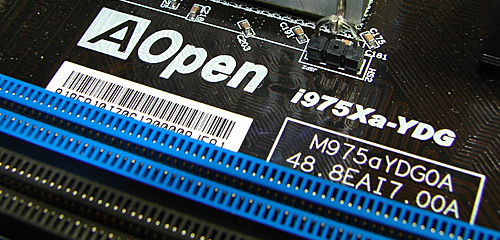
This leads us into the main star of today's discussion, the AOpen i975Xa-YDG, so let's take a closer look at its features and performance.


 Facebook
 Twitter
 RSS
RSS


81 Comments
View All Comments
Per Hansson - Wednesday, May 17, 2006 - link
Hi Gary, just wanted to drop in and give you a kudos on this very nice review!It also makes me smile to finally see Intel catching up with AMD, this can only be good news for the customer...
And a small heads up, there are a few Intel Core Duo Engineering sample CPU's on sale at eBay, "hint hint engineering sample=multipler unlocked"
And also a big thanks for finally posting those capacitor shots and mentioning them, keep up the good work!
Also I think Aopen deserves recognition for designing a mainboard with so high-quality components, Rubycon=Way to go!!!
goinginstyle - Friday, May 19, 2006 - link
Agreed....
vailr - Thursday, May 4, 2006 - link
Updated driver:(from: http://www.station-drivers.com/page/intechip.htm)">http://www.station-drivers.com/page/intechip.htm)
Intel Chipset software Installation Utility
Version 7.3.1.1013 - Windows 2000/XP 32/64bits/2003Server Multi Langues & officiel
ftp://aiedownload.intel.com/df-support/10392/eng/i...">ftp://aiedownload.intel.com/df-support/10392/eng/i...
Version 8.0.0.1005 Alpha
Windows 2000/XP 32/64bits/2003Server Multi Langues & non officiel
http://www.station-drivers.com/telechargement/inte...">http://www.station-drivers.com/telechargement/inte... Alpha.exe
Gary Key - Thursday, May 4, 2006 - link
Thank you for posting these links. :) We have a policy of utilizing the latest driver sets on a supplier's website at the time our testing starts, in this case the Intel general download page is still posting the 7.2.2.1006 driver set. However, I am using the 7.3.1 driver set on our retail board sample tonight. ;-)irev210 - Sunday, May 7, 2006 - link
Hello Gary,Sorta funny how that other fellow has absolutely no idea what he is talking about.
I just wanted to touch upon something that I didnt see get much attention.
You should have mentioned in your article about how efficient the core architecture is, and how well it scales with increased frequency. The chip turns into a total monster once you get past 3ghz, and continues to perform better and better as you increase the speed. The fastest I could get on air was around 3.1ghz. I wouldnt be afraid to crank the volts to the 1.5 max on the aopen board... with a different cooler, you should hit some nice speeds. Try swapping out for a zalman 9500, or a big typhoon.
The shortfalls, are as you mentioned the southbridge lacking raid, and the poor bios options. Vcore should let us up to 1.65-1.7, while Vdimm should let us do atleast 2.3.
While this may not satisfy the most serious enthusiast, this board does fill a nice niche. The price is pretty high, but core duo CPU's can be had on the cheap, which makes up for it. For someone that is worried about their electric bill, and wants performance and performance per watt, this is a great alternative.
For others who must have the fastest. This just makes them drool. This is the low end of the core architecture. Merom and Conroe to follow... we shall be stunned.
Consdering Meroms being tested now at 3.0Ghz are faster than 3.2Ghz Yonah's... AND YOU WILL SEE Conroe EE at 3.33 w/ a 1333fsb doing 4ghz w/ 1500mhz FSB :)
For those that dont get it yet... AMD will need a AM2 processor running at about oh 4.8Ghz to beat a 4Ghz clocked conroe :)
Good things to come. I take no sides, im just excited about new stuff :)
Marlowe - Thursday, May 4, 2006 - link
How come a ~1 % cpu usage translates into a massiv 20 fps drop in BF2? Looks like EA have a deal with Creative :(A lot of world records have been beaten with this mobo already over here at XS :)
coolaler even got SLI enabled on it ;) also running a merom in it ;)
Your 266 FSB is very good and about normal for aircooling. Give it some cold and it will go further ;)
Frumious1 - Thursday, May 4, 2006 - link
[font color="#000000] (Damn white text. Nice comment engine AnandTech.... Need a new programmer?)Because RightMark is a theoretical test and not actually a real game or audio application. Also, look at the 3D/EAX scores - it's more than 1% CPU usage, but still less than 20% or whatever.
Gary Key - Thursday, May 4, 2006 - link
It has to do with the Realtek driver load and Creatives to some extent being split between the cores during the RightMark testing. I noted in the text that although the cpu utilization is extremely low in our Rightmark results due to the load balancing that the actual game results (percentage differences) were basically the same as our single core scores. The drop in BF2 is due to the audio algorithms being generated by the CPU rather in hardware as on the X-FI card. Our audio settings in BF2 are set to hardware, medium quality, EAX enabled, the high quality setting extracts another 6FPS but we generally have not noticed an increase in audio quality. This is one penalty you pay for on-board audio in a CPU limited game although Serious Sam II is the one exception for either solution.
We are hoping to receive a T2700 chip from Intel shortly and will "chill" it to see what results come from it. :) Yes, we had SLI working on the board also, but that is a topic that will be buried with Jimmy Hoffa at this time. ;-)
NT78stonewobble - Friday, May 5, 2006 - link
Intriguing last 2 sentences.The comments section has some really good info alot of the time :).
And kudos for bringing into the review something about the penalty for using onboard audio versus dedicated hardware.
You're not by any chance planning on writing something about audio quality some-time? Not that im an audiophile or the like, just curious.
Gary Key - Friday, May 5, 2006 - link
We will expand our audio section in the next update to our motherboard review section. We are looking at several variations of the review process as we enter a very busy time of the year with AM2, Conroe, and others all launching over the next 90 days. :)