



Jetway 939GT4-SLI: Gem with a New SLI Twist
by Wesley Fink on August 24, 2005 8:30 AM EST- Posted in
- Motherboards
Jetway has had many interesting products in the last couple of years. Smaller players in the PC Market often have a hard time getting noticed, and we applaud Jetway for bringing some unique products to market as a means of shining the spotlight on the Jetway brand. When we first heard of the Jetway nForce4 SLI board with 3 x16 PCIe slots, we figured it was just another interesting twist from Jetway. However, the idea is such a good one that we really wanted to take a closer look.
The first SLI motherboards provided SLI capabilities with a Paddle card that was reversed to switch between single x16 video and dual x8 operation.
Jetway did a very clever and elegant rethinking of SLI in the design of the 939GT4-SLI-G, which is the subject of this review. All of the competing SLI boards use at least two-slot spacing between the two x16 slots to allow for double-width cards like the NVIDIA 6800 Ultra. Jetway used this fact to create a fresh new approach.
Jetway does not need a paddle card, or jumpers, or switches in this arrangement. The design is simplicity in itself. What's more, this board theoretically could be a better performer without the paddle, jumpers or switches that can limit overclocking performance.
The first SLI motherboards provided SLI capabilities with a Paddle card that was reversed to switch between single x16 video and dual x8 operation.
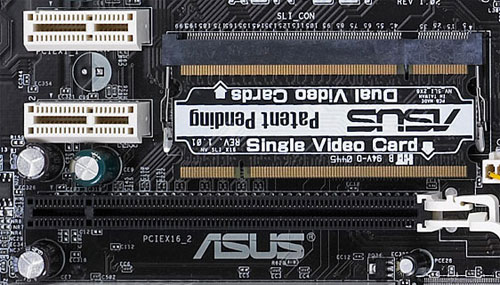
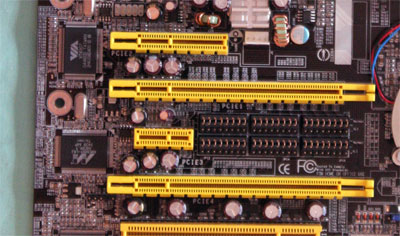
Jetway did a very clever and elegant rethinking of SLI in the design of the 939GT4-SLI-G, which is the subject of this review. All of the competing SLI boards use at least two-slot spacing between the two x16 slots to allow for double-width cards like the NVIDIA 6800 Ultra. Jetway used this fact to create a fresh new approach.
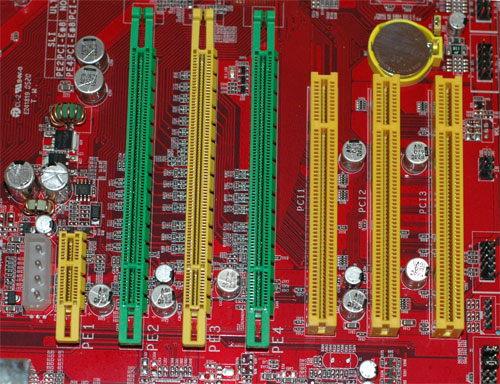
Jetway does not need a paddle card, or jumpers, or switches in this arrangement. The design is simplicity in itself. What's more, this board theoretically could be a better performer without the paddle, jumpers or switches that can limit overclocking performance.


 Facebook
 Twitter
 RSS
RSS


46 Comments
View All Comments
KublaKhan - Sunday, September 11, 2005 - link
I bought this board recently from newegg but haven't tried it out yet. What is the purpose of the power connector immediately above the PCI-E x1 slot? I thought it might be used for extra power for the PCI-E cards but then with 24 pin moboard connectors and graphics cards with their own additional power connectors, isn't there enough power already? Also, nowhere in the documentation nor reviews of this board on other hardware sites do I see any indication that this board supports SATA-2. Wesley, where did this info come from?raildogg - Thursday, September 1, 2005 - link
guys, I've heard that they are the identical boards, however, some of their specs may not be. are they the exact same boards? not surecheck this out
http://www.newegg.com/Product/ProductCompare.asp?C...">link
kennyG - Sunday, September 4, 2005 - link
yeah ok..but the eVGA board doesn't have 3 PCI Express x16??At lease they dont state this infomation on the site(Newegg link you gave)..Now if the jetway bios updates the evga board to the same state then I think it could make a great buy..And yes they both(eVGA&jetway) need to make there colors a little make adult like.
Wesley Fink - Tuesday, September 6, 2005 - link
Look at the Newegg EVGA pictures. The EVGA board does have 3 x16 slots. The Newegg specs are not in agreement with the pictures. and the pictures match other EVGA pictures and specs we have seen. The EVGA and Jetway appear the same board with different BIOS. Many Forums are reporting success with flashing the EVGA with the Jetway BIOS.inkysowner - Wednesday, September 7, 2005 - link
Hi Wes,I have the evga board and the same memory 2x512 with 2 evga 7800gtx's(acs kits in the box), just want to verify this.
"Tests used OCZ PC3200 Platinum Rev. 2, which uses Samsung TCCD chips. All memory ran at 2-2-2-7 timing in all benchmarks."
So at 12 x 244 you were running 2-2-2-7 Command 1T and at what voltage.
I have a 4400+ that I am trying to get up near 2.7 and at the stock multi of 11 and those timings at 244 I should be in the sweet spot, I think the aquagate-mini should be able to cool the processor enough at those settings, esp based on the new inquirer article review of the coolermaster aquagate mini-120 which I have in a cm stacker.
Thanks in advance
Wesley Fink - Wednesday, August 31, 2005 - link
There are now several reports on the web of eVGA users successfully flashing with the latest Jetway BIOS. Users are also reporting that the Jetway BIOS offers more options and better overclocking that the eVGA which appears otherwise to be the same motherboard with a different, more subdued, color scheme.kennyG - Sunday, September 4, 2005 - link
do you have any links..I'd like to read what others are getting as far as overclocks ?Fozzik - Thursday, August 25, 2005 - link
I noticed that pretty much know I/O benchmarks were run...Do we know that this board doesn't have any glaring problems with onboard NIC, USB, etc? The new Sapphire boards based on ATI's Xpress 200 chipset look great, except for seeminly (an difficult to explain) lousy performance of their integrated divices on the PCI-Express bus. I know this isn't the same chipset, and that all Nforce 4 SLI Implimentations are probably similar...but I'm just wondering since none of those benchmarks were included in this review. Let's get right down to it... I'm paranoid about Jetway. ;) Usually when things look too good to be true, they are.
Wesley Fink - Sunday, August 28, 2005 - link
We have already tested I/O performance of all of the chips on the Jetway board, so we saw no valid reason to retest the IO performance. The Marvell PCIe PHY for Gigabit LAN is an excellent performer and is just a Physical Layer to the nF4 chipset Ethernet hooks. SATA 2, USB and IDE are controlled by the nForce4 SLI chip, there is no onboard firewire or additional SATA 2 controller, and the Realtek ALC850 audio codec is used by almost every nF4 motherboard.Fozzik - Sunday, August 28, 2005 - link
Thanks for the reply. =)