



Understanding the iPhone 3GS
by Anand Lal Shimpi on July 7, 2009 12:00 AM EST- Posted in
- Smartphones
- Mobile
The GPU and its Performance
We’ve gone through, in great depth, the CPU in the new iPhone 3GS. But the GPU is arguably the more interesting upgrade. I’ve already covered the GPU pretty well so I present you with a blatant copy/paste of what I’d already written:
Now that we’re familiar with the 3GS’ CPU, it’s time to talk about the GPU: the PowerVR SGX.
Those familiar with graphics evolution in the PC space may remember Imagination Technologies and its PowerVR brand by their most popular desktop graphics card: STMicro’s Kyro and Kyro II. The Kyro series used the PowerVR3 chips and while STMicro ultimately failed to cement itself as a NVIDIA competitor in the desktop, the PowerVR technology lived on in ultra-mobile devices.
The SGX is on Imagination Technologies’ fifth generation of its PowerVR architecture, and just like the Kyro cards we loved, the SGX uses a tile based renderer. The idea behind a tile or deferred renderer is to render only what the camera sees, not wasting clocks and memory bandwidth on determining the color of pixels hidden by another object in the scene. Tile based renderers get their name from dividing the screen up into smaller blocks, or tiles, and working on each one independently. The smaller the tile, the easier it is to work on the tile on-chip without going to main memory. This approach is particularly important in the mobile space because there simply isn’t much available bandwidth or power. These chips consume milliwatts, efficiency is key.
The MBX-Lite used in the original iPhone was also a tile based architecture, the SGX is just better.
Also built on a 65nm process the PowerVR SGX is a fully programmable core, much like our desktop DX8/DX9 GPUs. While the MBX only supported OpenGL ES 1.0, you get 2.0 support from the SGX. The architecture also looks much more like a modern GPU:
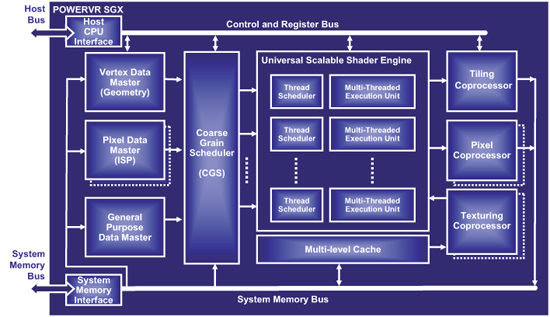
Pixel, vertex and geometry instructions are executed by a programmable shader engine, which Imagination calls its Universal Scalable Shader Engine (USSE). The “coprocessor” hardware at the end of the pipeline is most likely fixed-function or scalar hardware that’s aids the engine.
The SGX ranges from the PowerVR SGX 520 which only has one USSE pipe to the high end SGX 543MP16 which has 64 USSE2 pipes (4 USSE2 pipes per core x 16 cores). The iPhone 3GS, I believe, uses the 520 - the lowest end of the new product offering. Update: Thanks to BlazingDragon and psonice for pointing out that the 3GS may in fact use a PowerVR SGX 535 based on drivers on the iPhone 3GS. It could still use a lower end SGX core and use the 535's driver, but there's at least the possibility that the 535 is under the hood of the 3GS.
A single USSE pipe can execute, in a single clock, a two-component vector operation or a 2 or 4-way SIMD operation for scalars. The USSE2 pipes are upgraded that handle single clock 3 or 4 component vector operations, have wider SIMD and can co-issue vector and scalar ops. The USSE2 pipes are definitely heavier and have some added benefits for OpenCL. For the 3GS, all we have to worry about is the single USSE configuration.
| iPhone 3G (PowerVR MBX-Lite) | PowerVR SGX @ 100MHz | PowerVR SGX @ 200MHz | |
| Manufacturing Process | 90nm | 65nm | 65nm |
| Clock Speed | ~60MHz | 100MHz | 200MHz |
| Triangles/sec | 1M | 3.5M | 7M |
| Pixels/sec | 100M | 125M | 250M |
In its lowest end configuration with only one USSE pipe running at 200MHz, the SGX can push through 7M triangles per second and render 250M pixels per second. That’s 7x the geometry throughput of the iPhone 3G and 2.5x the fill rate. Even if the SGX ran at half that speed, we’d still be at 3.5x the geometry performance of the iPhone 3G and a 25% increase in fill rate. Given the 65nm manufacturing process, I’d expect higher clock speeds than what was possible on the MBX-Lite. Also note that these fill rates take into account the efficiency of the SGX’s tile based rendering engine.
Obviously all games on the app store were designed for the PowerVR MBX-Lite and the SoC in the iPhone/iPhone 3G/iPod Touch. Some do run faster/smoother on the 3GS thanks to the faster CPU and GPU, but the new hardware should enable an entirely new class of game in the future.
Developers will have to deal with a segmented user base, since there are around 20 million PowerVR MBX-Lite based phones and a bit over 1 million SGX based 3GSes in the market.
The GPU Comparison
There are obvious limitations to the iPhone 3GS being used as a gaming platform. But there are also obvious limitations to the 3GS being used as a camera or a video player. The point isn’t that the 3GS could replace the Nintendo DS or the Sony PSP, it’s that the iPhone could get you maybe 80 - 90% of the way there.
There are serious control and battery life limitations, but the platform has the right combination of hardware, a software delivery system and ubiquity to at least be considered a viable gaming system. It has a much more powerful CPU/GPU combination than a Nintendo DS, now what it needs is the iPhone equivalent of Mario. Perhaps Apple should buy a game developer.
The obvious smartphone GPU comparison here is the Palm Pre. The TI OMAP 3430 used in the Pre (good job Palm on full disclosure there, just add clock speeds and you’ll get an A+) is a very similar SoC to the Samsung chip in the iPhone 3GS. As such, it also has a PowerVR SGX core.


 Facebook
 Twitter
 RSS
RSS


60 Comments
View All Comments
lightzout - Saturday, July 11, 2009 - link
My wife actually offered to give me her 3g if she got the the 3gs but I didnt think it was worth it. She asked me this morning how it was better and I didnt know (didnt admit it of course)Now I want her 3G "free" and she really does need the 3gs since since is always multitasking/social/mail..me, including aim.
I thought the 3gs would have some radical new gps stuff but the compass is not impressive. Nothing to get me geeked on to the tune of $200. For my purposes having the older iphone would make travel and remodeling job estimating easier over my tattered razr.
My media mogul mamacita however needs that sleek new 3gs like yesterday as every gripe she has about the 3g phone seems to have been addressed somehow.
Great write-up!
Only regret is when I saw the new screen and sleek size of the 3gs at the apple store a couple days ago it does screem "arent I beautiful?" but that is what apple does so well right?
MrBowmore - Saturday, July 11, 2009 - link
Give the magic, or hero another chance!Your numbers for those phones are whacked, its faster than the 3G at alot of things. Try to kill all the backgroundapps. (yes, it multitasks)
RadnorHarkonnen - Friday, July 10, 2009 - link
Very good analisys.I was just surprised ARM CPUs still made on 90nm and 65nm. With the performance and power saving 55nm and 45 nm processes i would imagine they would jump the bandwagon fast.
nubie - Thursday, July 9, 2009 - link
Some people can't drop $600 in a lump or $2600 over 3 years on something as stupid as a cellphone. No matter what it can do.Besides the fact that Apple is killing all support for proper hardware acceleration and access to OpenGL 2.0, whatever.
Can we get more Android and G1 coverage? Please?
psonice - Friday, July 10, 2009 - link
Like the guy above said, you buy a phone, you either pay a lot upfront, or you get it with a contract. Either way you'll still need to pay a ton of money each month to for your voice and data. You could get a cheap phone that only makes calls and costs almost nothing, but that's not the same is it?And what's this about apple not supporting hardware acceleration / opengl es 2.0??? Almost everything in the gui is hardware accelerated. And there's very good opengl es 1.1/2.0 support in the sdk, hence the ton of hardware accelerated games. There may not be much supporting es2.0 yet, but that's because the first 2.0 capable device has only just been released.
Affectionate-Bed-980 - Friday, July 10, 2009 - link
You know what? The cost is:$199 up front
$70 / year * 24 months
= $1680 + $199
But let's face it, most of you already have cell phones. A quick look at a WinMo phone like the HTC Touch Pro is $70 / month too at minimum ($39.99 voice + $30 data. Same with a Blackberry.
SO WHY THE HELL ARE YOU COMPLAINING?
So if $1880 is too much for you, don't get a cell phone period.
Stop complaining. The iPhone is actually pretty damn cheap. You're locked in a contract, but even if you had another phone WHY WOULD YOU GO DATALESS?
araczynski - Thursday, July 9, 2009 - link
i'll care about the iphone/ipod when they start sporting VGA screens. if my digital camera can have a 3" 640x480 display, so should these overpriced toys.psonice - Friday, July 10, 2009 - link
Higher res screens look pretty, but 640x480 needs 2x more power to fill than 480x320. The screen is more than acceptable already, so I'd take faster running apps/games and longer battery life over more pixels any day.Kougar - Thursday, July 9, 2009 - link
Thanks for the informative crash course in CPU instructions, that filled in some gaps I didn't understand. It's nice to now understand how some aspects of the design fit into or affect the rest of the design.Unfortunately, you've only drummed up the excitement factor for Intel's Sandy Bridge... from some general info that's been around and based on what you've given it sound like the potential is very much there for some very significant performance jumps. So much for Gulftown's allure!
christinme7890 - Thursday, July 9, 2009 - link
I love the attention to detail when describing the CPUs and the graphics processor and stuff. Very cool. I hate that other people are dissing the iphone hardware. If you don't like Macs rules get a pre. Plain and simple. I for one support these people that want to sell their apps for a good price and are trying to make it big in the dev world. Kudos and I will buy your apps.I will be honest, I am sick of the multitasking argument. You do hit on a point that needs to be addressed imho by Apple and that is that there is no good app for chatting. I really think that Apple needs to include their own IM App that stays on in the background (if you want it to) and collects all your SMS, MMS, IM, facebook, Twitter, etc messages. This would be great. While it would be great I recognize that this would totally sap the power on the iphone. If you had all this info push to your phone, the servers would be constantly sending you messages every second. As for multitasking, I don't really care to have it. There are areas where I wish I had it but it is not necessary. Not to mention that the palm pre has a horrible battery life...plain horrible. I hear people talk like they need 3 backup batteries just to get through the day.
I have noticed myself that the compass is a little sketchy. There was a time on 07/04 that a friend and I were lost in the city walking around and we used my maps app to find where we are and I tried to get the compass to work to make reading the map easy and it wouldn't work. The map wouldn't rotate and it was frustrating. Oh well.
Your review of the camera was spot on. It will never replace my uber camera but when I am out and about doing whatever it does great for quick and easy pics. And the movie functions are awesome as well. Now if only you could cut out middle pieces of a movie. Hopefully soon.
I love the speed of the 3gs. I notice, not tested but notice, a large speed increase and I absolutely love it.
The one major place the 3GS has over the pre is the App store. No company has been able to implement an app store like Apple. I get all my multimedia from one source (itunes) which is great....Movies, podcasts, video, audio, apps, etc...all in one place is the best thing that apple has done in forever. I will not argue prices or app submission ethics because I truly believe that apple keeps the People as their top priority.
Great article.