



A Preview of Intel's Centrino 2 Platform
by Anand Lal Shimpi on July 15, 2008 12:00 AM EST- Posted in
- Laptops
The Chipset: G45
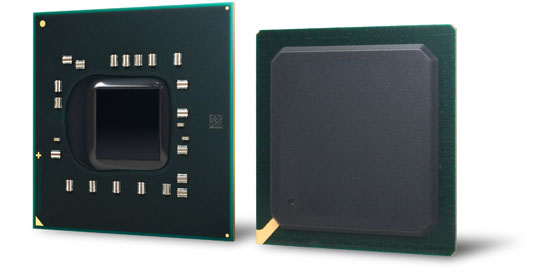
The major component of Centrino 2, and a large part of the reason for its delay, is Intel's new GM45 chipset - the mobile variant of the desktop G45 chipset.
| Intel GMA X4500HD (GM45) | Intel GMA X3100 (GM965) | |
| Shader Processors | 10 | 8 |
| Core Clock | 533MHz | 500MHz |
| H.264 Decode Acceleration | Yes | No |
| TDP | 12W | 13.5W |
With 25% more shader processors and a 6.6% increase in clock speed, the GM45's integrated graphics is definitely a step up from the GM965 chipset, which was a part of the Santa Rosa Refresh.
As we mentioned earlier in this article, we couldn't get the hardware video decode acceleration working properly on the GM45's integrated graphics. We used a beta version of Cyberlink's PowerDVD 8 Ultra (v8.0.1903.50) with support for GM45, but when playing back Gone Baby Gone we ran into some issues. CPU utilization did go down, but so did our frame rate. It was almost as if the video decode engine was only decoding half of the frames, the stuttering was that bad. Granted this is pre-release hardware, with pre-release drivers and a pre-release Blu-ray player, but going back to what we originally said - we expected a little more polish less than 30 days away from availability.
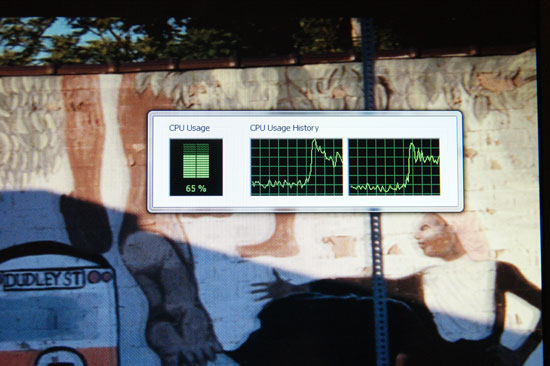
Blu-ray playback, hardware acceleration disabled
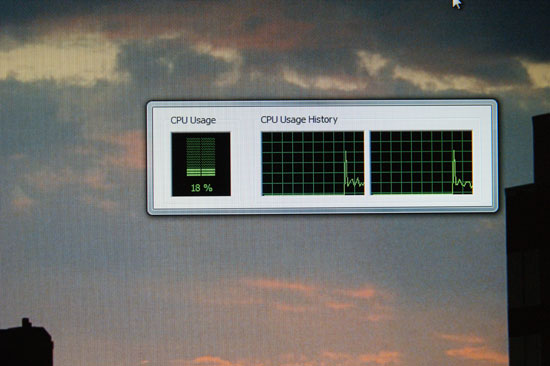
Blu-ray playback, hardware acceleration enabled - the CPU usage drops, but so does our frame rate
One interesting feature of the GM45 chipset is the ability to dynamically switch between integrated and discrete graphics, similar in nature to features announced by AMD and NVIDIA (e.g. NVIDIA's Hybrid Power). Unfortunately, our test system didn't have a discrete GPU so we couldn't test the feature ourselves. To make matters worse, Intel couldn't go into great detail about how the technology worked.
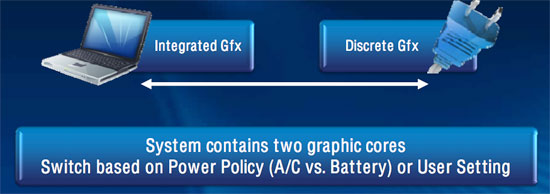
We're still waiting to find out how Intel's switchable graphics will work in practice
We were told that OEMs will either implement a hardware or a software switch to allow you to enable/disable discrete graphics, but we have no idea how it'll work. NVIDIA's implementation of a similar technology copies the frame buffer to main memory, using the integrated graphics core to output it to your display - Intel told us that its version doesn't work this way. Unfortunately we aren't sure if that means switching between integrated and discrete graphics will require a hardware reboot, or if it'll be possible to do so on the fly. We have more questions than answers here so it's better that we leave speculation alone and wait until it's something we can test ourselves.
Both the GM45 and its discrete graphics counterpart (PM45) support DDR2 and DDR3 memory, the latter being a newcomer to the mobile space. DDR2-667/800 and DDR3-800/1066 are both supported, although at the same data rate DDR3 should offer better battery life thanks to a lower operating voltage (1.5V vs. 1.8V). DDR3-667 support will eventually come with the release of SFF Centrino 2 platforms.


 Facebook
 Twitter
 RSS
RSS


12 Comments
View All Comments
gfxmatters - Friday, July 18, 2008 - link
So now that we have established that the HD video is broken (unless you like frame-skipping :>), how about the 3D and some games? I like Intel (I own many) and give them the benefit of the doubt on CPUs, but not GPUs. Why? Track record, from Vista issues to reported game perfornace and compatibility! Let's see the numbers....SmartyPants - Wednesday, July 16, 2008 - link
Not 100% sure, but don't the new Lenovo Thinkpad X200 have Centrino 2? Some people have gotten their hands on units and reviews are popping up.FITCamaro - Wednesday, July 16, 2008 - link
I'm glad this feature is finally making a real push in the market. And it doesn't get any lower power than an integrated Intel GPU. All I want on the go is web browsing, DVD playback and Office. If I'm playing a game on a laptop, its with the power cord plugged in.nysupport - Tuesday, July 15, 2008 - link
http://www.ecogeek.org/content/view/1880/85/">http://www.ecogeek.org/content/view/1880/85/kevinkreiser - Tuesday, July 15, 2008 - link
Seriously, does anyone know when G45 based boards will finally hit the market? The article mentions that GM45 laptops should be out within 30 days, but it seems like I've been waiting for what seems like 6 months for the G45.Brian23 - Tuesday, July 15, 2008 - link
I think your package info for the chips is wrong. 35mm^2 is smaller than the size of your pinkey fingernail. I think you meant to say 35mm x 35mm. That would be 1225mm^2 or 1.225cm^2.strikeback03 - Wednesday, July 16, 2008 - link
actually, that should be 12.25cm^2MrSpadge - Tuesday, July 15, 2008 - link
Hi Anand,you're writing:
"Note that here, while the voltages dropped vs. Merom, maximum current draw actually went up to 44A from 41A. This could be due to greater leakage, the higher clock speeds offered by Penryn or simple inexperience with the 45nm process compared to Intel's tried-and-true 65nm process upon its release."
It's much simpler than that. P = U*I, so if P=const (35W) and V goes down, I has to go up.
Regards,
MrS
crimson117 - Tuesday, July 15, 2008 - link
Not so much "new platform" as "new marketing opportunity for OEMs".I don't mean to knock Centrino - the original platform really did move the wireless revolution along.
Centrino2 however brings nothing new other than upgraded (or downgraded!) components.
I think AMD went the right way by including graphics requirements in their http://game.amd.com/us-en/amdgame_whatis.aspx">AMD GAME! platform, but only time will tell. Centrino is such a strong brand name it might be hard to top. It would be nice to see a gaming-based Centrino.
ltcommanderdata - Tuesday, July 15, 2008 - link
It'd be nice if you could also get a similarly configured system with the 2.53GHz T9400 and P9500 to try to ascertain the realworld battery-life benefits between the 35W and 25W TDPs. (I'd wish they'd just call the 25W TDP parts Medium Voltage, Mxxxx parts, which makes it more intuitive where they belong compared to LV and ULV parts.)And maybe a comparison between a 2.4GHz SL9400 and a 2.4GHz P8600 to see how big a difference the loss of 3MB of L2 cache is. With a 1066MHz FSB, it probably isn't a big deal.