



Opening the Kimono: Intel Details Nehalem and Tempts with Larrabee
by Anand Lal Shimpi on March 17, 2008 5:00 PM EST- Posted in
- CPUs
Prior to its Intel Developer Forum, Intel is revealing a bit more detail on some new products coming down the pipeline - including Nehalem and Larrabee.
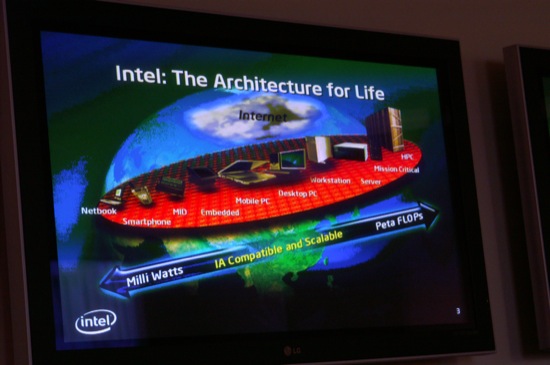
IDF is going to be all about scaling Intel Architecture from milli watts all the way up to Peta FLOPs. This is clearly a reference to the Intel Atom on the milli watts side and new high end quad-core Itanium and Larrabee products on the Peta FLOPs side.
First up is Intel's quad-core Itanium product, codenamed Tukwila:
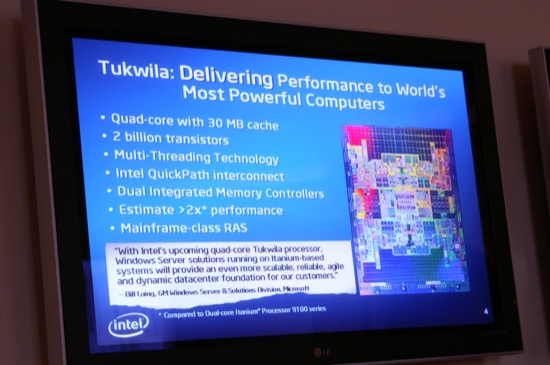
Tukwila is Intel's first chip with a full 2 billion transistors and should be shipping by the end of this year, with full systems available next year. Tukwila, like Nehalem, will support Intel's QuickPath Interconnect (QPI), a point-to-point interconnect similar to AMD's Hyper Transport. Also like Nehalem, Tukwila will feature an integrated memory controller - two in this case.
Next up was the Intel Dunnington processor, a 45nm 6-core Xeon part based on Penryn cores:
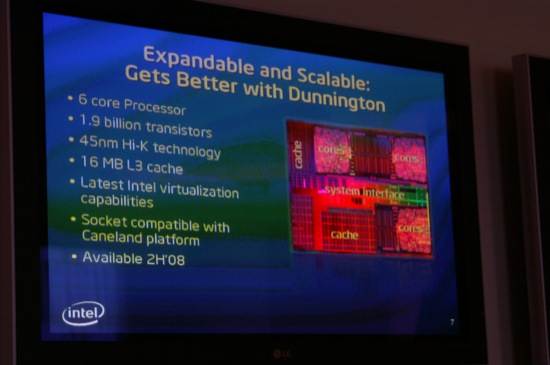
With 6 cores (3 dual-core pairs on a single die) and a massive 16MB shared L3 cache, Dunnington is close to Tukwila in transistor count, weighing in at a whopping 1.9 billion transistors. Dunnington is the first shipping product to come out of Intel's India Design Team based out of Bangalore, India.
Architecturally there's not much difference between Dunnington and current Penryn based Xeon parts, you simply get more cores and a very large L3 cache shared by all of the cores. Designing such a beast isn't an insignificant effort, but it's made easier because when Intel designs a core it designs everything up to but not including the L2 cache. The L2 and everything external to it is referred to as the "uncore" and is made somewhat modular, although not quite to the same degree as Nehalem.
Dunnington is the first step in Intel implementing a very Phenom-like cache architecture with its future Core products, culminating in Nehalem.


 Facebook
 Twitter
 RSS
RSS


53 Comments
View All Comments
pugster - Monday, March 24, 2008 - link
Intel core2duo is probably good for business, but the OS doesn't need need anything more than 2 cores running at an average of 2ghz. I know that there are people out there who wants the latest and greatest for games, but more and more people rather buy in a game console like the ps2 rather than putting money down for an geforce 9800. It seems that the only way for Intel to make money making new products like the silverthorne or going back on the flash memory race.PlasmaBomb - Thursday, March 20, 2008 - link
Since it is based on penryn isn't 16 MB of cache an odd number? Should that not be 18 MB? (i.e. 3 x dual cores at 6 MB each)IntelUser2000 - Sunday, March 23, 2008 - link
Plasmabomb, Penryn has 6MB L2, not L3. Dunnington has 16MB L3 in addition to the whatever L2 it will have, please read!perzy - Wednesday, March 19, 2008 - link
Larrabee, thats good news. Finally some competition in the graphics department!Let's face it, right now you can get 2 xbox 360's and an ipod for the price of one fast graphics card...that can't be right.
AcaClone - Tuesday, March 18, 2008 - link
What can I say ...AcaClone - Tuesday, March 18, 2008 - link
On second thought - I guess that it is possible that the demo software is indeed multithreaded, but that only one thread is running when left idle??ajg - Tuesday, March 18, 2008 - link
The slide showing Intel: The architeturr for life is a page lifted from AMDs slide "Diversifying Platform Design Tracks"link below
http://www.tgdaily.com/index.php?option=com_conten...">http://www.tgdaily.com/index.php?option...mp;slide...
The CPU architecture is no different. I guess can't make expect an old dog to come up with new tricks?
clnee55 - Tuesday, March 18, 2008 - link
Yes, AMD said it but couldn't do it. Easily said than donemicha90210 - Tuesday, March 18, 2008 - link
Is that possible? There's a limit in XP to 3.25GB of ram. XP can't handle 16GB... is that picture real?oldhoss - Tuesday, March 18, 2008 - link
I'd venture to guess either XP Pro x64, or Windows 2003 Server.