



Intel's 45nm Dual-Core E8500: The Best Just Got Better
by Kris Boughton on March 5, 2008 3:00 AM EST- Posted in
- CPUs
Initial Thoughts and Recommendations
Although the release of Core 2 Duo E8000-series Wolfdale processors will never be as groundbreaking as the Conroe launch during the summer of 2006, Intel has done a fine job of building upon their already enormously successful Core 2 platform. Reductions in power consumption, improvements in energy efficiency (especially at idle), and the amazing overclocking capacity of these processor make them downright irresistible. Now that we've had a good chance to experience all that this new 45nm process has to offer, we will be hard pressed to buy anything else. Without a doubt, Intel has re-proclaimed their dominance in the marketplace of technology.
One of the most popular uses for processors of this caliber is 3D gaming. If excellent performance is already possible when running at default speeds, just imagine the stunning frame rates displayed when overclocking to 4GHz and beyond on air-cooling alone. (Ed: Assuming you have the GPUs to back that up, naturally.) Never before has achieving these levels of overclocks been so easy. However, don't become tempted by the incredible range of core voltage selections your premium motherboard offers; it's important not to lose sight of the bigger picture.
These processors are built on a new 45nm High-K process that invariably makes them predisposed to accelerated degradation when subjected to the same voltages used with last-generation's 65nm offerings. Although we certainly support overclocking as an easy and inexpensive means of improving overall system performance, we also advocate the appropriate use of self-restraint when it comes to choosing a final CPU voltage. Pushing 0.1V more Vcore through a processor for that last 50MHz does not make a lot of sense when you think about it.
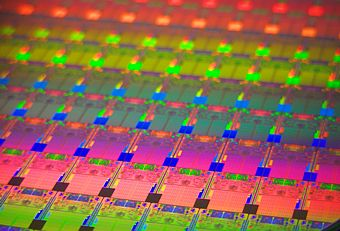
More than a couple Penryn dies will comfortably fit on a single 300mm wafer used in the manufacturing of these processors.
Perhaps even more exciting than the prospect of assembling a game rig is the potential these processors possess for use in the HTPC arena. Some of our initial tinkering has allowed us to realize the hope of creating a complete home entertainment solution capable of full-load operation at less than 90W power draw from the wall. With the recent availability and - dare we say it? - affordability of Blu-ray drives in the US, the prospect of putting together an all-in-one multimedia powerhouse that runs both cool and silent is finally becoming a reality. Of the models soon to hit the shelves, the E8200 at 2.66GHz or E8300 at 2.83GHz are sure to be winners when looking for processors suited for just these types of low-power applications. Couple this with an Intel G35 chipset with integrated graphics, Clear View Technology, and onboard HD audio over HDMI and you have all the makings of a serious HTPC.
Intel has also worked hard to make all of this performance affordable. Many US retailers now stock the 65nm Q6600 quad-core CPU at less than $200, which places it squarely in the 45nm dual-core price range - something to think about as you make your next purchasing decision. However, if it comes down to the choice between a 65nm and 45nm CPU we would pick the latter every time - they are just that good. The only question now is exactly when Intel will decide to start shipping in volume.


 Facebook
 Twitter
 RSS
RSS


45 Comments
View All Comments
mdma35 - Friday, October 9, 2009 - link
Epic Article was pleasure to read thnx for sucj informative stuffjamstan - Sunday, July 13, 2008 - link
I just did a build with an E8500. The temp always shows 30 degrees no matter how high I overclock it or what speed I have my Vantec Tornado at. Being an overclocker it stinks that I bought a cpu with a temp sensor that doesn't work. I guess its a common problem with this cpu and I hear Intel won't RMA a cpu with a bad sensor. I'm gonna be giving them a call.Johnbear007 - Saturday, March 8, 2008 - link
I'd still like to know (other than microcenter) what retailer(S) are carrying the q6600 for "under 200$". I would much rather have a sub 200$ q6600 than a 260$ e8400 from mwaveMrSpadge - Thursday, March 6, 2008 - link
I do not agree with much of mindless1's critique on page 3, but we arrive at a somewhat similar conclusion: the section " The Truth About Processor "Degradation" " is lacking. Rather than adressing my issues with mindless1's post I'll just explain my point.Showing the influence of temperature on reliability is nice and well, but you neglect the factor which is by far the most important: voltage. It's effect on reliability / expected lifetime / MTTF is much higher than temperature (within sane limits).
How did you generate the curves in the first plot on that page? Is it just a guess or do you have exact data? Since you mention the 8500 specifically I can imagine that you got the data (or formula) from some insider. If so I'd be curious about how these curves look like if you apply e.g. 1.45 V. There should be a drastic reduction in lifetime.
If you don't think voltage is that important and you have no ways to adjust the calculations, you could pm dmens here at AT. I'd say he's expert enough in this field.
MrS
Toferman - Thursday, March 6, 2008 - link
Another great article, thanks for your work on this Kris. :)xkon - Thursday, March 6, 2008 - link
where are the sub $200 q6600's? i know microcenter had some for $200, but they are no where near me. any other ones? stating it in the article like that makes me think they are available at almost any retailer for that price. maybe if it was rephrased to something like they have been known to be priced as low as $200 or something like that. then again. maybe i'm not in the know, and am just not looking hard enough.TheJian - Thursday, March 6, 2008 - link
Yet another example of lies. The cheapest Q6600 on pricewatch is $243. And that doesn't come with a 3yr warranty OR a heatsink. So really the cheapest is $253 for retail box with heatsink/fan and 3yr. That's a FAR cry from $200. Cheapest on Cnet.com is $255. Where did they search to find these magical $200 Q6600 chips? I want one. I suspect pricegrabber etc would show the same. I'm too lazy to check now...LOLMaulSidious - Thursday, March 6, 2008 - link
dunno about america but in britain you can get a q6600 anywhere for 130-150 poundsJohnbear007 - Thursday, March 6, 2008 - link
150 pounds is about 250-300$ american which is nowhere near what the articles author is claiming. One microcenter deal doesnt really constitute claiming you can bag one from retailer(S) for under 200$. Also, another poster pointed to what he called a q6700 for 80$. That is not true, it was an e6700 which is dual core not quad.Karaktu - Wednesday, March 5, 2008 - link
I would just like to point out that it has been possible to run a sub-90-watt maximum HTPC for nearly two years. In fact, I've been doing it.It DOES require a Core Duo or Core 2 Duo mobile chip, but MoD isn't a new concept.
ASUS N4L-VM DH
- Using onboard Intel graphics, Realtek SPDIF and Gigabit network
Core Duo T2500 (2.0GHz)
- Cooled by a Nactua NC-U6 northbridge cooler and 60mm fan set to low
2 x 1GB DDR2 667
Vista View D1N1-E NTSC/ATSC PCI-E tuner
Vista View D1N1-I NTSC/ATSC PCI tuner
- (That's two analog and two HDTV tuners)
1TB WDC GP 5400rpm hard drive
750GB Samsung Spinpoint F1 7200rpm hard drive
Antec Fusion case (rev 1)
- VFD
- 430-watt 80 Plus power supply
- 2 x 120mm TriCool fans set to low
- External IR for remote and keyboard
Running MCE 2005
Idles at 68 watts AT THE WALL and draws a maximum of 90 watts at full load (recording 4 shows and watching a fifth show/movie).
If I ever get around to dropping the PSU to an EA-380, I'm sure the efficiency would go up a little since I would be closer to that magic 20 - 80% range on the power supply.
Joe