



NVIDIA Introduces ESA - Enthusiast System Architecture
by Wesley Fink on November 5, 2007 9:00 AM EST- Posted in
- Cases/Cooling/PSUs
Final Words
One of the frustrations of technology launches, as opposed to actual hardware and software launches, is that no matter what you write it ends up sounding something like a commercial for the product. That is why all the writers at AnandTech much prefer the hard reality of testing a product at launch, where we can make comparisons.
Today is the technology launch of ESA, with hardware officially launching shortly. However, ESA is a new standard, driven by hardware and software, more than it is a static product. As such, it is much easier to look at ESA for the potential it could bring to a market with no real standards in system monitoring and control. ESA will try to be that new standard, and we certainly welcome NVIDIA's earnest attempt to bring some standardization and additional tools to enthusiasts and system builders. The result could be the best performing systems we have ever seen - or the quietest systems or the most self-regulating systems. Certainly, the potential is there.
How fast ESA develops into a truly effective set of system tools depends on how widely adopted the standard becomes, and how fast component manufacturers embrace the standard. NVIDIA already has laid some excellent groundwork for the ESA standard as evidenced by the large number of important industry manufacturers who have already signed on to use ESA. The company is confident that ESA will emerge as a building block for Smart PCs - confident enough that they shared their vision of the future of ESA.
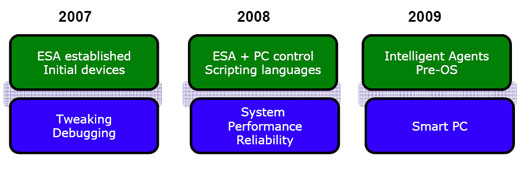
This year's ESA launch will see the initial launch of ESA components, with a heavy slant toward devices communicating monitoring information to the software interface. In 2008, NVIDIA believes we will begin to see ESA+PC Control and the development of ESA scripting languages. This could enable some very large steps toward system control and tuning, as utilities that address this segment have been decidedly lacking up until now. Finally, in 2009 NVIDIA expects to see Intelligent Agents and ESA utilities that work before loading of the OS. Removing ESA from the constraints of OS software will certainly speed development of the Smart PC as ESA evolves.
It is often difficult in the PC industry for one company to develop and champion a new PC standard. The business is competitive, and manufacturers are often distrustful of each other's motives. We are very happy NVIDIA decided ESA should be an open standard available to all, that certification for ESA is in the hands of an independent testing laboratory, and that NVIDIA has quickly built an impressive list of well-known launch partners for ESA components. All of these developments point toward a real effort to establish a new standard that will benefit computer enthusiasts and their suppliers; we can even see the potential for ESA support to trickle down into non-enthusiast market segments over time, provided it gains enough traction.
Looking ahead, it is our plan to take a closer look at an ESA system with as many ESA certified components as there are available to see how they work together. There will also be an eye toward how they might work together in the future. When we actually touch and see ESA working with a large array of off-the-shelf components we can be more confident of where ESA may go. The demonstrations at NVIDIA only scratched the surface, and while they looked interesting we want to see more.
ESA may be the winner for the new system standard for monitoring and control, or it may languish in the market place. You and manufacturers will decide if ESA is a winner. We think the idea is a good one, and if not ESA it will likely be something very similar that will take system control to the next level.
One of the frustrations of technology launches, as opposed to actual hardware and software launches, is that no matter what you write it ends up sounding something like a commercial for the product. That is why all the writers at AnandTech much prefer the hard reality of testing a product at launch, where we can make comparisons.
Today is the technology launch of ESA, with hardware officially launching shortly. However, ESA is a new standard, driven by hardware and software, more than it is a static product. As such, it is much easier to look at ESA for the potential it could bring to a market with no real standards in system monitoring and control. ESA will try to be that new standard, and we certainly welcome NVIDIA's earnest attempt to bring some standardization and additional tools to enthusiasts and system builders. The result could be the best performing systems we have ever seen - or the quietest systems or the most self-regulating systems. Certainly, the potential is there.
How fast ESA develops into a truly effective set of system tools depends on how widely adopted the standard becomes, and how fast component manufacturers embrace the standard. NVIDIA already has laid some excellent groundwork for the ESA standard as evidenced by the large number of important industry manufacturers who have already signed on to use ESA. The company is confident that ESA will emerge as a building block for Smart PCs - confident enough that they shared their vision of the future of ESA.
This year's ESA launch will see the initial launch of ESA components, with a heavy slant toward devices communicating monitoring information to the software interface. In 2008, NVIDIA believes we will begin to see ESA+PC Control and the development of ESA scripting languages. This could enable some very large steps toward system control and tuning, as utilities that address this segment have been decidedly lacking up until now. Finally, in 2009 NVIDIA expects to see Intelligent Agents and ESA utilities that work before loading of the OS. Removing ESA from the constraints of OS software will certainly speed development of the Smart PC as ESA evolves.
It is often difficult in the PC industry for one company to develop and champion a new PC standard. The business is competitive, and manufacturers are often distrustful of each other's motives. We are very happy NVIDIA decided ESA should be an open standard available to all, that certification for ESA is in the hands of an independent testing laboratory, and that NVIDIA has quickly built an impressive list of well-known launch partners for ESA components. All of these developments point toward a real effort to establish a new standard that will benefit computer enthusiasts and their suppliers; we can even see the potential for ESA support to trickle down into non-enthusiast market segments over time, provided it gains enough traction.
Looking ahead, it is our plan to take a closer look at an ESA system with as many ESA certified components as there are available to see how they work together. There will also be an eye toward how they might work together in the future. When we actually touch and see ESA working with a large array of off-the-shelf components we can be more confident of where ESA may go. The demonstrations at NVIDIA only scratched the surface, and while they looked interesting we want to see more.
ESA may be the winner for the new system standard for monitoring and control, or it may languish in the market place. You and manufacturers will decide if ESA is a winner. We think the idea is a good one, and if not ESA it will likely be something very similar that will take system control to the next level.


 Facebook
 Twitter
 RSS
RSS


28 Comments
View All Comments
PeteRoy - Tuesday, November 6, 2007 - link
BTX was a much cheaper easier solution than this, it's too bad that the hate for intel blinded people with how great BTX is.Bluestealth - Tuesday, November 6, 2007 - link
Well... it was more of Intel coming along and saying... wouldn't it be nice if you retooled all your factories for us?... I am sure in their mind it made perfect sense... however I don't think anyone else saw profit in it for them.What we really need is for Video Cards to start reigning in their power requirements,. It is ridiculous that you can have a nearly silent very high end system, but throw in a video card and the whole thing turns into a mini-cyclone... it makes makes up for all the noise and heat that the rest of the industry has worked on.
This whole ESA thing is just another gimmick that I don't want or need. I hope this thing fails so I don't have to pay for the additional expense of having it in the hardware I purchase.
Odeen - Monday, November 5, 2007 - link
I propose that nVidia should not be allowed to release any new chipsets or chipset utilities until they fix ActiveArmor. That piece of networking genius sucked too many hours out of my life.FrankThoughts - Monday, November 5, 2007 - link
What exactly was the point of this article? Seriously! I about puked when I saw the "industry quotes" - taken, I might add, straight from the NVIDIA slides. That was some quality writing, I tell you what! I'm not at all surprised that Falcon, HP/Voodoo, Dell/Alienware, etc. think this is great, because that's just one more way for them to try and pretend their insanely priced "gamer systems" are worth purchasing.I don't know that ESA is going to be a complete waste of time, but it looks more like another way to charge more money for "enthusiast" components. The stupid 1100W and higher power supplies are already making me sick. Do we really need three graphics cards? Oh, wait! There's a huge difference between 4xAA and 8xAA that we MUST HAVE!
FWIW the GPU fans that start out quiet and then spin up to insanely loud levels are not what I want for the rest of my system. I'm much more interested in a reasonble performing system that stays quiet than uber-monitored hardware that lets me know it's overheating. As if the fans spinning at 10000 RPM weren't a good indication of that already.
Wesley Fink - Monday, November 5, 2007 - link
Since you have the nVidia slides for ESA you obviously work for another website. What did you post for ESA?emboss - Tuesday, November 6, 2007 - link
Nice dodge. Actually, not really that nice, too obvious.FrankThoughts - Tuesday, November 6, 2007 - link
You don't have to write for a website to find slides, or quotes. Like this material http://www.nvidia.com/object/io_1194260551610.html">direct from the NVIDIA press release. That takes care of the Dell and HP quotes. I have written nothing about ESA online, other than these comments. I have, however, seen a couple different PPT files on the subject. Most of those are no longer available, but it's amazing what turns up on the internet now and then. I think I even had a draft version of the ESA presentation before NVIDIA even held their Editor's Day! LOLI appreciate that you were somewhat cautious in the conclusion, but that whole section on industry support and ESA problem solving just smacked of marketing rather than reporting. Numerous other sentences were ripped directly from the press release/marketing materials. If this were an English assignment, you'd be in serious jeopardy for plagiarism. Considering you write for a respected (mostly) publication, this might be even worse.
The truth is that we still know basically nothing about the actual ESA hardware and software. Will it rock my world or will it just add bloat and cost? I can tell you how many times I've used nTune (a couple tries initially, followed by a return to the BIOS as it was more useful). I doubt ESA software is going to be dramatically better. Different, sure, but probably not better.
http://enthusiast.hardocp.com/article.html?art=MTQ...">[T also has most of the slides, for the interested.
FrankThoughts - Tuesday, November 6, 2007 - link
That was supposed to be http://enthusiast.hardocp.com/article.html?art=MTQ...">TardOCP. Seems the comment system doesn't like brackets within links or something.vhx - Monday, November 5, 2007 - link
I sure they implement and code this better than nTune, which is so buggy in its current state.Ytterbium - Monday, November 5, 2007 - link
WS-Management has been around for a while and was developed for server for the same sort of purposes.