



Seagate Announces New Laptop and Desktop SSHDs (Solid State Hybrid Drives)
by Anand Lal Shimpi on March 5, 2013 9:28 AM EST- Posted in
- Storage
- Seagate
- Hybrid Drive
- SSHDs
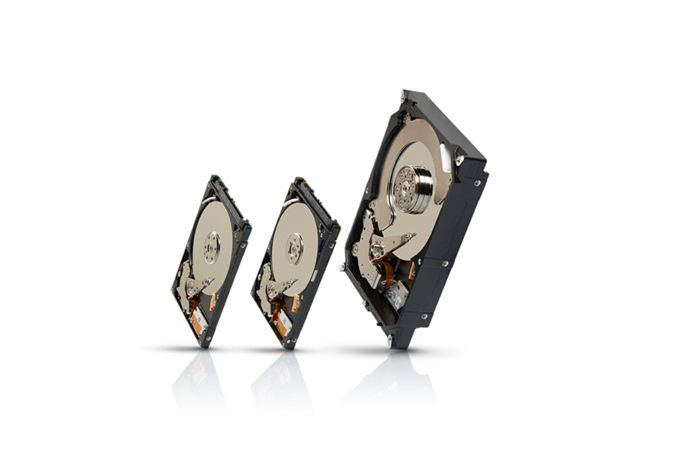
A few days ago we reported that Seagate would stop selling 7200 RPM 2.5” hard drives by the end of the year. Now we know why. Seagate will continue to offer 5400 RPM 2.5” drives, but if you want more performance without diving into the performance/capacity tradeoffs of an SSD Seagate will offer you its 3rd generation solid state hybrid drive (SSHD).
Once sold under the Momentus XT brand, the 3rd gen hybrid drives will simply be sold under the SSHD moniker. As Seagate alluded to many times in the past, we’ll also be getting a 3.5” hybrid drive as well. The two families will simply be called the Seagate Laptop SSHD and Seagate Desktop SSHD.
While both families will have many members, at launch we’ll see the following:
| Seagate SSHD Lineup 1H 2013 | ||||||||
| Capacity | Form Factor | Platters | Speed | NAND | Price | |||
| Seagate Laptop SSHD | 500GB | 2.5" 7mm | 1 | 5400 RPM | 8GB MLC | $79 | ||
| Seagate Laptop SSHD | 1TB | 2.5" 9.5mm | 2 | 5400 RPM | 8GB MLC | $99 | ||
| Seagate Desktop SSHD | 1TB | 3.5" | 1 | 7200 RPM | 8GB MLC | $99 | ||
| Seagate Desktop SSHD | 2TB | 3.5" | 2 | 7200 RPM | 8GB MLC | $149 | ||
All of the drives use a standard SATA interface, and all of them feature 8GB of MLC NAND (with a small portion of the NAND set aside for use in SLC mode, similar to SanDisk’s nCache). This is a disappointingly small amount of NAND, however Seagate hinted at future, higher performance versions shipping with somewhere around 32GB of NAND. As we found in our investigation of Apple’s Fusion Drive, the ideal number is likely somewhere in the 128GB - 256GB range but that puts you in a very different price class.
The benefit of using only 8GB of NAND is that Seagate is able to keep prices very low. Both Laptop and Desktop SSHDs are expected to carry around a $15 - $20 price premium over competing 7200RPM alternatives.
The NAND mostly acts as a read cache, although this time around Seagate claims it will be able to cache some writes. Seagate is understandably sensitive to writing tons of data to the NAND since it’s only an 8GB MLC device, but endurance shouldn’t be too much of a problem to navigate around with good firmware. There’s no data separation, everything that is written to NAND also exists on the hard drive - although it’s not clear if that write happens in tandem or sequentially.
Seagate is particularly proud of their very low time to use performance with the new SSHDs. Apparently Seagate aggressively tuned its algorithms to cache roughly all accesses that happen within the first minute of power on.
Although I’m not very excited about the performance of these drives compared to SSDs, their low price should make Seagate’s SSHDs an obvious choice compared to a traditional hard drive. The fact that we’ll get both 2.5” and 3.5” SSHDs is nice since many SSD users on the desktop are still consumers of mechanical drives as well. Personally I’m not sure how much I’d benefit from using Seagate’s Desktop SSHDs in my RAID array since I mostly do large block sequential transfers (which would be uncached) to/from the array. For gamers or folks who have an SSD that’s smaller than their total application footprint these SSHDs might be compelling.
When I first reviewed the Momentus XT I concluded “There's no reason for any performance oriented mechanical drive to ship without at least some small amount of NAND on board.” Three years later, it looks like that vision has finally come to be.


 Facebook
 Twitter
 RSS
RSS


51 Comments
View All Comments
slashbinslashbash - Wednesday, March 6, 2013 - link
"80% of your windows folder is fonts" What in the world ever gave you that idea? My Windows folder (Windows 7, vanilla install) is almost 19GB and the Fonts folder is less than 400MB.Tams80 - Thursday, March 7, 2013 - link
The Fusion drive is actually two drives.While 4 or 8GB is not much, I can tell you that even 4GB is a noticeable step up from just a 7,200rpm HDD. Start up and frequently used programs are much quicker to start up; the whole point of them.
Still, a 2.5" SSD and a 2.5" HDD, or a mSATA SSD and 2.5" HDD are better options, as you can fit the whole OS and frequently used programs (the whole program as well, not just the start up part) on them. They are more expensive though and; the former can mean you have to sacrifice a second battery/ODD/weight saver and the latter often a 3G/4G/UTMS modem.
nerd1 - Wednesday, March 6, 2013 - link
I think they are still vastly overpriced, as 128G SSDs now cost LESS THAN $100. And more and more laptops nowadays has mSATA slot too (except for apple :]) so I don't see any reason to get hybrid HDD at all.ET - Wednesday, March 6, 2013 - link
I'd wait for some benchmarks, but I can see buying these for the laptops I have, if they get a reasonable performance increase for normal use. Not that I really use my laptop (tablet fulfills my needs), but my wife's could use this.ET - Wednesday, March 6, 2013 - link
By the way, looks like they're currently selling way over the SRP. $110 and $150 for the laptop drives at Newegg. $82 (with shipping; good price) and $145 at Amazon.Wolfpup - Wednesday, March 6, 2013 - link
In case anyone's looking to buy-the second gen Momentus XT has a 7200RPM 750GB drive, 32MB RAM cache, and 8GB SLC. This has 5400RPM, presumably 8MB RAM, and 8GB MLC. Every spec is worse, save for the extra 250GB.cjl - Wednesday, March 6, 2013 - link
Why would you presume a cache size of 8MB when the last gen one had 32? Even low end drives tend to have 16MB cache...T2k - Thursday, March 7, 2013 - link
Someone is truly clueless at Seagate - look at WD, at least they will ship their hybrids with 32GB flash, now that's something, that will make a difference.fteoath64 - Thursday, March 14, 2013 - link
If Seagate has ANY sense, it would build a multi-port sata chip in the disk and has an msata connector (space for it, there is enough space on the metal parts of a 3.5 inch disk) so one can plug any of your own Msata drives into the HDD. Then run with it from a single sata port!.The beauty of this design is on a Mac, it can become a Fusion drive right away!. PC based users can use their own caching software or just (JOBD) install an OS on the msata and use the HDD as data drive. On recent Intel board SRT the thing .... (8G of MLC these days!, ha!.).
chas488 - Tuesday, March 19, 2013 - link
The best way is to get a WD Raptor drive and a Sandisk 30g cache drive.I love the setup and got the Raptor for half price at Newegg when they were on sale. I found out after reading a lot of reviews that the Sandisk cache drive has the best software. This setup is fast and have had no problems with it.