



Microsoft Surface Review
by Anand Lal Shimpi on October 23, 2012 9:01 PM EST- Posted in
- Tablets
- Microsoft
- Mobile
- Surface
- Windows RT
Surface: Simply Put
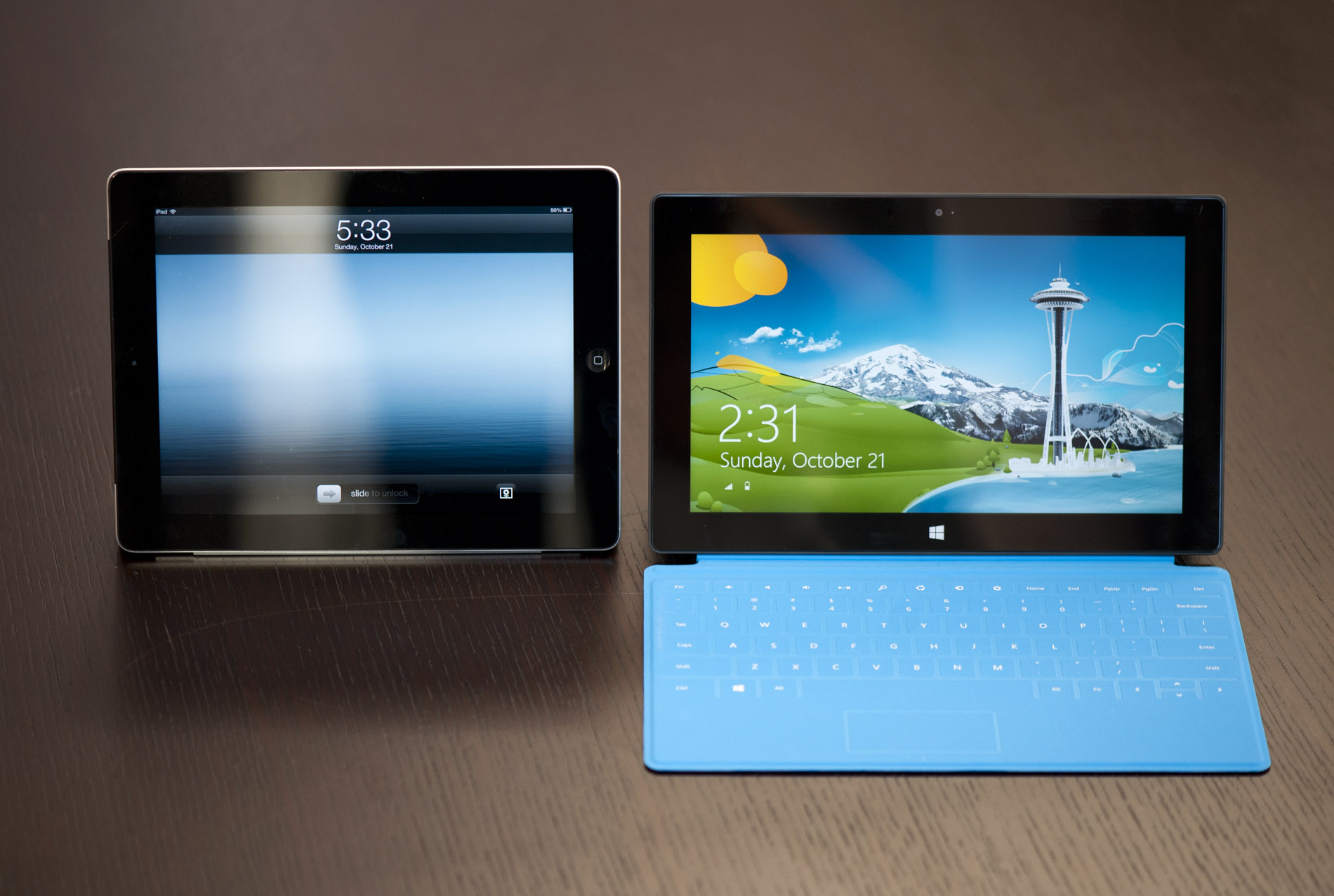
Surface is very well built and extremely well designed. It’s easily among the best built products I’ve had the opportunity to handle, and definitely puts a lot of earlier attempts from far more experienced companies to shame. I wouldn’t say that it looks better or worse than the iPad, it’s simply different. I talked about perspectives earlier, Microsoft’s perspective on tablets is a bit more utilitarian than Apple’s and Surface’s design reflects that reality.
Where the iPad is curvy and without any IO expansion, Surface is squared off with 22-degree beveled edges. The iPad features a light aluminum finish while Surface contrasts with its dark Magnesium surface. Not better or worse, just different.
Surface is both larger and heavier than the iPad, both design decisions on Microsoft’s part to built a device that could better deal with Windows RT’s multitasking capabilities as well as make room for a comfortable typing area when used with one of its two keyboard covers.
The added weight is offset by superb internal weight distribution. Microsoft claims a lower moment of inertia by more evenly distributing weight inside Surface’s chassis. I don’t know that I’d consider Surface light but it is very comfortable to carry around. It’s not quite like porting around a pad of paper, but carrying Surface feels very natural.
The focus on weight distribution results in a device that is honestly comfortable to hold in tablet mode and very comfortable to carry around. The more squared design of Surface actually makes in hand feel more like a book than the iPad, which was an early goal for the device.
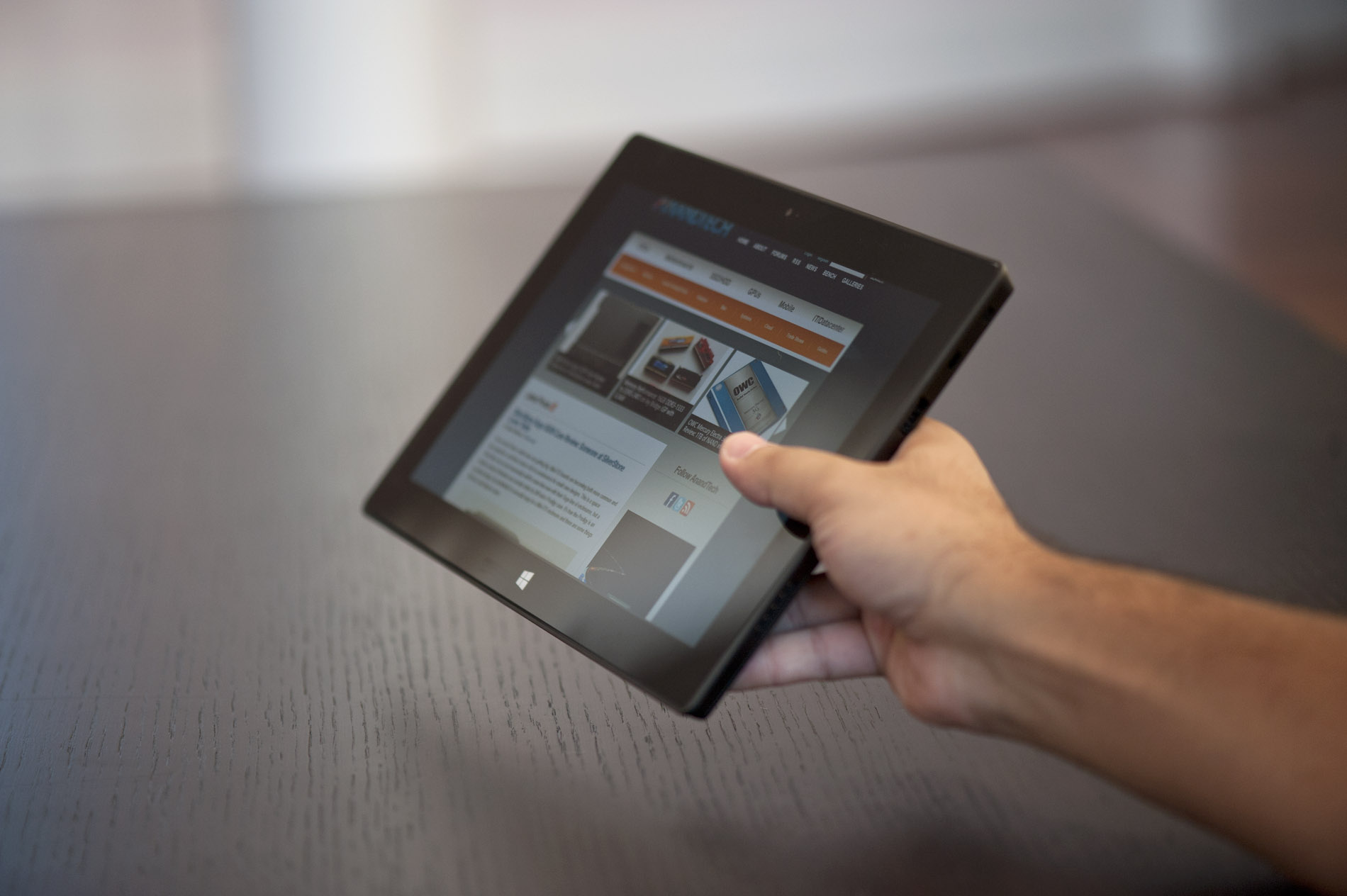
The chassis is built out of an injection molded Magnesium, which gives it a very different feel to most machined Aluminum or plastic tablets we’ve used in the past. Microsoft calls this process VaporMg (vapor-mag) and I have to say that I’m pleased with the outcome. Surface’s finish is smooth and lacks the same texture that we’ve come to expect from machined Aluminum. The device feels very durable and doesn’t seem to scratch or scuff easily, although I didn’t purposefully try to mar my review unit over the past week. Striking a balance between robustness and light weight is very tricky business when building mobile devices, Surface easily falls on the robust side of the scale without feeling overly heavy. I never felt that the device was too fragile.


The power of Surface is in its flexibility. Microsoft’s talents not as a software developer nor as a parts assembler are what make Surface great here, rather its design and manufacturing intuition. I would’ve expected Surface to come from a company that had much more experience in designing and building tablets and PCs, not from a company that’s traditionally known for putting stickers all over them.
Surface’s flexibility comes from three areas: the tablet itself, the integrated kickstand and the optional Touch/Type covers. In tablet mode, Surface is Microsoft’s take on the new wave of tablets. It delivers the same intimate content consumption experience that you’d get from other tablets but with the added benefits of Windows RT, such as improved multitasking and better task switching.
Surface also features an integrated kickstand, also made out of the same VaporMg process as the rest of the chassis.
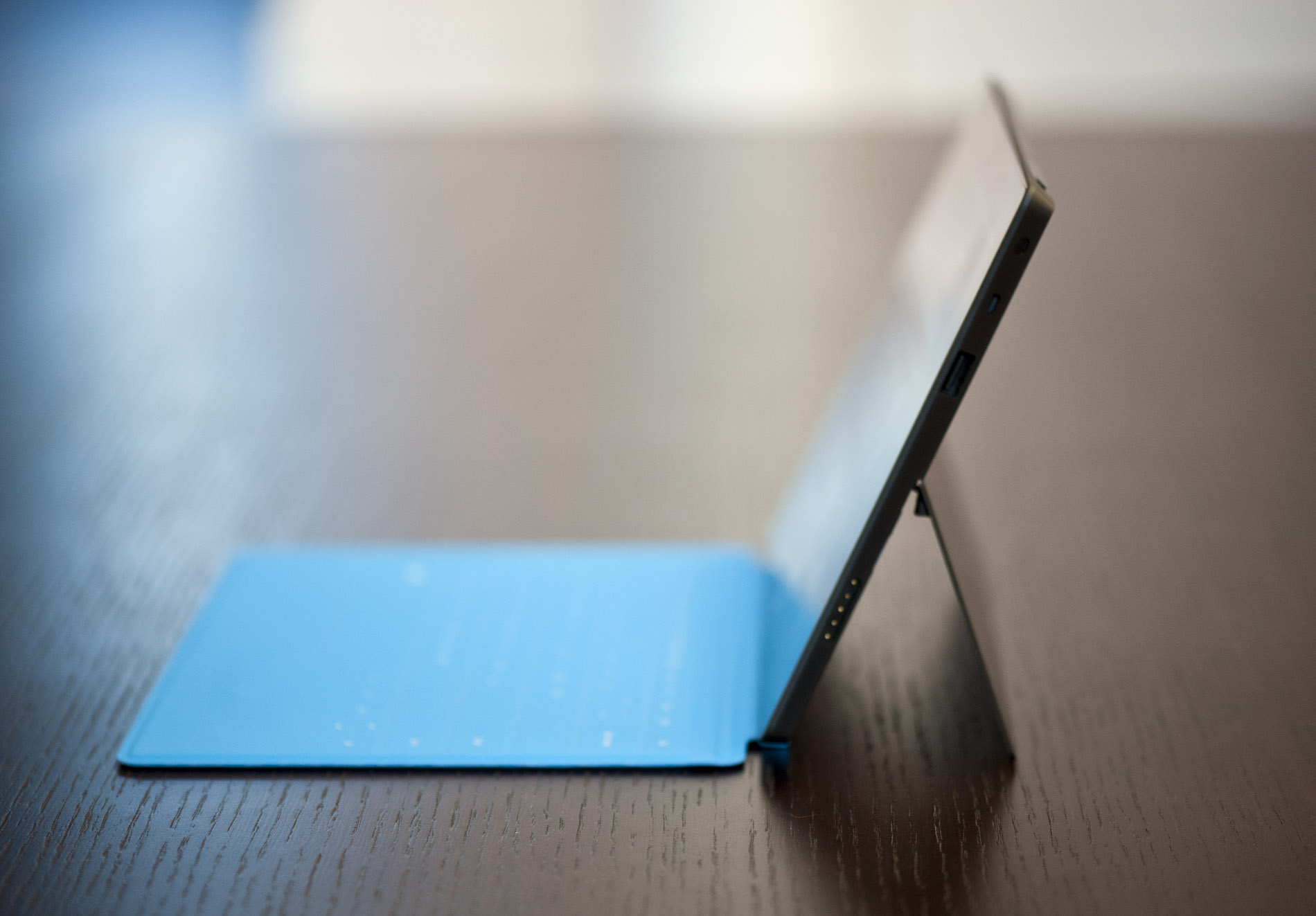
Microsoft wants you to be able to quickly transition between notebook, tablet and display modes. It’s rare that I see a goal so well executed. Surface really masters the art of quick transitions between all three modes. I can be in word, typing out this review and quickly switch to a tablet mode where I’m browsing the web with the keyboard cover folded neatly behind the display. If I need to respond to a comment or answer an email, I can just as easily switch back. The kickstand is a necessary part of enabling these quick transitions, and it does its job well.
There’s only one side of Surface that has a cutout for you to easily flick the stand out from its resting place. The kickstand’s range of motion does take some getting used to. It’s spring loaded enough to pop out at good velocity (and strong enough to pinch your skin nicely if you close it on a part of your finger by accident). When deployed it positions the top of Surface away from you at a 22-degree angle, matching the bevel of Surface’s edge.
With a fixed angle of deployment the kickstand doesn’t always deliver the best viewing experience, although it’s usually good enough. The kickstand is perfect for desk use and even for using while reclined on a couch or even in bed. Where it does fall short is if you’re hunched over Surface on an airplane in coach without a lot of room to move the device away from you. In those situations you’re going to find that you’d wish the kickstand could open at a wider angle.
Microsoft is particularly proud of the acoustics and feel of the kickstand. In my experience I felt the kickstand actuated nicely but I don’t know if I’d go so far as to draw the luxury car door comparison. The best way I can put it is the kickstand never feels cheap and doesn’t rattle, it works and gives you the confidence that it’ll always work and not just break after half a year. It’s not often that I find a substantial moving part on a mobile device that I feel is more functional than gimmicky. Surface’s kickstand is definitely a job well done.
The third element of Surface that makes it a very flexible device is also responsible for the splash of color in the design that gives the otherwise business appearance a consumer twist. I’m talking about Surface’s Type and Touch Covers.


 Facebook
 Twitter
 RSS
RSS


235 Comments
View All Comments
bogieworf - Thursday, November 29, 2012 - link
While I cannot disagree that it would be better to wait and see how these windows tablet/PCs shake out, this is still an exceptionally well sorted out product for a first try. If you need a tablet with the qualities this tablet has, there is no reason to wait. The next gen will be better (aren't they all, pretty much???), but I doubt that it will be dramatically better. The only competition on the horizon right now is the Lenovo Yoga 11 which will be more expensive, probably heavier, and definitely thicker. I don't think this will be much competition (But I do like the Yoga 13 which is a different device aimed at a different market).The next gen will be better, but this is a solid device and it is good enough today to buy IF this tablet meets your needs
bogieworf - Wednesday, December 12, 2012 - link
After using the Surface for several weeks and talking with co-workers who are in the market for a tablet/laptop, I have to reluctantly give the Surface a failing grade. MS has positioned the Surface as the productivity tablet. The catch is that you have to offer enough productivity for people to care about your device and buy it over an comparably priced iPad.The problem is NOT RT or anything taken out out Office to make it work on the Surface. For the vast majority of people, this is a secondary device and those compromises are fine. Heavy word processing or other productivity will be done on a bigger, more capable device.
Rather the problem is that many, if not most offices, have some SW which has to be downloaded onto your computer in order to access their network and Surface won't let you do that. That is a MAJOR omission. The Office suite covers close to 100% of what most people would do with a tablet like this, but I HAVE to be able to connect to my office!!!
A second and basically related issue is that there is no cellular option. This is a highly portable device and I need the option to connect to my Office on the go. That is not possible with the Surface.
With these two options, the Surface would work for most people as a media tablet with secondary, but meaningful productivity capabilities. Without them, the Surface RT just does not offer enough productivity for most people to prefer this device over an iPad.
bogieworf - Thursday, December 13, 2012 - link
Sent my comments to MS regarding the need for the Surface RT to connect to offices. Their response: the Pro will be available in January. While I do not think the Surface is a direct competitor with the iPad, the iPad does set the top price that people expect to pay for a tablet. If you are gong to price your product at the top of the market, you need to make sure the value proposition is there. Just not convinced that the productivity offered by the RT is sufficient to justify the price if you cannot connect the device to your office (or college).Kit Karamak - Wednesday, February 26, 2014 - link
when paying for iPad, you're also paying for a device that has lots of apps, a vast bevvy of choices, etc.The MS Store stinks, let's face it. Some people would rather get a 16GB ipad2 referb with all the apps they know and like, than to get a surface 32GB that has expandable microSD space, because the apps stink. :(
I have both. I use both for what I intend them for. But not everyone has that option. Then again, having all these gadgets also means I don't own a TV or pay for cable as my trade off. It is what it is. But both devices are great for what they do best. :)
Of course, I waited until the surface came down to $199 on eBay, and yet I bought the iPad Mini 2 /Retina at full price. Ironically, I'm an Android fanboy lol
Kit Karamak - Wednesday, February 26, 2014 - link
Now that you can find the Surface RT on eBay, refurbished by Microsoft with 8.1, for a low price of $199 in mint condition, I've decided to take the plunge.I'm glad I did. I'm an aspiring novelist. I type a lot, and 8.1 seems to be quite smooth. It runs great. Typing doesn't slow things down one little bit.
The first gen RT runs Grand Theft Auto: San Andreas very well, and I can use my xbox 360 controller to play it. In desktop mode, I can have twitter open in the desktop browser, I can have outlook polling for email, I can type a document and have Facebook up all at the same time. Or more if I want. People often say to get rid of Metro UI for desktop w8, and get rid of desktop for Surface RT/2, but I disagree. Having the desktop mode is fantastic for having ten different windows open (or more if you can squish everything down lol), and the RT, for me, keeps up fairly well.
W8.1 seems to have fixed things people have complained about. I cannot say much more on the subject because I've only owned the tablet for two days, now.
Touch cover is good, two finger scrolling works fine. Type cover is NOT very good. It doesn't let you use the mouse and keys at the same time, meaning you cannot game; these covers do not handle several key strokes at the same time either. Just two or three. In other words, don't expect to use it as a piano replacement for a piano app, or something like that. (I can't really think of a better example at the moment).
Battery is good. Brightness and darkness is good. I hate having things bright when I'm reading at night. And while it's kind of weird to read on this monster-length screen, it can get darker than my iPad 4, which is great when you're in a ridiculously dark room (or re-reading /revising in the dark with a Migraine - yeah I've done it).
moving on, I have to say the microSD card moves fairly quick. As fast as you'd expect from a desktop version of the same thing plugged into a USB2 header on the mobo. It's not searing fast, and it's no slouch either.
The Microsoft store, for gaming, sucks horribly. If San Andreas wasn't on there, I wouldn't even have anything nice to say at all. But I'll take what I can get. Netflix app is good. Always appreciated, y'know? I wish YouTube had one as well, so that you could watch high def videos for long periods of time in an optimized state but... that's okay. Google only has one app for the MS Store - "Search". And that's it.
Speakers are horrible. They're loud enough for watching Netflix, sure. but if you play music or crank them for something other than TV show compressed dialogue sound... then they will distort when you've got the volume up. Not badly. But if you listen to dynamically compressed music (any modern rock or rap or pop group), which is dynamically boosted in the mastering process... then you can be SURE it will distort a little. As an example, the first Foo Fighters album (at full volume) does not distort. But the new Falling in Reverse album distorts horribly. The Chronic (Dr Dre) no distortion. New Eminem? ...Crazy distortion.
RT is supposed to get only 5 points of touch at one time. I have no idea if this is hardware or software based. PRO gets 10, so I've read.
Also, plugging in a 24" Dell 1920x1080 to the first gen RT works fine. At least for me on 8.1 ... but don't expect to game on it. Use it for writing, or having a website open off to the side, or keeping Facebook open while you watch Netflix on your smaller monitor... or just use it for Netflix on your TV and do nothing on the touch screen.
I have NOT tried to see if sound is sent out through the HDMI port. I suspect it should, but I haven't yet tried it, as there are no speakers in my 24" Dell. Sorry, gang.
Finally, battery has been great. It's onpar with my iPad1 and son's iPad mini (1st gen) which have been the best for iPad battery life that I've seen so far (I own the 1, used to own the 2, owned the 4, and an ipad mini2 with retina. The 1 and my kid's Mini1 have the best iPad battery life of the group).
The surface holds its own easily with the 4 I used to own and the mini/retina I currently use.
Finally, as a closing comment, I can plug in my Apple keyboard, which has a USB hub, and it will still power a mouse, connected through the keyboard. It powers two devices. I'm quite happy with that. It makes things a lot easier, to be able to bypass the need for a powered hub is huge for me.
When I'm on the go, I use a Microsoft Bluetooth Entertainment 7000 keyboard. Most of the extra keys work - Volume rocker, dedicated back key, etc. But a lot either doesn't, or isn't marked properly. Fn-F4 has a "home" picture (and when paired to an iPad DOES take you 'home'), but on the surface, it opens the mobile metro version of Internet Explorer.
Also, the other buttons do nothing (magnifying, favorites, music app, camera button, calling button, gadgets obviously, etc). However, the built in mouse it has on the side works great. So that's awesome. I use that most of all. It pairs instantly. As soon as I turn on the keyboard, it starts working right away with Surface. There's no lag time in re-pairing.
If you've read this far... well, thanks for reading! I hope it helped!
I don't know why these websites don't re-review products that have been out for a while. Obviously iPad1 with iOS5.1 and iPad2 with iOS7, and Surface1 with W8.1 are going to work very differently than when they were reviewed. Some things will be better, some will be worse (like battery life on the iPad 4, LOL. Got it became awful later on).
I'd like to suggest to these tech sites to do a "Where are they now" kind of segment to show people interested in buying older tech (IE from ebay) how these devices stack up.