



AMD A10-5800K & A8-5600K Review: Trinity on the Desktop, Part 2
by Anand Lal Shimpi on October 2, 2012 1:45 AM ESTGeneral Performance
SYSMark 2012
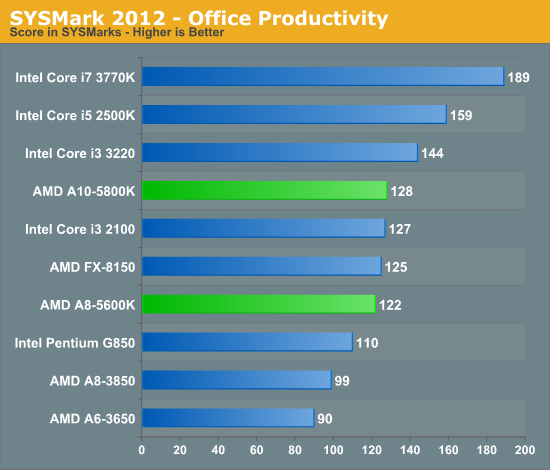
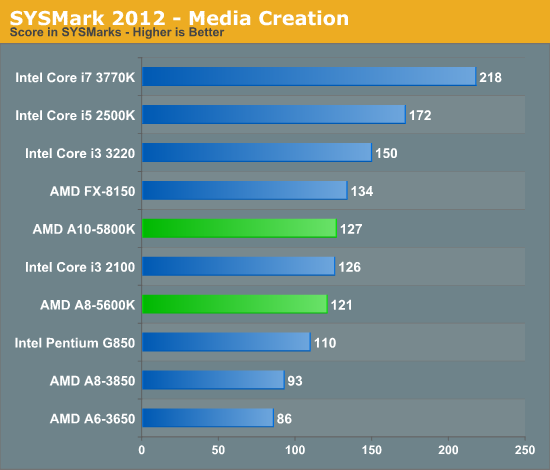
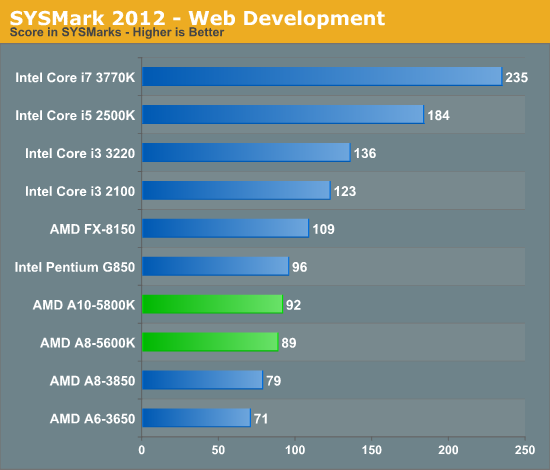
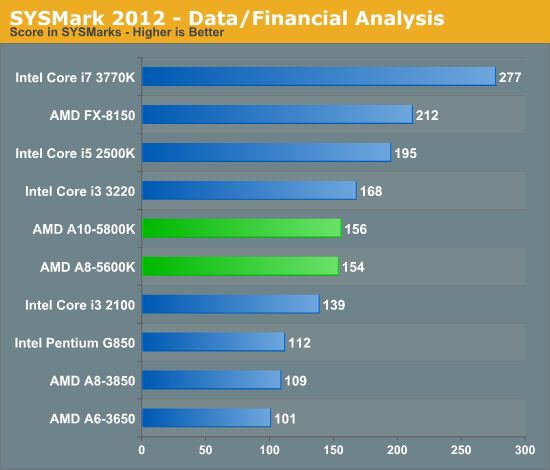
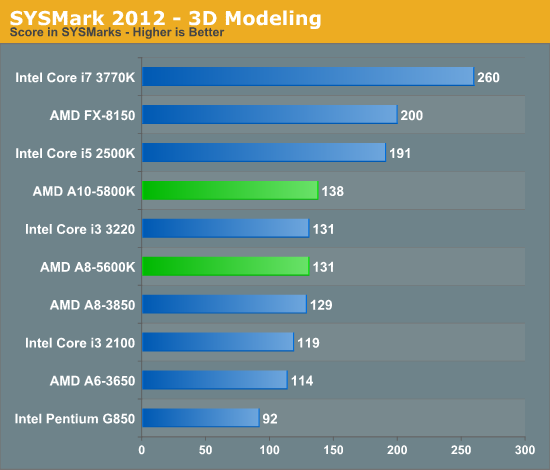
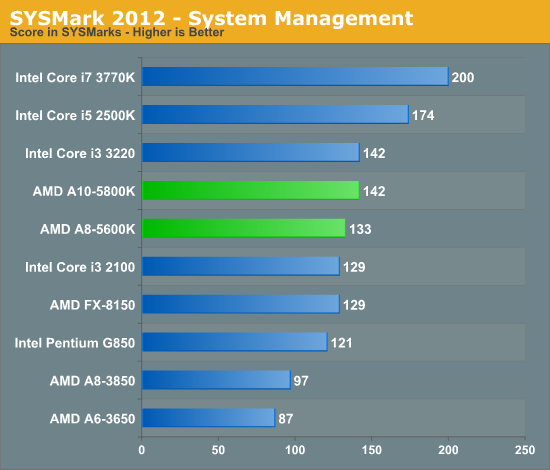
Although not the best indication of overall system performance, the SYSMark 2012 suite does give us a good idea of lighter workloads than we're used to testing.
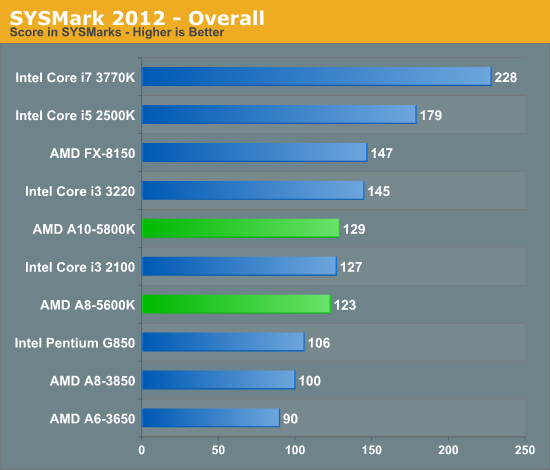
AMD does surprisingly well here in SYSMark 2012. The Core i3 3220 manages a 12% advantage over the 5800K, but that's not as much as we'd normally expect given the significant single threaded performance deficit we pointed out earlier. Once again, whether or not Trinity makes sense for you depends on how much you value processor graphics performance.


 Facebook
 Twitter
 RSS
RSS


178 Comments
View All Comments
SymphonyX7 - Tuesday, October 2, 2012 - link
Idiotic assessment. On the GPU side, AMD completely dominates Nvidia from the low-end all the way up until just below the high-end. They may not have the fastest of the fastest, but volume-wise they do sell more simply because they beat the competition in performance for the same dollar. It has something to do with Intel's business practice particularly with OEMs that make them sell more at every price point.meloz - Tuesday, October 2, 2012 - link
I can only assume that the bold "Idiotic assessment" declaration was to describe the diarrhea that followed in the rest of your reply, because nothing about that made any sense or correlates with reality.Today we learnt: AMD "dominate" and outsell nvidia, although no one is quiet sure what this fantastic fiction has to do with the discussion about CPUs.
Today we learnt: Intel are somehow being shady with their OEM customers to sell more CPUs. And yet, these OEM customers prefer to deal with 'shady Intel' -and Intel continue to make record profits- inspite of the "fact" that AMD offers more performance / $.
Those OEMs be crazy. The consumers be crazy. Erryone crazy, but pure and noble AMD.
In your desperation to find anything positive about AMD -and all things negative about Intel and nvidia- you come across sounding like Comical Ali.
owlxp - Tuesday, October 2, 2012 - link
I'm not trying to bash either company here. Facts are facts. Intel has more compute power and AMD is better on the GPU side of things. I'd just rather see something that pushes the limits of Trinity's benefits and see how it stacks up (dollar to dollar) to what something intel can offer. To not post the max allowable gpu for a hybrid crossfire set up seems like huge oversight to me. Strapping on high end discrete cards to each processor is a pretty useless test, IMO. It's no secret that intel has been stomping AMD in sales......I never argued that. That doesn't mean that the market can't shift. The average computer user might be ok with "good enough computing/entry to mid level gaming." It seems like that is what AMD is gambling on. If the number of power users decline and the the low end market grows, AMD stands to do very well. All speculation of course, but, it appears that this is AMD's strategy. The fact that it wasn't the right approach for the past few years is irrelevant. Trinity now gives AMD something intel cannot match (dollar for dollar) It's now in the hands of the consumers.Byte - Tuesday, October 2, 2012 - link
Me and a lot of buddies still have first gen i7s and such, how does Trinity compare to to them. Any sites do a lot of benchmarks with older processors for comparison?Penti - Tuesday, October 2, 2012 - link
There is i7 860 in the benchmarks, and yes a 2009 CPU still has about the same power as a modern mainstream desktop processor. In that way it has stagnated, but at least AMD tries to do architectural improvement every year now. Let's see how that goes, but they need to bring in some talent. K8 was around for more then four years without any real architectural changes. K10 was around for about 4 years too. It's also a good thing that you don't need to buy a new rig just for the performance every few years now. A three year old cpu still has about the same power as mainstream today, so as far as say gaming goes it's mostly about the GPU. All that has been introduced since 2009 is basically SATA 3/ 6gbps, PCI-e 3.0, USB 3.0 two of which you could add to a system with an add-in board. We are still on DDR3. It will take some time before we see any major increases. Most has come in the mobile/notebook form factor. AMD get's GCN integrated graphics next. That will have to wait for Kabini/Temash though, and HSA has to wait for Steamroller/Excavator. It think they set the bar a little low with 10-15% performance increases each year though, that might be fine but they also need to leap to something truly new with performance before that is a satisfactory gradual increase.abianand - Tuesday, October 2, 2012 - link
how about some gaming tests at 1920x and 1440x?after all, there are a lot of ppl playing at these resolutions - including me at 1920x.
Kevin G - Tuesday, October 2, 2012 - link
With a discrete GPU, at 1920 x 1080 you'll generally be limited by the discrete GPU. There are exceptions depending on what game/video card is used but there wouldn't be much to gain by testing this.Testing at 1920 x 1080 using the integrated graphics with modern games would be painful. It doesn't matter if the integrated graphics were from Intel or AMD, you'd get a slide show due to the lack of memory bandwidth on these parts. The only hope for integrated graphics to pick up performance would be using eDRAM to side step the bandwidth issue a bit.
abianand - Tuesday, October 2, 2012 - link
you're right...playing at 1920x with any IGP leads to non-smooth gameplay in a few games.However, if someone needs the 4 integer cores and is also looking at the A8 and A10 chips as possible cheap/value gaming chips - they are just $130 - perhaps they need to know how it performs at that resolution.
About the 1440x and the 16xx resolutions, I am from India and here many still use the 'lower' resolutions.
I am just saying that that extra information would (have) be useful, is all.
Roland00Address - Tuesday, October 2, 2012 - link
If you are a cheap gamer adding a discrete get the Athlon x4 750k which is the trinity cpu sans the integrated graphic and is to have an expected price of $81. It also has an unlocked multipler.Use the $40 dollar savings to get a bigger graphics or a larger size ssd.
abianand - Tuesday, October 2, 2012 - link
yes, that's a good suggestion !