



Preparing for the iPhone Next: Rumors Analyzed
by Brian Klug & Anand Lal Shimpi on August 27, 2012 9:40 PM EST- Posted in
- Smartphones
- Apple
- Mobile
- iPhone
While we typically don't comment on rumors we don't know to be true at AnandTech, we often get requests to help set rational expectations ahead of major iDevice launches. The shroud of secrecy around major Apple launches can pave the way for both sensible and unrealistic conclusions.
Given the growth of Apple's iPhone/iPad devices, it has become increasingly difficult for suppliers in the chain to remain mum about any changes. Similar to how we often get early access to CPUs, motherboards and other components out of Taiwan, it has become increasingly commonplace to see leaks of iDevice components out of the big ODMs in China.
Apple is largely expected to launch its sixth iPhone next month. The historical cadence of design, SoC, and cellular changes are in the table below:
| Apple iPhone - Historical Trends | |||||||
| Release Year | Industrial Design | CPU Architecture | GPU Architecture | Cellular Architecture | |||
| iPhone | 2007 | 1st gen | ARM11 | MBX-lite | Infineon S-Gold 2 | ||
| iPhone 3G | 2008 | 2nd gen | ARM11 | MBX-lite | Infineon X-Gold 608 | ||
| iPhone 3GS | 2009 | 2nd gen | Cortex A8 | SGX-535 | Infineon X-Gold 608 | ||
| iPhone 4 | 2010 | 3rd gen | Cortex A8 | SGX-535 | Infineon X-Gold 618 in 4 GSM / Qualcomm MDM6600 in 4 CDMA | ||
| iPhone 4S | 2011 | 3rd gen | 2 x Cortex A9 | SGX-543MP2 | Qualcomm MDM6610 (MDM6600 w/ ext. trans) | ||
| iPhone Next | 2012 | ? | ? | ? | ? | ||
Trends are pretty easy to spot in the table. With the exception of the first iPhone, the industrial design appears to be on a 2-year cadence. The CPU and GPU architectures are also on the same 2-year cadence. From a silicon standpoint even the cellular architecture is trending towards the same 2-year cadence, with a few notable exceptions (e.g. GSM/CDMA iPhone 4 divide).
Based on historical trends alone it's pretty easy to conclude that we'll see a 4th generation chassis, a pair of ARM Cortex A9s and a PowerVR SGX 543MP2 under the hood. Add the assumption of LTE (a reasonable one to make) and you have a pretty believable story. It turns out the currently available evidence helps corroborate this, but let's dig through what's out there to see how this all fits.
Chassis & Display
The chassis is largely a known quantity by this point. Enough examples out of China have surfaced to support the current working theory of a 4-inch diagonal (16:9) display in a slightly taller chassis with roughly the same width. Put simply, it's a new taller aspect ratio, which also has the consequence of including a larger 4-inch, 640 x 1136 display. The result is a change only in one dimension for developers to worry about.
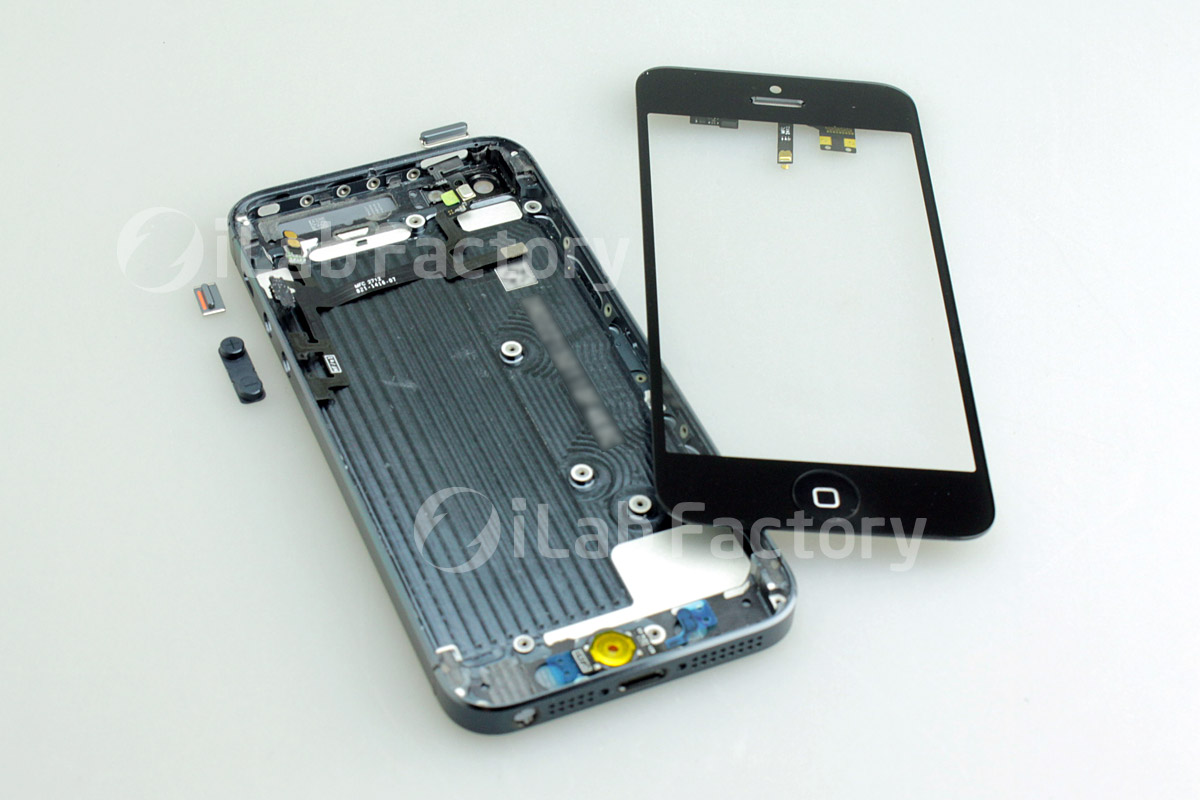
The other big rumored change is a move from on-cell touch sensing (which places the drive and detect ITO layers above the LCD assembly) to an in-cell touch solution. In-cell being the operative word because the drive layers are integrated into the LCD gating (or use it natively), or on the color filter layer. There's some debate about what counts as on-cell and in-cell that isn't quite settled, but ultimately what it boils down to is a thinner display stack that will contribute significantly to the reduction in overall device thickness that is rumored for the upcoming iPhone.
While the industrial design remains quite similar at a high level, there do appear to be some major changes. Where the 4 and 4S designs used front and back glass with an external metal band for support, the leaked designs out of China feature a metal unibody construction with cutouts for RF windows at top and bottom. There's enough evidence of this from the CNC machine marks visible on examples, and moreover moving to a larger form factor requires a beefier chassis.
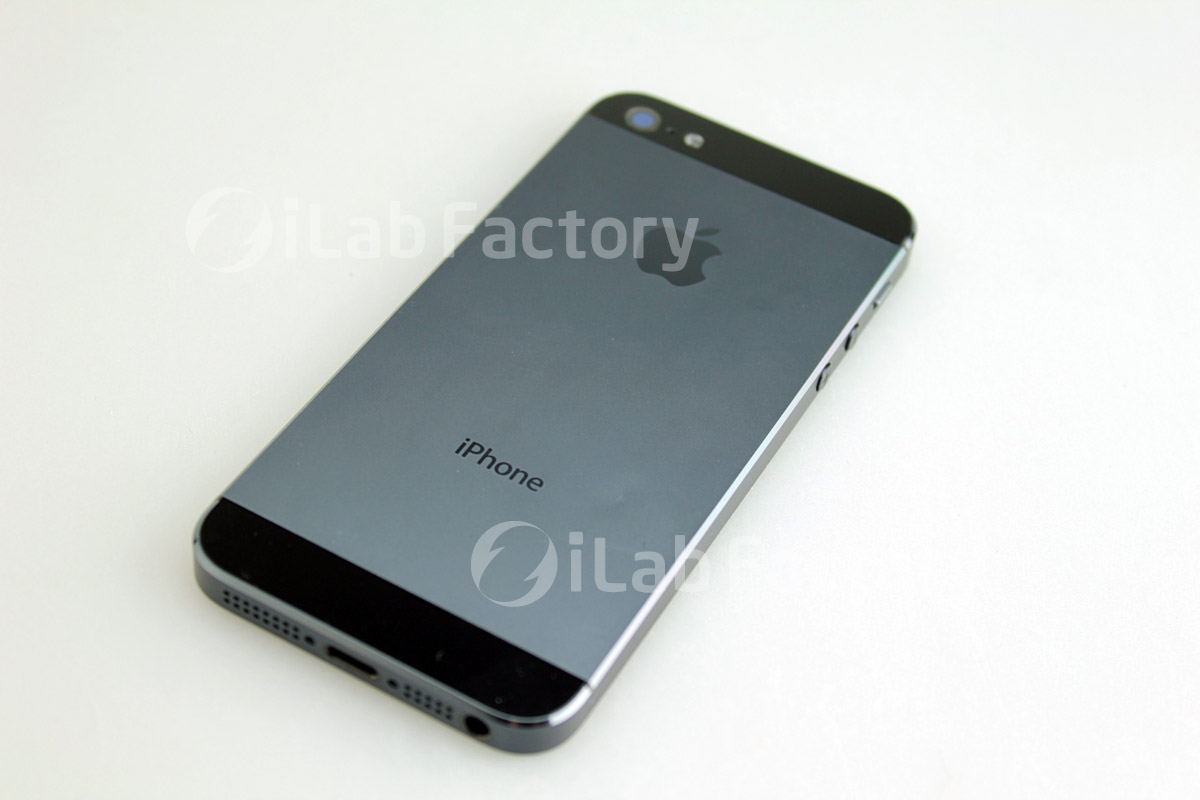
Black regions at top and bottom are likely RF window cutouts
With top and bottom RF windows (which appear to be glass) there shouldn't be any implications on antenna performance for cellular. If you followed our coverage of the evolution of Apple's cellular antenna design from the iPhone 4 GSM, to 4 CDMA, to 4S, you'll notice that this is a clear next step, largely inheriting the top/bottom antenna split from the 4S which fully mitigated deathgrip. Interestingly enough the exterior band appears to have a different chrome finish rather than the matte stainless steel of previous designs.
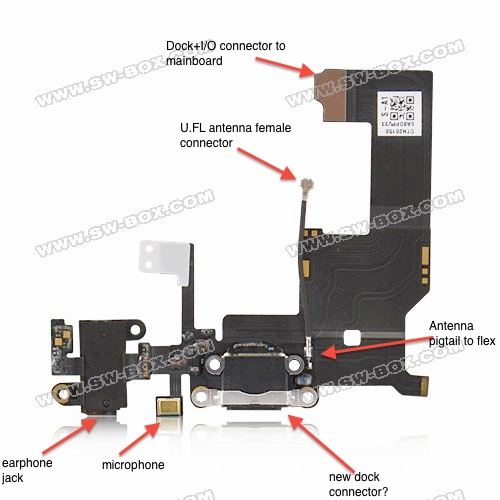
Bottom flex cable, annotations ours
Other things like moving the 3.5mm headphone jack to the bottom of the device and the mini 9-pin dock connector are fairly well corroborated by leaks with components that all fit together inside the case. Interestingly enough, parts indicating the mini dock connector and relocated headphone jack have been circulating for nearly 4 months.


 Facebook
 Twitter
 RSS
RSS


131 Comments
View All Comments
alxx - Tuesday, August 28, 2012 - link
but do ordinary consumers really care about whats under the hood(unlike us) ?A phone that works and with good battery life.
And whats on special at the carriers with a decent plan wins over the phone choice most of the time.
swb311 - Tuesday, August 28, 2012 - link
False, iOS is a thrifty OS that uses resources far better and efficiently than an off-the-shelf component thanks to Apple's custom designed silicon. So it may not look the same on paper, but the processor will feel just as fast. No one needs a quad core phone yet (apps are not prepared) so why take the battery hit? I'd rather have an upclocked dual core honestly.KoolAidMan1 - Tuesday, August 28, 2012 - link
"The iPhone is the new dumbphone"Considering that the iOS app selection is the best and largest of any mobile ecosystem, I'd say no, pretty much the opposite
KoolAidMan1 - Tuesday, August 28, 2012 - link
"they mgiht go for dual A9 (they certainly won't go quad) but that's so far behind the top phones"Even most PC applications don't use quad-cores, forget smartphones. No smartphone multitasks applications enough where quads would really matter. We're a few years away from where quad core SoCs are needed in cellphones. Until then it is marketing for neckbeards who look at spec pages without regard to practical usage scenarios or performance.
iampivot - Monday, August 27, 2012 - link
What about a fingerprint scanner?It seems obvious that one could be included in the home button, which would facilitate instantaneous verification of the user when doing NFC purchases.
8steve8 - Tuesday, August 28, 2012 - link
no a15?A5 - Tuesday, August 28, 2012 - link
Won't be ready and it wouldn't fit Apple's supply chain model to take a risk like that on the CPU. The article lays out the reasoning pretty clearly.iwod - Tuesday, August 28, 2012 - link
Not a faster SoC really annoys me, Krait from Qualcomm and Tegra etc... Quad Core ARM A9,a simple die shrinks? Or may be they bump the Frequency to 1.5Ghz or higher?
Dekker - Tuesday, August 28, 2012 - link
Even in the PC world the benefit of quad core is limited for many types of usage (email, web and office hardly benefit at all). I'm not convinced that absent a proper multitasking model in Android/iOS there is much benefit to going quad core (particularly if it reduces battery life). At this stage a slightly faster clock or more memory seems to be a more viable approach.iwod - Tuesday, August 28, 2012 - link
On PC we have Dual Thread from Single Core which accounts for 4 Threads with Dual Core. Mobile Dual Core we are still stuck at 2 threads. For the usage on mobile 4 threads will properly bring less benefits then on Desktop, but still large enough to warrant it. Having more then 2 threads for running the OS and Apps would help. Although we may wait big.LITTLE for that. Dual Core Cortex A7 + Dual Core Cortex A15.The Samsung GS3 has 4 Core 1.4Ghz SoC, I will have to see how Apple will pull its marketing and convince me to buy a Phone that is MUCH less powerful, and possibly even more expensive.