



The Intel Ivy Bridge (Core i7 3770K) Review
by Anand Lal Shimpi & Ryan Smith on April 23, 2012 12:03 PM EST- Posted in
- CPUs
- Intel
- Ivy Bridge
Our next game is Starcraft II, Blizzard’s 2010 RTS megahit. Starcraft II is a DX9 game that is designed to run on a wide range of hardware, and given the growth in GPU performance over the years it's often CPU limited before it's GPU limited on higher-end cards.
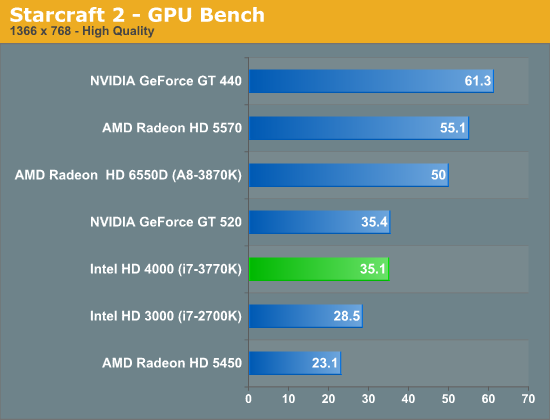
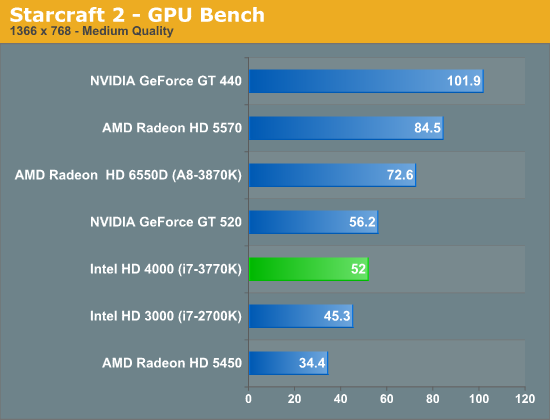
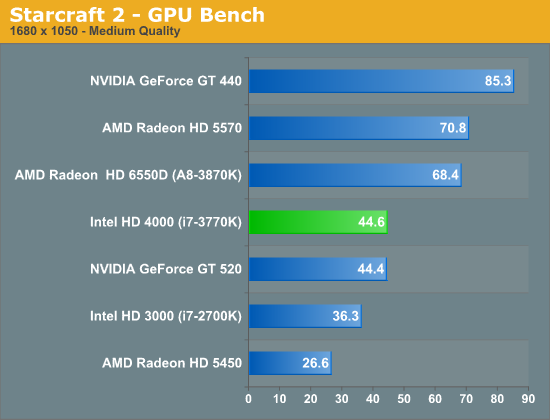
SC2 shows us a smaller advantage over Sandy Bridge—generally around 20%. Llano is able to maintain a much larger 40—50% advantage as a result. Still, it's enough to get above 40fps even at 1680. The only thing that's unclear here is whether we're still shader limited at medium quality—which is what the results near the GT 520 would indicate—or if perhaps we're more simply texture limited.


 Facebook
 Twitter
 RSS
RSS


173 Comments
View All Comments
cjb110 - Tuesday, April 24, 2012 - link
Considering that on most games both the Xbox and PS 3tend to be sub 720p, the iGPU in Ivy Bridge is impressive. Has anybody compared the 3?tipoo - Tuesday, April 24, 2012 - link
You have a unified shader GPU with similar performance to the x1900 series but more flexible, and something like a Geforce 7800 with some parts of the 7600 like lower ROPs and memory bandwidth...7 years later, if even an IGP didn't beat those, it would be pretty sad. Those were ~200gflop cards, todays top end is over 3000, a lower-mid range chip like this I would expect to be in the upper hundreds.gammaray - Tuesday, April 24, 2012 - link
Why do Intel and AMD even started building IGPs in the first place?Why can't they just put a video card in every desktop and laptop?
And if they continue making IGPs, whats their goal?
Do they eventually wanna get rid of video card makers?
versesuvius - Tuesday, April 24, 2012 - link
Better yet, why not just put the graphics on a chip like the CPU? That way the "upgrade path" is a lot clearer, not to mention "possible". It will also offer the possibility of having those chips in different flavors, for example good video transcoder or good gamer. There is room for that on the motherboard now that the north bridge is gone. Or they can review the IBM boards from 286 days and learn from their clean, and very efficient design.Unfortunately the financial model of the IT industry from a collective viewpoint entails throwing a lot of good hardware away just for a small advantage. Just the way many will throw away their HD3000 IGPs without having ever used it. The comparison is cruel but that should not be what distinguishes them from the toilet paper industry.
As of late, Anand has taken to reminding us that technology has taken leaps ahead of our wishes and that we need time to absorb it. That is not the case. No wish is ever materialized. We only have to take whatever is offered and marvel at the only parameter that can be measured: speed. Less energy consumption is fine, but I suppose that comes with the territory (i.e. can Intel or AMD produce 22 nm chips that consume the same watts as 65 nm chips with the same number of transistors?).
tipoo - Wednesday, April 25, 2012 - link
Cost, size, power draw. All reduced by putting everything on one chip. I'm not sure if AMD wants to get rid of discreet graphics cards considering that's their one profitable division, but Intel sure does :)klmccaughey - Tuesday, April 24, 2012 - link
I've tried every setup possible and have never got quicksync to work at all. It won't even work with discrete graphics enabled and my monitor hooked up to the intel chip on my Z68 board.I have tried mediacoder (error 14), media converter 7, MEdia Espresso. I have downloaded the media SDK, I have tried the new FFmthingy from the intel engineer. Nothing, nada. It has never ever worked. AMD media converter will convert a few limited formats that went out of fashion 5 years ago (of all my 1.5TB of video the only thing it would touch was old episodes of Becker).
All in all I have got nothing whatsoever from any video accelerated encoding and I have always had to go back to my tried and trusted handbrake.
I don't think it actually works - I've never heard of anyone getting it working and the forums on mediacoder are full of people who have given up.
klmccaughey - Tuesday, April 24, 2012 - link
*disabled (for discrete graphics)JarredWalton - Tuesday, April 24, 2012 - link
What input format are you using? I've only tried it on laptops, and I've done MOV input from my Nikon D3100 camera with no issues whatsoever. I've also done a WMV input file (the sample Wildlife.WMV file from Windows 7) and it didn't have any trouble. If you're trying to do a larger video, that might be an issue, or it might just be a problem with the codec used on the original video.dealcorn - Tuesday, April 24, 2012 - link
Intel has big eyes for the workstation graphics market and has had some success at the bottom of this market. Will IB's IGD advances enhance Intel's access to this market?chizow - Tuesday, April 24, 2012 - link
Hope you're not counting yourself, you've proven long ago your opinion isn't worth paying attention to.