



The Ivy Bridge Preview: Core i7 3770K Tested
by Anand Lal Shimpi on March 6, 2012 8:16 PM EST- Posted in
- CPUs
- Intel
- Core i7
- Ivy Bridge
Ivy Bridge Architecture Recap
At IDF Intel disclosed much of Ivy's CPU architecture, but below is a quick summary:
- 4-wide front end with µOp cache from Sandy Bridge
- OoO execution engine from Sandy Bridge
- Data structures previously statically shared between threads can now be dynamically shared (e.g. DSB queue), improves single threaded performance
- FP/integer divider delivers 2x throughput compared to Sandy Bridge
- MOV instructions no longer occupy an execution port, potential for improved ILP when MOVs are present
- Power gated DDR3 interface
- DDR3L support
- Max supported DDR3 frequency is now 2800MHz (up from 2133MHz), memory speed can be moved in 200MHz increments
- Lower system agent voltage options, lower voltages at intermediate turbo frequencies, power aware interrupt routing
- Power efficiency improvements related to 22nm
- Configurable TDP
I've highlighted the three big items from a CPU performance standpoint. Much of the gains you'll see will come from those areas coupled with more aggressive turbo frequencies.
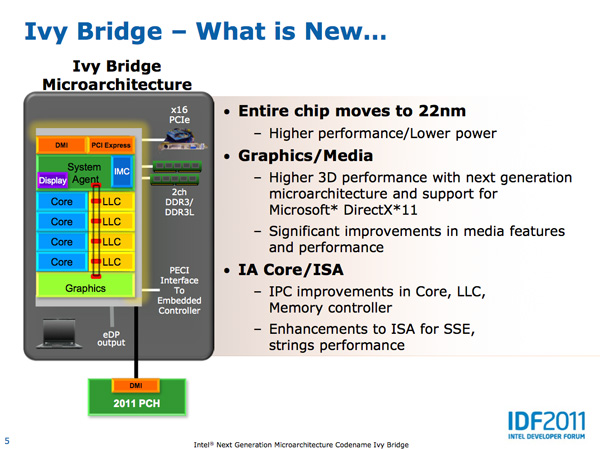


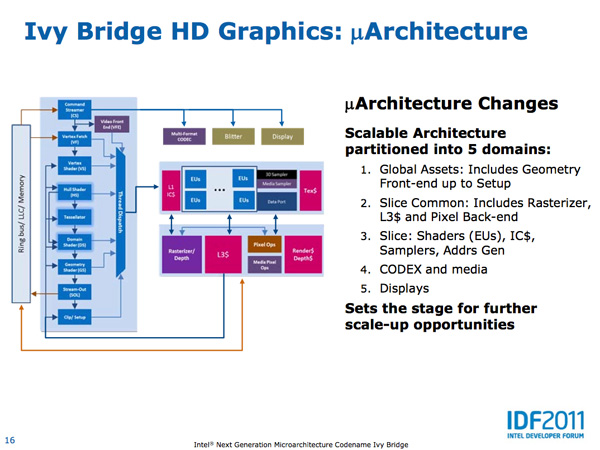
On the GPU, the improvements are more significant. Some of the major changes are below:
- DirectX 11 Support
- More execution units (16 vs 12) for GT2 graphics (Intel HD 4000)
- 2x MADs per clock
- EUs can now co-issue more operations
- GPU specific on-die L3 cache
- Faster QuickSync performance
- Lower power consumption due to 22nm


 Facebook
 Twitter
 RSS
RSS


195 Comments
View All Comments
taltamir - Monday, March 12, 2012 - link
Rarson is correct.He isn't suggesting no IGP at all. He is saying put a good IGP on the lower end.
While there ARE people who need a powerful CPU and will not get a video card because they don't play games, those people do not in any way benefit from having a higher end IGP.
High end gamers = discreete GPU + Powerful CPU
Budget gamers = IGP + mid-low range CPU
Non gamers with money = High end CPU + IGP (underused)
Non gamers on a budget = Mid-low range CPU + IGP (underused)
The only people who need a more powerful GPU are the budget gamers and thus it makes sense on the lower end CPUs to have a more powerful IGP.
Urillusion17 - Monday, March 12, 2012 - link
Great article but.... where are the temps??? The few benches I have seen don't mention overclocking, and if they do, they do not mention temps. I am hearing this chip can boil water! I would think that would be as important as anything else...DrWattsOn - Tuesday, March 13, 2012 - link
+1 (very much in agreement)boogerlad - Wednesday, March 14, 2012 - link
is it possible to fully load the igp with an opencl application, and not affect the cpu performance at all? From what I've read, it appears the igp shares the cache with the cpu, so will that affect performance?rocker123 - Monday, March 19, 2012 - link
Generational performance improvements on the CPU side generally fall in the 20 - 40% range. As you've just seen, Ivy Bridge offers a 7 - 15% increase in CPU performance over Sandy Bridge - making it a bonafide tick from a CPU perspectiveShould be :Generational performance improvements on the GPU side generally fall in the 20 - 40% range
rocker123 - Monday, March 19, 2012 - link
Generational performance improvements on the CPU side generally fall in the 20 - 40% range. As you've just seen, Ivy Bridge offers a 7 - 15% increase in CPU performance over Sandy Bridge - making it a bonafide tick from a CPU perspectiveShould be :Generational performance improvements on the GPU side generally fall in the 20 - 40% range
tipoo - Monday, March 19, 2012 - link
They give the drivers their own tweaks and bug fixes, but I doubt they could do something like add T&L without the manufacturers support. In fact, they didn't, unless they have bigger driver teams now.ClagMaster - Wednesday, March 21, 2012 - link
"Personally, I want more and I suspect that Haswell will deliver much of that. It is worth pointing out that Intel is progressing at a faster rate than the discrete GPU industry at this point. Admittedly the gap is downright huge, but from what I've heard even the significant gains we're seeing here with Ivy will pale in comparison to what Haswell provides."Personally, I believe on-board graphics will never be on par with a dedicated graphics part. And it is obcessive-compulsive ridiculous to compare the performance of the HD4000 with discrete graphics and complain its not as good.
The HD4000 is meant for providing graphics for business and multi-media computers. And for that purpose it is outstanding.
If you want gaming or engineering workstation performance, get a discrete graphics card. And stop angsting about how bad onboard graphics is to discrete graphics.
pottermd - Thursday, March 22, 2012 - link
Today's desktop processors are more than fast enough to do professional level 3D rendering at home.The article contained this statement. It's not really true. I've had a long nap and the render I'm doing is still running. :)
Dracusis - Friday, April 6, 2012 - link
"The people who need integrated graphics"No one *needs* integrated graphics. But not everyone needs discrete graphics. The higher performance an IGP has, the less people overall will *need* DGPs.
Not all games need dedicated graphics cards, just the multi million dollar re-hashed COD's that choke retail stores. There are literally thousands of other games around that only require a small amount of graphics processing power. Flash now has 3D accelerated content and almost every developer using it will target IGP performance levels. Almost all casual game developers target IGPs as well, they're not selling to COD players. Sure, most of those games won't need a hight end CPU as well, but people don't buy computers to play casual games, they buy them for a massive range of tasks, the vast majority of which will be CPU bound so faster would be better.
Also, as an indie game developer I hit performance walls with CPUs more often than I do with GPUs. You can always scale back geometry/triangle counts, trim or cut certain visual effects but cutting back on CPU related overheads generally means you're cutting out gameplay.