



The Ivy Bridge Preview: Core i7 3770K Tested
by Anand Lal Shimpi on March 6, 2012 8:16 PM EST- Posted in
- CPUs
- Intel
- Core i7
- Ivy Bridge
Ivy Bridge Architecture Recap
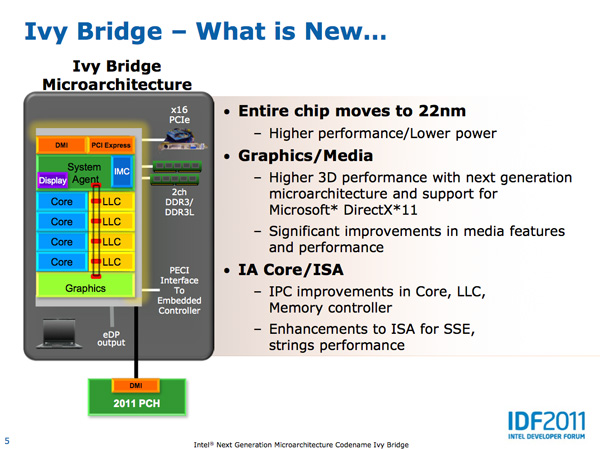
At IDF Intel disclosed much of Ivy's CPU architecture, but below is a quick summary:
- 4-wide front end with µOp cache from Sandy Bridge
- OoO execution engine from Sandy Bridge
- Data structures previously statically shared between threads can now be dynamically shared (e.g. DSB queue), improves single threaded performance
- FP/integer divider delivers 2x throughput compared to Sandy Bridge
- MOV instructions no longer occupy an execution port, potential for improved ILP when MOVs are present
- Power gated DDR3 interface
- DDR3L support
- Max supported DDR3 frequency is now 2800MHz (up from 2133MHz), memory speed can be moved in 200MHz increments
- Lower system agent voltage options, lower voltages at intermediate turbo frequencies, power aware interrupt routing
- Power efficiency improvements related to 22nm
- Configurable TDP
I've highlighted the three big items from a CPU performance standpoint. Much of the gains you'll see will come from those areas coupled with more aggressive turbo frequencies.


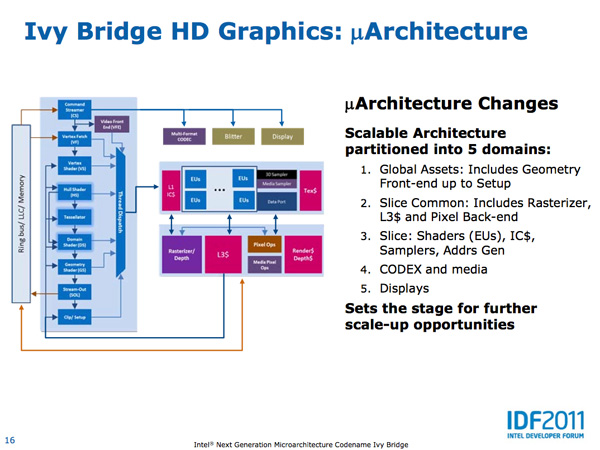
On the GPU, the improvements are more significant. Some of the major changes are below:
- DirectX 11 Support
- More execution units (16 vs 12) for GT2 graphics (Intel HD 4000)
- 2x MADs per clock
- EUs can now co-issue more operations
- GPU specific on-die L3 cache
- Faster QuickSync performance
- Lower power consumption due to 22nm


 Facebook
 Twitter
 RSS
RSS


195 Comments
View All Comments
dagamer34 - Thursday, March 8, 2012 - link
Most players who game at 1920x1080 also have graphics cards that cost more than $100. That's not what this was testing.kensiko - Thursday, March 8, 2012 - link
Man you won't believe the difference :)Get an SSD with that.
dagamer34 - Thursday, March 8, 2012 - link
You're going to seriously start wondering why you didn't upgrade sooner. Just don't hurt yourself too much when you slap your own face. Tech has advanced astronomically in the last 10 years.Heck, I'm pretty sure the iPad 2 is faster than your Northwood Pentium 4.
Yojimbo - Thursday, March 8, 2012 - link
uhh.. i don't think that's true. graphics intensive applications are not the only ones that benefit from fast CPUs.krumme - Thursday, March 8, 2012 - link
Where does Charlie claim to be biased?But i agree, this sacred, aura, "this is not sanctioned by Intel" is a pain to read. It makes thesse articles a little bit difficult to start reading :)
But how profitable, and how good a business do you have if you dont have "good conections"? - charlie uses his for underhand information, anand his to get info before the others. Its very obvious for us to interprete Anands article because we know the obvious, - it have to be profitable for both anand and Intel. But what about Charlie, what is the motives for the people leaking info to him? - its not quite so obvious and transparrent.
awg0681 - Thursday, March 8, 2012 - link
"Sure, he was comparing Intel graphics to Intel graphics, except he wasn't, because he himself threw Llano in there to compare."By the same token, if he had not included Llano results people would be wondering where they were and complaining that they weren't included. Puts Anand in a catch 22 when deciding whether or not to include Llano.
There is validity to the complaint about the numbers being incorrect. Those should be looked at and corrected. Glossing over the results and no mention of Llano being more capable, again, this was mainly to compare Intel v Intel in a preview of their new chip and improvements they've made since last gen. Sure, he could've been more thorough with the AMD v Intel side, but that's not really what this article was about. We could also go to a steakhouse and complain there's not a large vegetarian meal selection too.
Azeraph - Thursday, March 8, 2012 - link
it doesn't really matter if the igp isn't that great most people don't buy them for their graphics power.I get the feeling that maybe intel is just putting them out there to keep it's base solid against AMD,Not that it needs it and i'm an amd fan. i found something the other day that will possibly change how tomorrows processors will use light instead of electricity.http://scitechdaily.com/penn-researchers-build-a-c...
arno - Friday, March 9, 2012 - link
...hi everybody.I'm an electrical engineer, doing intensive "spice" simulations.
I want to know if, as it requires a lot of floating point calculations, does it worth to wait for Ivy Bridge instead of buying right now a laptop with a quadcore Sandy Bridge? I expected Ivy Bridge for March and i've been waiting since last december :(.
To buy now would be very comfortable, as i'm in the simulaiton phase of my project. To buy later, I believe, would make more sense in term of pure performances . But how much sense is the question....
Thanks for sharing
PS (another thing is also theuse of 1600 memory instead of 1333, which might be doing it for another software I use)
arno - Friday, March 9, 2012 - link
I wonder how IvyBridge perform in term offloating point calculations as I do intensive electrical simulations.I urgently need an upgrade and would definitely go for a Ivy Bridge. But I've been waiting a long time now and Ivy Bridge may again been delayed.
Does anyone have an advice about it?
Thanks for sharing.
Nomorehero - Friday, March 9, 2012 - link
How about OC? Info please?Is hard to decide wait until IB or get SB now because the how well IB can OC.