



The Xeon E5-2600: Dual Sandy Bridge for Servers
by Johan De Gelas on March 6, 2012 9:27 AM EST- Posted in
- IT Computing
- Virtualization
- Xeon
- Opteron
- Cloud Computing
Virtualization Performance: Linux VMs on ESXi
We introduced our new vApus FOS (For Open Source) server workloads in our review of the Facebook "Open Compute" servers. In a nutshell, it a mix of four VMs with open source workloads: two PhpBB websites (Apache2, MySQL), one OLAP MySQL "Community server 5.1.37" database, and one VM with VMware's open source groupware Zimbra 7.1.0. Zimbra is quite a complex application as it contains the following components:
- Jetty, the web application server
- Postfix, an open source mail transfer agent
- OpenLDAP software, user authentication
- MySQL is the database
- Lucene full-featured text and search engine
- ClamAV, an anti-virus scanner
- SpamAssassin, a mail filter
- James/Sieve filtering (mail)
All VMs are based on a minimal CentOS 6 setup with VMware Tools installed. All our current virtualization testing is on top of the hypervisor which we know best: ESXi (5.0). We have changed two things in our vApusMark FOS setup: we upgradeded the guestOS from 5.6 to 6.0 and increased the number of vCPUs of the OLAP VM from 2 to 4. This small upgrade means that our latest results should not be compared to the results in our older articles.
We (Tijl Deneut and myself) tested with four tiles (one tile = four VMs). Each tile needs nine vCPUs, so the test requires 36 vCPUs.
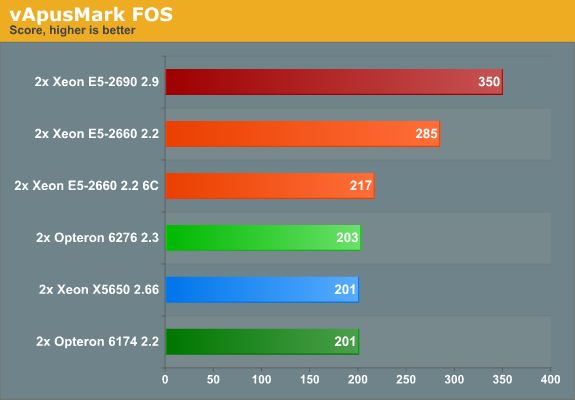
The benchmark above measures throughput. As for response times, let's take a look at the table below, which gives you the average response time per VM:
| vApus FOS Average Response Times (ms), lower is better! | ||||||||
| CPU | PhpBB1 | PHPBB2 | MySQL OLAP | Zimbra | ||||
| AMD Opteron 6276 2.3 | 671 | 514 | 1410 | 758 | ||||
| AMD Opteron 6174 2.2 | 674 | 524 | 1210 | 861 | ||||
| Intel Xeon E5-2660 2.2 | 645 | 394 | 160 | 631 | ||||
| Intel Xeon E5-2690 2.9 | 362 | 288 | 40 | 483 | ||||
| Intel Xeon X5650 2.66 | 745 | 569 | 821 | 866 | ||||
Considering that we may assume that the Xeon E5-2690 consumes considerably more than the E5-2660, it looks like the Xeon E5-2660 is the new virtualization champ. Let us check out the power consumption numbers under a realistic load.


 Facebook
 Twitter
 RSS
RSS


81 Comments
View All Comments
think-ITB-live-OTB - Tuesday, March 6, 2012 - link
Can i ask you a question? do you at least get paid when you bend over for Intel?These are Server Chips - who cares about single-threaded application performance.. or Corporate IPOs. AMD has delivered far greater TCO/performance than Intel has for at least a Decade and running.
You want to praise a company like a Deity? ARM Holdings. nuff said. They can design a 35 dollar computer that can decode H.264 better than Intel can on SoCs that run 4x's the price. Currently have more Chips in more devices than in Intels entire history and Push Power envelopes far beyond anything Intel could ever muster.
Just you wait before the Storm ARM and its Licensees unleash as it will eventually take over ALL markets including the Server space (Calxeda much?). Oh and as for Apple. (an ARM Licensee itself... i can see them moving to in-house ARM designs pretty soon). 4-6-8 Core Cortex A15 (with A7 core for low power iPod/tablet sync) Macbook Airs anyone?
Intel is becoming the strongest of the Dinosaurs. But even the T-Rex fell eventually.
swizeus - Wednesday, March 7, 2012 - link
We have been using the Flemish/Dutch Web 2.0 website Nieuws.be as a benchmark for some time. 99% of the loads on the database are selects and about 5% of them are stored procedures.The database is loaded 104%. is it possible ?
JohanAnandtech - Wednesday, March 7, 2012 - link
Stored procedures can contain selects :-)fredisdead - Saturday, April 7, 2012 - link
From the 'article' .....'The Opteron might also have a role in the low end, price sensitive HPC market, where it still performs very well. It won't have much of chance in the high end clustered one as Intel has the faster and more power efficient PCIe interface'
Well, if that's the case, why exactly would AMD be scoring so many design wins with Interlagos. Including this one ...
http://www.pcmag.com/article2/0,2817,2394515,00.as...
http://www.eweek.com/c/a/IT-Infrastructure/Cray-Ti...
U think those guys at Cray were going for low performance ? In fact, seems like AMD has being rather cleaning up in the HPC market since the arrival of Interlagos. And the markets have picked up on it, AMD stock is thru the roof since the start of the year. Or just see how many Intel processors occupy the the top 10 supercomputers on the planet. Nuff said ...
InsaneScientist - Wednesday, March 7, 2012 - link
Johan, where in the specs where you have this line:Transistors (Billion) 2,26 2x 1,2 2x 904 1,17
I sure hope that 2x 904 (Billion) is a typo... otherwise AMD has some serious explaining to do. ;)
Should be 2x ,904 (I think? Would be 2x .904 for me, I assume you follow the same rules...)
iliev - Wednesday, March 7, 2012 - link
Page 5, Benchmark ConfigurationR2208GZ4GSSPP specs table... E5-2660 is 2.2Ghz, and not 2.9GHz
dodge776 - Wednesday, March 7, 2012 - link
Hi Johan,Always look forward to reading your server reviews at AT, but no SAPS benchmarks this time?
ppennisi - Wednesday, March 7, 2012 - link
For maximum VMware performance on Opteron Interlagos cpu under VMWARE it's better to disable C1E and enable, where available, HPC mode.I found myself on a fresh installation of ESXi 5.0 on Dell R715 that leaving C1E enable literally crippled vm performance.
boudini - Thursday, March 8, 2012 - link
I'm not sure I would recommend using iray as a reliable benchmark renderer in 3ds max. It is not a self configuring mental ray, but an unbiased renderer which behaves fairly differently to mental ray, and most other renderers such as vray, final render and brazil. It is comparible to maxwell and fryrender, but is very new compared to those two longer established unbiased render engines. It also attempts to use the gpu to add to its calculations as well - which could significantly skew results.Using mental ray or vray might well give you quite a different result, and besides I don't think iray is widely used in the industry.
omega4711 - Friday, March 9, 2012 - link
This. The results of iray are mostly dependent on the GPU. The lack of proper scaling certainly isn't due to Amdahl's law. Just use mentalray with small enough render buckets and you can easily satisfy 64+ threads.Also, due to the limitations of iray, it can (at this moment) only be used in about 1-3% of real world scenarios.
Please, for all the people that care about these benchmarks, use mentalray and/or vray.
Otherwise, it's a brilliant article.