



Introduction
A little bit more than a month ago, AnandTech published "No more mysteries: Apple's G5 versus x86, Mac OS X versus Linux" with the ambitious goal of finding out how the Apple platform compares, performance-wise, to the x86 PC platform. The objective was to find out how much faster or slower the Apple machines were compared to their PC alternatives in a variety of server and workstation applications.Some of the results were very surprising and caught the attention of millions of AnandTech readers. We found out that the Apple platform was a winner when it came to workstation applications, but there were serious performance problems when you run server applications such as MySQL (Relational Database) or Apache (Webserver). The MySQL database running on Mac OS X and the Dual G5 was up to 10 times slower than on the Dual Opteron running Linux.
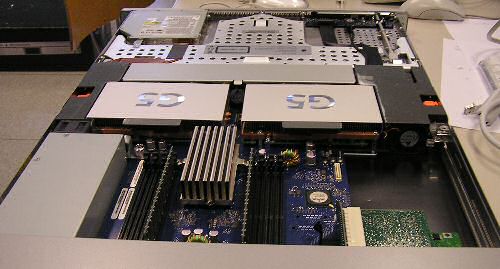
That is what we'll be doing in this article: we will shed more light on the whole Apple versus x86 PC, IBM G5 versus Intel CPU discussion by showing you what the G5 is capable of when running Linux. This gives us insight on the strength and weakness of Mac OS X, as we compare Linux and Mac OS X on the same machine.
The article won't answer all the questions that the first one had unintentionally created. As we told you in the previous article, Apple pointed out that Oracle and Sybase should fare better than MySQL on the Xserve platform. We will postpone the more in-depth database testing (including Oracle) to a later point in time, when we can test the new Apple Intel platform.
Why Bother?
Why do we bother, now that Apple has announced clearly that the next generation of the Apple machines will be based on Intel? Well, this makes our research even more interesting. As you will see further in the article, the G5 is not the reason why we saw terrible, slow performance. In fact, we found that the IBM PowerPC 970FX, a.k.a. "G5", has a few compelling advantages.As Apple moves to Intel, the only thing that makes Apple unique, and not yet another x86 PC OEM, is Mac OS X. That is why Apple will attempt to prevent you from running an x86 version of Mac OS X on anything else but their own hardware (using various protection schemes), as Anand reported in "Apple's Move to x86: More Questions Answered". Mac OS X will be the main reason why a consumer will choose an Apple machine instead of a Dell one. So, as we get to know the strengths and weaknesses about this complex but unique OS, we'll get insight into the kind of consumers who would own an Intel based machine with Mac OS X - besides the people who are in love with Apple's gorgeous cases of course....
Firstly, Apple's own website contradicts this in every tone. Secondly, we found a 2.5 GHz G5 to perform more or less like a Pentium 4 3 - 3.2 GHz in integer tasks. So, a 2 GHz G5 is probably around the speed of a 2.6 GHz Pentium 4. It is only natural that a much faster single CPU with a better disk and memory system outpaces a slower dual CPU in single threaded booting and development tasks. Thirdly, the whole CPU industry is focused now on convincing the consumers of how much better multi-core CPUs are compared to their "old" single core brethren.


 Facebook
 Twitter
 RSS
RSS


47 Comments
View All Comments
Lori - Friday, September 2, 2005 - link
http://en.wikipedia.org/wiki/Microkernel">http://en.wikipedia.org/wiki/MicrokernelMacOS X uses a modified microkernel (a monolithic / microkernel hybrid). The idea was to cut down IPC costs by putting servers that would be IPC heavy directly into the kernel. However, there has recently been a lot of work in the microkernel world to reduce this IPC cost and bring its speed near that of a monolithic kernel.
L4Ka::Pistachio is an example of this:
http://www.l4ka.org/">http://www.l4ka.org/
leviat - Thursday, September 1, 2005 - link
If the problem is indeed in the thread creation portion of the OS, it would be interesting to see how a single threaded webserver fairs. I would love to see a benchmark test of Lighttpd (www.lighttpd.org) to see a comparison of how that runs on Darwin vs linux-ppc.Another interesting test would be to see MySQL can be configured to precreate the handler threads. This might allow us to see how it handles the context-switching between the multiple threads and allow for it to compete.
Anyways, great article!
JohanAnandtech - Friday, September 2, 2005 - link
What exactly to do you mean by single threaded? Because Apache 1.3 works with processes, and is thus single-threaded per user.MySQL can make use of a Thread cache, we played with it but it didn't give any substantial boost. I don't see how the software would be able to precreate all threads as it has close down and open connections. If you got some insight, please share :-).
Context switching is quite fast on the G5 OS X, give or take a few percentages compared to Linux x86 or G5 Linux, as we tested with lmbench.
Lori - Friday, September 2, 2005 - link
Actually there are more than one way to handle multiple connections in a server application.To give you some examples...
1. Multi process
2. Multi thread
3. Some hybrid of the two
You can see combinations of these types all provided by Apache 2's MPMs. (perchild, prefork, threadpool, worker, leader.. etc)
4. Asynchronus multiplexing.
Your program becomes its own schedular. You can do all your processing within a single thread. Also read up on non blocking i/o. I am actually surprised apache does not have a MPM to handle this type of connection multiplexing but I also read its harder to get OS support.
Letsee... links... umm... ahh...:
http://www.kegel.com/c10k.html">http://www.kegel.com/c10k.html
Avalon - Thursday, September 1, 2005 - link
Seems like once you remove the G5 from OSX, it's a very capable chip.jamawass - Thursday, September 1, 2005 - link
Great article, in response to the previous post Anand has posted tons of server articles on x86 systems so Apple is fair game here. Secondly Apple servers are based on OSX in the market, corporations want to know the real world performance not the desktop feel. Also Johan's speculation on Apple's move to Intel raises some troubling questions for Apple execs.karlreading - Thursday, September 1, 2005 - link
a lot of people commenting on how apple have mad a wrong dicision turning to intel.possibly, but IMHO, and, if im not mistaken, didnt the opteron dominate all the tests.
so in my mind whilst its true for people to doubt apple for going intel, x86 on the whole is still a very viable option if you go the AMD route.
yes i know people will say AMD dont hae the capacity, but amd powered macs should be how x86 macs are done.
karlos
karlreading - Thursday, September 1, 2005 - link
also worth noting is that they say the FP poerformance is as good as the fastest x86 chip. well scuse me, but isnt that a 2.7ghz g5 part there testing there? thats the fastest g5 currently avalible isnt it? well then why not test the opteron 254. thats the fastest x86 chip, running 2.8ghz, rather than the 850/250 2.4ghz part tested? that would put some lead against the g5 and also, 2.8ghz is a lot closer than 2.4ghz is to the 2.7ghz g5's core speed. if were trying to be fair.if we was being really picky we would be stating duakl core opteron as the fastest x86, but i digress....
karlos
JohanAnandtech - Friday, September 2, 2005 - link
You are right about the recentely introduced 2.8 GHz Opteron. Well, to be really accurate, at the time of the introduction of the 2.7 GHz G5, a 2.6 Ghz opteron was available.Anyway, It was not my intention to be "accurate", it was more a general impression. Give or take a few percent, the G5 can compete FP wise :-).
Pannenkoek - Thursday, September 1, 2005 - link
It's a matter of scalability, SMP support and not so much of how fast some system calls are executed as the reason for the bad performance I would think. Linux is the most used OS for superclusters these days, Mac OS remains a desktop OS. It's no wonder that it performs poorly as a serious server on a multiprocessor/core system. It would have been interesting to see how Windows would have faired (on the x86 of course), if we are testing OSes in this way.However, MySQL benchmarks say little about desktop performance, Anandtech's audience consists of desktop users and the reason people love or hate Mac OS is its desktop. Nevertheless, almost a great article. It should have been if the autor could have resisted the temptation of too much speculation, instead of honest benchmark numbers.